As the mining industry continues to evolve, Environmental, Social and Governance (ESG) principles are becoming central to how mining companies operate. What was once viewed primarily as a reporting framework is now influencing investment decisions, operational strategies, regulatory compliance, and long-term business success.
One area where ESG has become particularly significant is tailings management. With increasing expectations from investors, governments, and local communities, mining companies are placing greater emphasis on managing tailings safely, recovering valuable resources, and reducing their environmental footprint. Effective tailings management is no longer simply about waste disposal, it is about creating safer, more sustainable operations that deliver value throughout the life of a mine.
What Is ESG?
ESG stands for Environmental, Social, and Governance. It is a framework used to assess how responsibly a company manages its operations beyond financial performance.
For mining companies, ESG considerations include:
- Environmental stewardship
- Water management
- Waste reduction
- Community engagement
- Worker safety
- Ethical governance
- Regulatory compliance
- Long-term sustainability
Strong ESG performance can influence investment decisions, improve stakeholder confidence, and support a company’s social licence to operate.
Why Tailings Management Matters
Tailings are the fine-grained waste materials that remain after valuable minerals have been extracted from ore. These materials are typically mixed with water to form a slurry before being transported to a storage facility.
As ore grades continue to decline and global demand for minerals increases, mines are processing larger volumes of material than ever before. This results in greater volumes of tailings, making efficient management increasingly important.
Recent years have also highlighted the consequences of poor tailings management. High-profile tailings dam failures have reinforced the importance of robust engineering, effective governance, and responsible operational practices. In response, the mining industry has adopted a stronger focus on risk management, transparency, and continuous improvement.
The Environmental Challenge
Water is one of the mining industry’s most valuable resources, particularly in regions where supply is limited. Every litre of water recovered from the processing circuit reduces the need for fresh water intake and improves the overall efficiency of an operation.
This is where modern separation technologies are making a measurable difference.
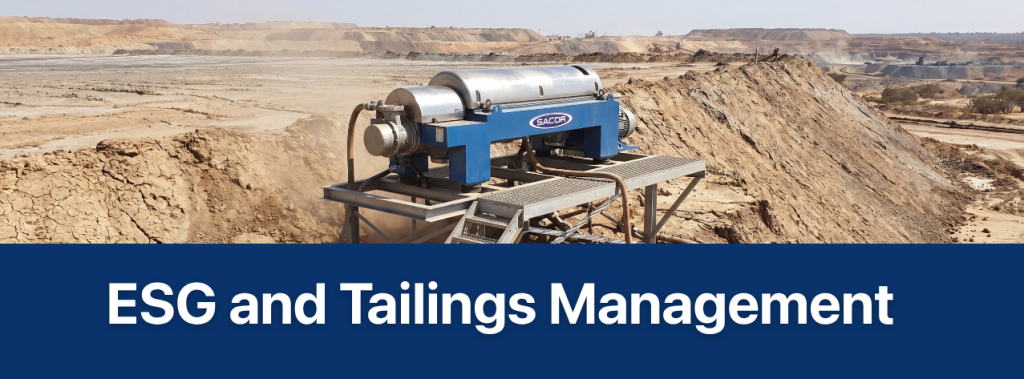
By mechanically separating solids from liquids, equipment such as decanter centrifuges helps recover process water that can be returned to the plant for reuse. Recovering water not only supports ESG sustainability objectives but can also reduce operating costs and improve plant performance and tailings management.
Efficient dewatering also reduces the amount of water contained within tailings, resulting in a more concentrated material that is easier to manage and transport through downstream processes. While the most appropriate tailings strategy varies from site to site, improving water recovery is becoming an important objective for many mining operations.
Beyond Environmental Performance
Although the environmental aspect of ESG often receives the greatest attention, the social and governance components are equally important.
Communities expect mining companies to operate responsibly and minimise potential impacts on surrounding environments. Responsible tailings management demonstrates a commitment to protecting local ecosystems, supporting worker safety, and maintaining trust with stakeholders.
Good governance also plays a vital role. Effective monitoring, regular inspections, clear operational procedures, and sound engineering practices all contribute to safer and more reliable tailings management. Many mining companies are also aligning their operations with internationally recognised frameworks, such as the Global Industry Standard on Tailings Management (GISTM), to strengthen oversight and improve accountability.
Technology Driving Sustainable Mining
As sustainability expectations continue to grow, technology is becoming one of the mining industry’s most valuable tools.
Advanced monitoring systems, automation, real-time process data, and improved separation equipment are enabling operators to make better decisions and optimise plant performance. These innovations help mines recover more valuable resources, reduce waste, improve water efficiency, and operate more sustainably without compromising productivity.
Decanter centrifuges have become an important part of this evolution. By continuously separating solids from liquids, they help maximise water recovery, increase solids concentration, and support more efficient downstream processing. While they represent just one component of a broader tailings management strategy, they can make a significant contribution to improving operational efficiency and supporting ESG objectives.
Looking Ahead
The future of mining will be shaped by more than production targets alone. Companies will increasingly be measured on how responsibly they manage resources, protect the environment, and engage with the communities around them.
Tailings management sits at the centre of this transition. Operations that prioritise water recovery, efficient separation, and responsible waste management will be better positioned to meet regulatory expectations, strengthen stakeholder confidence, and build more resilient businesses for the future.
At Sacor, we understand that every mining operation is different. Our high-performance separation solutions are designed to help customers optimise water recovery, improve process efficiency, and support more sustainable mineral processing. As the industry continues to evolve, we’re committed to providing the expertise and technology needed to help our customers meet the challenges of tomorrow.
To learn more about Sacor’s separation solutions for mining, visit www.sacor.com.au.