
Reliable decanter operation isn’t achieved by chasing one setting. When feed conditions shift, separation can change too, leaving operators unsure whether to adjust feed rate, bowl speed or differential speed. Isolated adjustments can make results harder to repeat if they aren’t guided by a clear operating routine. Decanter centrifuge operational best practices start with understanding how these variables interact with the process and the equipment’s requirements.
A consistent approach helps operators spot changes earlier, respond deliberately and give maintenance teams useful information for troubleshooting. This practical guide explains how to establish a repeatable routine for your process, monitor performance indicators and investigate likely causes when separation changes. It also covers how to document operating conditions and coordinate operations and maintenance, so discussions with equipment or service specialists are better informed. Because the appropriate operating window depends on the machine and process duty, verify machine-specific limits against the manufacturer’s documentation rather than relying on a universal recipe.
Key Takeaways
- Decanter centrifuge operational best practices begin with a documented baseline matched to the machine, process duty and intended separation result.
- Feed rate, bowl speed, differential speed and pond depth interact, so review process changes together rather than relying on a universal adjustment.
- Consistent records of centrate, cake condition and available machine readings can help distinguish routine variation from a developing performance change.
- A clear shift routine supports safer, more consistent operation and gives the next team useful information for handover.
- Persistent deviations may call for an engineering review to distinguish process changes from equipment suitability or refurbishment needs.
Why decanter centrifuge operational best practices start with a stable baseline
Operational best practice is a repeatable, documented method matched to a decanter’s design, process duty and intended separation result. A baseline gives operators a reliable reference before changing settings and helps distinguish a genuine performance shift from normal variation in the feed or process.
Start by agreeing what the process needs to achieve. Is the priority to capture more solids, produce a drier cake, improve centrate quality, or balance these outcomes with required production? These objectives can affect one another, so a change that benefits one measure may affect another. The Decanter centrifuge operating principle provides useful context on how the bowl and scroll separate and convey material. However, the appropriate operating window depends on the individual machine and application.
What does good decanter operation look like?
Good operation means maintaining stable output against targets established for the specific process, not meeting a universal benchmark. Define the measures that matter, such as centrate clarity and cake dryness, alongside the required production level. Assess them together with feed characteristics and equipment condition.
For example, a change in centrate appearance might coincide with a different solids load in the feed. That observation alone doesn’t establish the cause or justify an immediate setting change. Reviewing output, feed variability and relevant machine readings together gives operators a better basis for investigation and reduces the risk of improving one result at the expense of another.
Build a baseline before changing settings
Record the conditions associated with normal, acceptable operation. Use approved site records and the manufacturer’s guidance, and include information that will make later comparisons useful:
- Machine configuration and relevant operating values, verified against the equipment documentation.
- Feed characteristics and any known changes in the material being processed.
- Observed centrate and cake condition, production context and equipment readings available to operators.
Keep records consistent across shifts. If feed conditions change, note when and how they differ instead of assuming the previous baseline still applies. This helps operations and maintenance assess whether a deviation may be process-related, equipment-related or linked to the machine’s suitability for the duty. Verify machine-specific limits and procedures against the relevant manufacturer documentation and site requirements.
If equipment suitability is still under assessment, the decanter centrifuge selection criteria can help frame the factors to review. A sound baseline makes decanter centrifuge operational best practices a practical reference for monitoring and informed troubleshooting, not a fixed recipe for every machine.
How feed, bowl speed and differential speed shape decanter performance
Separation depends on several linked variables, not a single control setting. Bowl speed affects the centrifugal environment, while feed rate influences the volume and solids load entering the machine. Pond depth affects the liquid pool in which separation takes place, and the scroll’s differential speed governs how quickly separated solids move through and out of the bowl. A change in one part of the process can alter the effect of the others.
Differential speed influences how quickly the scroll conveys solids and how much time they have to drain inside the bowl. The right balance depends on the feed and separation objective. Use this relationship to guide an investigation, not as a universal instruction to increase or decrease a setting.
How feed condition changes the operating window
Feed can vary in solids concentration, particle characteristics, temperature or consistency. Where these factors are relevant, record changes alongside centrate quality, cake condition and signs of altered machine loading. A change in feed may help explain a change in output, but doesn’t by itself identify which setting, if any, should change.
Different duties also behave differently. Abrasive mining slurry and a food-processing feed shouldn’t be assumed to respond alike. Assess each observation in context, taking account of the equipment configuration and process requirements.
Understand the relationship between bowl and differential speed
Differential speed is the relative speed of the scroll compared with the rotating bowl. It affects solids conveyance and residence time: changing how quickly solids move can also change the time available for drainage. The useful balance depends on the machine, feed and desired result. Before making an adjustment, check the manufacturer’s operating envelope and applicable site procedures.
Use observed changes to guide what to review, rather than treating them as automatic instructions to alter a setting:
| Observed process change | Variables or conditions to review |
|---|---|
| Centrate appearance changes | Feed solids concentration, particle characteristics, feed rate and relevant bowl or pond settings |
| Cake condition changes | Feed consistency, differential speed, pond depth and the intended separation target |
| Machine loading or behaviour changes | Feed rate and characteristics, operating records and equipment condition |
| Several outputs shift together | Whether feed, bowl speed, differential speed and pond depth have changed or interact under the current duty |
Compare observations with the established baseline and change settings only within approved machine-specific limits. These decanter centrifuge operational best practices help teams investigate cause and effect without relying on a setting that may not suit another machine or process. If operating requirements point to a need for equipment assessment or a customised separation solution, Sacor Engineering’s decanter centrifuge expertise may be relevant to the discussion.
How to monitor decanter centrifuge performance and identify changes
Monitoring is most useful when operators record the same indicators consistently and interpret them against the documented baseline and process objectives. A single reading may reflect a brief feed change; repeated movement across several readings can point to a developing issue. Trends are more useful than isolated readings when diagnosing process changes.
Which operating indicators should teams track?
Choose measures that are available on the machine and relevant to the site’s approved monitoring procedure. Depending on the installation, these may include feed rate, centrate appearance, cake condition, vibration and torque where fitted. Record measurements alongside operating settings and feed conditions so the readings retain their process context.
Consistent records help shifts compare like with like. Note when a change was observed, what changed in the feed or process, and whether other indicators moved at the same time. Follow the manufacturer’s instructions and site procedures for monitoring, including the response to alarms, abnormal vibration or unusual noise.
When a process change may signal a wider issue
First check whether the feed or operating conditions differ from the baseline. If they don’t, or if a deviation persists, record the symptoms and escalate for assessment rather than diagnosing the cause remotely or making repeated adjustments. Blockage, wear, imbalance or a control issue may warrant investigation, but only inspection by appropriately authorised personnel can establish the cause.
Take alarms, abnormal vibration and unusual noise seriously. Follow site safety procedures and equipment instructions to determine whether operation must stop, the machine must be isolated, or the issue must be escalated. Don’t inspect or intervene in equipment unless authorised and following the required isolation process.
A useful record for handover or investigation includes:
- Baseline and current readings, including the time and operating context.
- Any changes in feed, centrate, cake condition or machine behaviour.
- Alarms or unusual sounds or vibration, plus the actions taken under site procedure.
This evidence gives operations and maintenance a shared starting point and helps distinguish process variation from a potential equipment or control concern. For a structured diagnostic workflow, see the centrifuge performance troubleshooting checklist. Consistent monitoring is a practical part of decanter centrifuge operational best practices, supporting earlier recognition of change and better-informed follow-up.
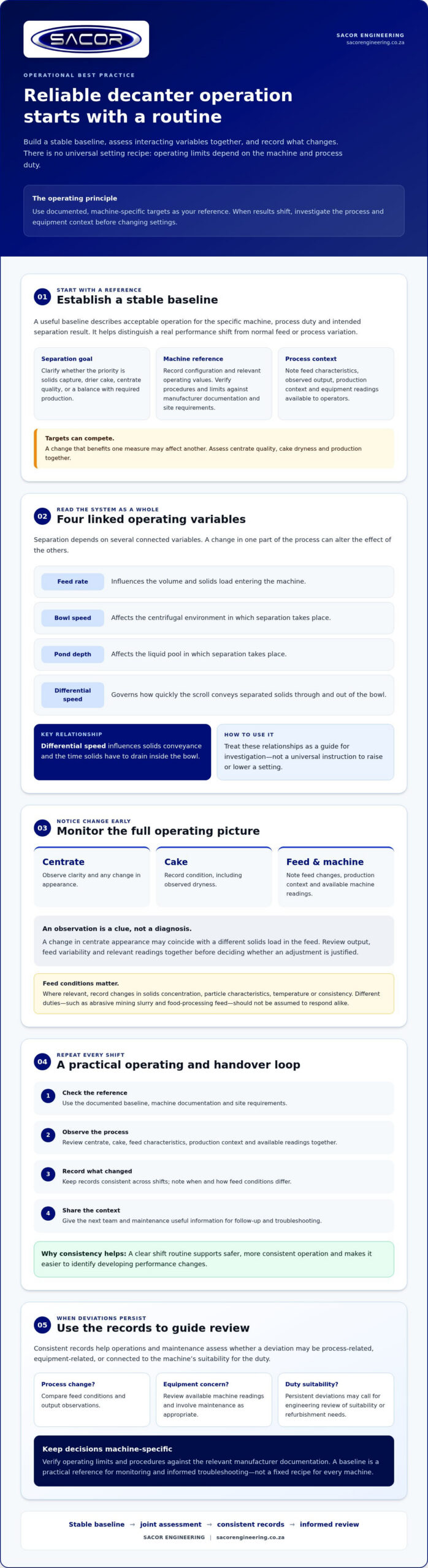
A repeatable decanter centrifuge operating routine for every shift
A consistent shift routine helps operators follow the same instructions, recognise deviations and pass on useful information. Adapt the sequence below to the site’s risk assessments, approved procedures and specific machine. Manufacturer instructions take precedence for operating limits and machine-specific requirements.
- Review instructions and handover notes. Check the current operating procedure, relevant manufacturer guidance, outstanding concerns and process changes reported by the previous shift.
- Confirm readiness. Use the approved start-up procedure to verify process readiness and required safeguards. Don’t bypass safeguards or start the machine if a required check hasn’t been completed.
- Establish the shift baseline. Note the applicable machine configuration, operating values and feed conditions. Compare them with the documented baseline and confirm that planned operation is within the approved operating envelope.
- Monitor during operation. Observe the indicators specified by site procedure, such as feed rate, centrate appearance, cake condition and available machine readings. Follow the approved response for alarms or abnormal behaviour.
- Document and hand over. Record relevant settings, process observations, deviations and actions taken. Clearly pass unresolved concerns to the next operator.
Start-up, normal running and handover
Make records specific enough to support the next decision. Instead of noting only that separation changed, state what was observed, when it happened, the feed or operating context, and whether any approved action followed. If there’s an alarm, unusual vibration or noise, follow site safety procedures and equipment instructions for stopping, isolation and escalation.
Cleaning, inspection and maintenance aren’t opportunities for improvised operating adjustments. Carry them out only under approved procedures, with the required isolation and authorisation. For related guidance, see the industrial centrifuge maintenance and safety guide.
Make controlled adjustments, not guesswork changes
If a change is permitted by site procedure and manufacturer guidance, alter one approved variable at a time where practical. Record the reason, the adjustment and the resulting process behaviour after an observation period suited to the process response. Changing several variables together makes cause and effect harder to assess. If the deviation persists or safe adjustment limits are unclear, stop experimenting and escalate through the site’s established process.
These decanter centrifuge operational best practices make shift-to-shift decisions more traceable and help operations and maintenance discuss the same evidence. For equipment assessment, customisation or technical support, contact Sacor Engineering about your centrifuge requirements.
When specialist decanter support can improve operating reliability
Further operator adjustments aren’t always the right response to a persistent deviation. If separation remains outside process objectives after feed conditions and approved settings have been reviewed, or reliability concerns recur, an engineering assessment may help identify what needs attention. Evidence gathered through decanter centrifuge operational best practices gives that discussion a useful starting point, but it can’t replace inspection when an equipment issue is suspected.
Decide whether the issue is process-led or equipment-led
Before requesting a technical assessment, assemble the operating records showing what changed and when. Include feed information, relevant settings, centrate and cake observations, available machine readings, alarms and actions already taken. This makes it easier to assess whether the deviation coincided with a process change or persisted under comparable conditions.
Refer recurring reliability concerns, visible damage or indications of wear for qualified inspection under site procedures. Keep suspected causes separate from confirmed findings. Refurbishment may be relevant when inspection identifies an equipment-related need, but it shouldn’t be assumed to resolve a process problem without assessment. Similarly, a new or different machine isn’t automatically the answer to inconsistent separation.
Match technical support to the application
Process optimisation, equipment suitability and refurbishment are related, but distinct needs. Optimisation focuses on how an appropriate machine is operated for its duty. Suitability considers whether the configuration aligns with the required throughput, feed behaviour and separation objectives. Refurbishment addresses equipment condition when inspection indicates it is appropriate.
Each question needs application-specific context. Mining duties and food and beverage processing have different requirements, so don’t assume a configuration or operating approach suitable for one will suit the other. Share the intended separation result, relevant feed characteristics, operating conditions and any recurring concerns to help frame the discussion.
Sacor Engineering supplies and customises industrial decanter centrifuges and separation solutions, and provides technical support and centrifuge refurbishment services. A discussion can help clarify whether the concern points towards process requirements, equipment suitability or a condition issue requiring further assessment. It won’t replace site procedures or a machine-specific inspection, but organised operating evidence can make the conversation more focused.
To discuss your application and operating evidence, discuss industrial separation requirements with Sacor Engineering.
Turn operating records into more reliable separation
Consistent decanter performance starts with a process-specific baseline, not a universal set of machine settings. The most useful decanter centrifuge operational best practices connect feed conditions, operating variables and separation objectives, then use consistent monitoring and shift handovers to identify changes early.
When results persistently deviate from expectations, well-kept operating records help teams decide whether to review the process, assess equipment suitability or investigate a condition issue. Follow manufacturer instructions and site procedures, and seek specialist input rather than making repeated adjustments without a clear basis.
Sacor Engineering supplies and customises decanter centrifuges and separation solutions for applications including mining and food and beverage processing. The company also provides technical support and centrifuge refurbishment, with the discussion shaped by your process duty and equipment evidence.
Ready to consider the next step? Discuss your decanter centrifuge requirements with Sacor Engineering, and bring your operating observations and separation objectives to the conversation. A clearer understanding of the process is a practical starting point for improving reliability.
Frequently Asked Questions
What are the best practices for operating a decanter centrifuge?
Decanter centrifuge operational best practices include following the manufacturer’s instructions and site procedures, defining the required separation result, and recording a stable operating baseline. Monitor relevant feed and machine indicators consistently, make only approved adjustments, and document the outcome. Use clear shift handovers so changes and unresolved concerns aren’t missed. Respond to alarms, abnormal vibration or unusual noise according to site safety procedures rather than attempting an improvised inspection or repair.
How do you improve decanter centrifuge performance?
Start by comparing current results with the process objectives and documented baseline. Check whether feed characteristics or operating conditions have changed, then review relevant indicators such as centrate appearance, cake condition and available machine readings. If an adjustment is permitted by site and manufacturer guidance, change one approved variable at a time and record the result. Persistent deviations may warrant technical assessment rather than further trial-and-error changes.
What happens if the feed rate is too high for a decanter centrifuge?
A feed rate that exceeds suitable operating conditions may increase the machine’s loading and reduce separation quality. Depending on the feed and equipment, operators might observe a change in centrate appearance, cake condition or other performance indicators. Don’t assume feed rate is the sole cause. Compare the change with feed characteristics, machine configuration and the manufacturer’s operating guidance before taking any action allowed by site procedure.
How often should a decanter centrifuge be monitored?
Follow the site’s approved monitoring procedure and equipment instructions, since suitable frequency depends on the machine, process and operating conditions. Monitoring should cover checks required for start-up and routine operation, with additional attention when feed characteristics change, performance deviates from baseline or an alarm occurs. Record readings at the intervals specified by the site so operators can recognise trends and pass useful information between shifts.
Which variables affect decanter centrifuge separation?
Separation is influenced by feed rate and characteristics, bowl speed, differential speed and pond depth, as well as machine configuration and condition. Solids concentration, particle characteristics, temperature and feed consistency can also matter, depending on the process. These factors interact, so a change in one may affect centrate quality, cake condition or loading. Review them together against the process objective and manufacturer guidance, rather than relying on a universal setting.
When should a decanter centrifuge operator stop and escalate an issue?
Stop and escalate when required by site safety procedures or equipment instructions, including in response to an alarm, abnormal vibration, unusual noise or another condition identified as unsafe. Don’t continue operating or attempt an unauthorised inspection to diagnose the cause. Follow the site’s stopping and isolation procedures, notify the appropriate personnel, and document what happened, when it occurred and any relevant operating or feed changes.
Can the same decanter centrifuge settings be used for different slurries?
Not necessarily. Different slurries can vary in solids concentration, particle characteristics and consistency, which may change how the process behaves. Mining slurry and food-processing feeds, for example, shouldn’t be assumed to require identical operating conditions. Use settings approved for the particular machine and duty, and compare results with the relevant process objectives. Confirm any adjustment range against manufacturer instructions and site procedures before changing operation.