
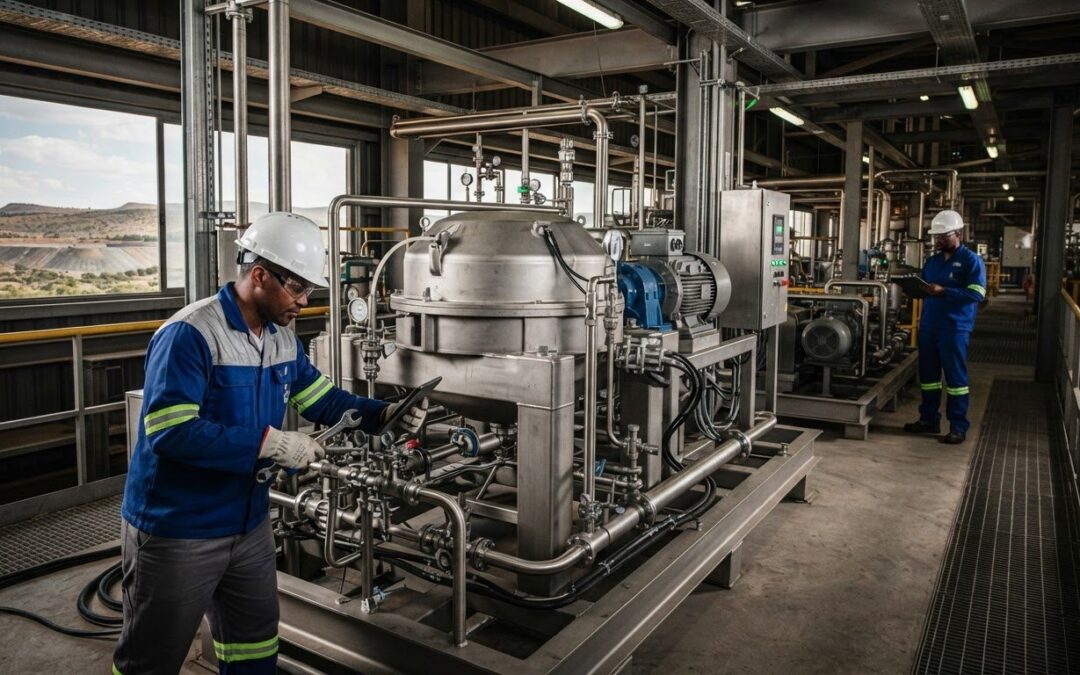
Could the safest start-up decision be knowing when not to proceed? A decanter centrifuge start up procedure is more than a sequence of switches. It depends on equipment condition, the process and the manufacturer’s instructions. Starting in the wrong order can cause damage, trips and disruption before feed even begins.
A reliable start-up depends on verified hold points, not a universal set of machine settings. The equipment manual and site safety procedure remain the authority for the machine in front of you. Use this guide as a framework for organising checks, not as a replacement for model-specific instructions.
This guide covers pre-start checks, starting and stabilising the bowl, and deciding when conditions are suitable for introducing feed. It also explains how to monitor the transition into stable operation and record a useful baseline for future comparison. Whether the application involves mining or food and beverage processing, adapt the sequence to the centrifuge and process.
Key Takeaways
- Use the decanter centrifuge start up procedure as a framework, not a substitute for the machine manual and site safety controls.
- Distinguish a routine restart from start-up after installation, overhaul or an extended shutdown, as each calls for different checks.
- Move through start-up in order, pausing at key hold points and following the machine-specific instructions for drives and operating speed.
- Introduce feed gradually where the manual permits, then monitor separation indicators and respond to abnormal conditions under site procedure.
- Record operating conditions, observations and outstanding actions so the next shift has a clear baseline.
Decanter centrifuge start-up procedure: what to verify before switching on
Use the machine manual and site-specific risk controls as the authority before applying a general checklist. A decanter’s design, drive arrangement and process duty affect what must be checked and in what order. A Decanter centrifuge separates solids from liquids by rotation, but that shared principle doesn’t make operating instructions interchangeable.
First, establish what kind of start-up is planned. A routine restart follows an established operating history, but the required checks still apply. A first start after installation, overhaul or an extended shutdown needs a more thorough review of equipment condition, assembly or maintenance work, and the readiness of connected systems. Don’t treat a successful previous run as evidence that a machine is ready after work or prolonged inactivity.
A pre-start hold point is a deliberate pause where authorised personnel verify that required safety, equipment and process checks are complete before the next start-up stage is released. It prevents unresolved defects or incomplete preparations from carrying into operation.
What must be checked before starting a decanter centrifuge?
Inspect the bowl, scroll area, casing and visible connections only under the approved isolation procedure. Don’t open guards or enter danger zones while equipment could move or start. Before releasing any isolation, confirm that inspection work is complete and the site procedure authorises the change.
Use a concise checklist to confirm that:
- Guards and covers are fitted, and safety devices are in the condition specified for the machine.
- Access routes and the surrounding area are clear, with no housekeeping issues or visible damage requiring attention.
- Lubrication, drive systems, flushing arrangements, utilities and instrumentation are ready in accordance with equipment documentation.
These are verification points, not universal instructions for testing or adjusting equipment. Lubricant requirements, drive checks and instrument functions differ by machine. Record defects and stop if a required check fails or its status is unclear.
How should operators prepare the process and work area?
Confirm that the process is ready for operation. Check feed and any polymer or other process aid where applicable, and verify that discharge routes, conveyors, pumps and receiving systems are prepared. A ready centrifuge can still disrupt the process if downstream equipment cannot accept its output.
Before releasing the hold point, record the equipment condition, outstanding defects and authorised personnel involved. Confirm that the work area is clear and the required utilities and process connections are available. If checks reveal damage, an unresolved defect or an unready process system, keep the machine at the hold point and follow the site procedure. This supports a controlled transition to the start-up sequence without assuming that one checklist fits every installation.
Decanter centrifuge start-up sequence: from drive checks to operating speed
Once pre-start checks are released, follow the machine’s documented sequence for control-system checks, drive engagement and acceleration. The order and control logic vary between machines, so use this framework as a set of hold points, not as a substitute for the manual. A decanter centrifuge start up procedure must use the specified speed targets, ramp behaviour and operating limits for that installation. Don’t apply RPM, ramp-time or differential-speed values from another machine.
- Confirm controls and safety status. Use authorised controls to review alarms and confirm the safety interlocks are in the specified state. Hold point: don’t proceed if an alarm, interlock or control indication is unresolved.
- Engage the drive as instructed. Follow the documented start command and drive sequence. Observe approved indicators for expected drive behaviour and parameter changes. Hold point: pause if the drive response differs from the machine’s instructions.
- Monitor acceleration without feed. Allow the bowl and associated drive systems to reach the specified condition in the prescribed manner. Check the relevant operating parameters as they change. Hold point: stop under site procedure if abnormal noise, vibration, leakage or an alarm occurs, and investigate before attempting another start.
- Verify no-feed operation. Compare indications with the machine’s permitted operating limits and confirmation criteria. Hold point: a speed indication alone doesn’t authorise feed. Confirm stable operation and process readiness first.
Which checks belong in the no-feed start-up stage?
During the no-feed stage, stay with the machine and monitor the approved displays and indicators for the drive and operating parameters. Review alarms and interlock status as required by the control sequence. Watch and listen for abnormal behaviour without approaching rotating parts or opening guards. If a condition falls outside the machine instructions or site procedure, carry out a controlled stop and investigation rather than overriding an alarm or continuing by assumption.
When is a decanter ready for feed introduction?
Feed may begin only after the machine reaches its approved operating condition and required process-readiness checks are satisfied. The manual determines whether a specific operating period or other confirmation is required. Don’t assume the same criteria apply to every decanter. Before moving to the feed stage, record relevant readings and obtain the operator authorisation required by site procedure. This separates permission to run from permission to process.
For equipment selection, customisation or refurbishment relevant to your process, explore industrial decanter centrifuge solutions from Sacor Engineering.
Introducing feed: how to stabilise separation without overloading the decanter
Once the no-feed operating condition has been approved, the next step is introducing material without placing an abrupt load on the bowl, scroll or downstream process. A gradual, controlled feed increase is generally preferable to opening the feed fully at once, but the machine manual and site procedure determine the permitted sequence and loading range. The right approach depends on the decanter configuration and feed characteristics, including solids content and behaviour.
How should feed be introduced during decanter start-up?
Before opening the feed route, confirm that the feed path, pumps and associated process equipment are ready, and that discharge systems can accept the output. Follow the installation’s approved feed-start sequence and remain within its specified operating limits. Don’t assume a valve position or loading rate used on another decanter is suitable for this machine.
Increase feed only as permitted by the operating instructions, allowing the process to respond before making the next change. If solids discharge, centrate quality, machine behaviour or alarms move outside site-defined limits, pause the increase. Follow site procedure to stabilise or stop the process as appropriate. Avoid making several adjustments at once, as that can obscure which change affected performance.
What should operators monitor while the process stabilises?
Use the indicators available on the installation and specified by its operating documentation. Depending on the machine, these may include bowl speed, differential speed, torque and vibration. Compare readings with approved limits rather than general values. Also observe how the feed behaves, whether solids discharge is consistent, and whether centrate clarity is approaching the process target.
- Machine: Record relevant readings, alarms and any change in sound or vibration.
- Separation: Note solids discharge behaviour and centrate quality against application targets.
- Adjustments: Log each permitted change, when it was made and the observed outcome.
This record makes cause and effect easier to assess and gives the next shift a traceable account of the start-up. It also helps operators distinguish a process response from a developing equipment issue. In a mining tailings application, feed behaviour and solids discharge inform the assessment of dewatering. Food and beverage processing may place different emphasis on liquid quality and process requirements. Neither example implies identical settings or targets.
Stable operation means machine readings and separation performance remain within the approved limits for the specific installation. The decanter centrifuge start up procedure should therefore treat feed introduction as a monitored transition, not a single control action. Use process targets and machine-specific instructions to guide any further adjustment.

Start-up problems and safety misconceptions operators should address
A procedure copied from another site or an online speed setting can’t establish that a decanter is safe to start. Machine design, control logic, process duty and approved operating limits differ. Treat the decanter centrifuge start up procedure as specific to the equipment and installation, not as a universal recipe. Never bypass a guard, interlock or alarm, or exceed a prescribed limit to keep start-up moving.
Why should operators never force a start-up through an alarm?
An alarm may indicate an equipment, process or safety condition that needs attention. Its meaning and response depend on the machine’s controls and documentation, so don’t guess at a fault or repeatedly reset an alarm without understanding the required response. Follow the site procedure and record the alarm, operating state, readings and actions taken. This gives authorised maintenance personnel useful information for review.
Unusual vibration, abnormal sound or visible leakage also warrants action. Follow the manufacturer’s instructions and site procedure to hold or stop the process safely. Don’t approach rotating parts, remove guards or attempt an inspection while the machine may move. Observation from a designated safe position is different from maintenance work: opening equipment, investigating internal components or correcting a defect requires the prescribed isolation and competent, authorised personnel.
What if the decanter shows vibration, leakage or poor separation?
Respond to the condition, not an assumed cause. If vibration or leakage appears, an alarm activates, sound changes, or separation quality falls outside site-defined limits, stop or hold the process as directed by the applicable procedure and manufacturer guidance. Record when the symptom appeared, whether feed was present, relevant indications and any action taken. Don’t alter settings beyond approved limits in an attempt to mask the symptom.
Poor separation may call for a process review, while unusual vibration or leakage may require equipment assessment. These observations help guide the next step, but they don’t prove a specific fault. Maintenance checks must follow isolation requirements, and only authorised personnel should inspect or work on the equipment. For further guidance on equipment care and safe maintenance practices, see the industrial centrifuge maintenance guide.
Where recurring start-up issues point to equipment condition, Sacor Engineering’s centrifuge refurbishment services can form part of a considered maintenance approach.
After start-up: handover, operating records and engineering support
A decanter isn’t ready for handover simply because its drive is running. Successful handover means the machine and separation process are stable within their approved limits, with any required operator authorisation in place. A clear record of how that condition was reached gives the next shift a practical baseline and helps identify changes before they become recurring problems.
What should a decanter start-up log include?
Keep the record specific enough for another operator to understand the machine’s condition and process at handover. Include:
- Date, equipment identity, personnel involved and checks completed.
- Relevant operating readings, approved settings and any authorised deviations.
- Feed conditions, alarms, adjustments made and the point at which stable operation was reached.
- Outstanding observations or defects, with actions communicated through the site’s maintenance and shift-handover process.
Record observations as well as readings. For example, note a change in centrate quality or solids discharge alongside the operating conditions at the time. This creates a traceable baseline for comparison, rather than leaving the next shift to rely on memory. Make recording and communicating this information part of the start-up close-out, not an optional task.
When should engineering support or refurbishment be considered?
Repeated start-up faults, abnormal behaviour or declining separation performance are reasons to review the equipment and process rather than repeatedly adjusting controls. Logs can help distinguish an isolated event from a recurring pattern, but they don’t establish the cause on their own. Follow site procedures for escalating concerns and ensure any inspection or maintenance work is carried out under the required isolation and authorisation controls.
A technical assessment should consider both equipment condition and the application’s requirements. Changes in feed behaviour or process targets may call for a process review; persistent equipment concerns may warrant maintenance or refurbishment assessment. Sacor Engineering supplies and customises decanter centrifuges and separation solutions, and provides centrifuge refurbishment services to support process and equipment needs.
Use the completed log, equipment history and process requirements to inform the next decision. To discuss equipment or separation requirements with Sacor Engineering, Discuss your industrial centrifuge requirements with Sacor Engineering.
Make every start-up a reliable handover
A safe decanter centrifuge start up procedure depends on verified hold points, not borrowed settings. Follow the machine manual and site controls, confirm stable operation before introducing feed, then monitor separation and record the operating baseline for the next shift. If vibration, alarms, leakage or declining performance arise, respond through the approved site process rather than forcing the machine to run.
Reliable performance also depends on equipment condition and fit for the process. Sacor Engineering supplies and customises industrial decanter centrifuges and separation solutions for mining and food and beverage applications, and provides centrifuge refurbishment and maintenance services. These capabilities support informed decisions as operating needs or equipment condition change.
For guidance aligned with your application, discuss your industrial centrifuge requirements with Sacor Engineering. With a documented start-up and the right technical support, your team can build confidence in safe, consistent operation.
Frequently Asked Questions
What is the correct start-up procedure for a decanter centrifuge?
Follow the procedure in the machine manual and your site’s safety controls, as start-up sequences differ by model and installation. Typically, operators complete pre-start checks, confirm control and safety-device status, start and monitor the drives without feed, then verify the approved operating condition before introducing material. Treat each transition as a hold point. Record readings and observations, and stop under site procedure if an alarm or abnormal condition occurs.
Can you start a decanter centrifuge with feed already flowing?
Don’t assume it’s safe to start with feed flowing; use the sequence specified for the particular decanter. Unless the manufacturer’s instructions explicitly require otherwise, keep the feed route closed or controlled during start-up, then introduce feed only after the machine reaches its approved operating condition. Starting under load may affect the machine or process. Confirm the feed route, pump and downstream systems are ready before opening it as instructed.
How long does a decanter centrifuge take to reach operating speed?
There isn’t one reliable time for every decanter. Acceleration depends on the machine’s design, drive arrangement and approved control sequence, so use the manufacturer’s stated ramp behaviour and confirmation criteria rather than estimating. Operators should monitor the specified indicators as the bowl accelerates and wait for the required operating condition. If acceleration differs from expected behaviour or an alarm occurs, follow site procedure and investigate before proceeding.
What should you check before starting a decanter centrifuge?
Before start-up, follow the manual and site risk controls. Confirm guards and covers are correctly fitted, access is clear, housekeeping is satisfactory and there’s no visible damage. Inspect internal or guarded areas only under approved isolation procedures. Check lubrication, drives, utilities, flushing systems and instrumentation against the equipment documentation. Also confirm the feed and discharge systems are ready for the planned operation, and record any unresolved defects before releasing the start-up hold point.
What should operators do if a decanter centrifuge vibrates during start-up?
If unusual vibration occurs, follow the manufacturer’s guidance and site procedure to hold or stop the machine safely. Don’t bypass a vibration alarm, continue accelerating or approach rotating components to inspect them. Record when the vibration began, the operating state, relevant readings and any alarms. Any inspection or maintenance that requires access to guarded areas must follow isolation requirements and be carried out by authorised, competent personnel before another start is attempted.
When should feed be introduced to a decanter centrifuge?
Introduce feed only after the decanter reaches the approved operating condition and required process-readiness checks are satisfied. The manual sets any required stabilisation period or confirmation criteria; these aren’t universal. Confirm that feed pumps, discharge routes and receiving equipment are ready, then follow the specified feed-start sequence and loading range. Monitor feed behaviour, solids discharge, centrate quality and available machine indicators, pausing any increase if conditions move outside site-defined limits.
Does every decanter centrifuge use the same start-up procedure?
No. Start-up sequences and operating limits vary with machine design, drive configuration, controls and process application. A procedure or speed setting suitable for one installation may be inappropriate for another. Use the relevant manufacturer documentation and site-specific safety controls as the authority. General checklists can help organise tasks, but they mustn’t replace model-specific instructions for interlocks, acceleration, operating speed, differential speed or feed introduction.
What information should be recorded after a decanter centrifuge start-up?
Record the date, equipment identity, personnel, checks completed and any authorised deviations. Log relevant operating readings, settings, feed conditions, alarms, adjustments and the point at which stable operation was reached. Note unusual observations and unresolved defects, then pass them through the site’s shift-handover and maintenance process. A complete record helps the next operator understand the current condition and compare future start-ups against a useful operating baseline.