
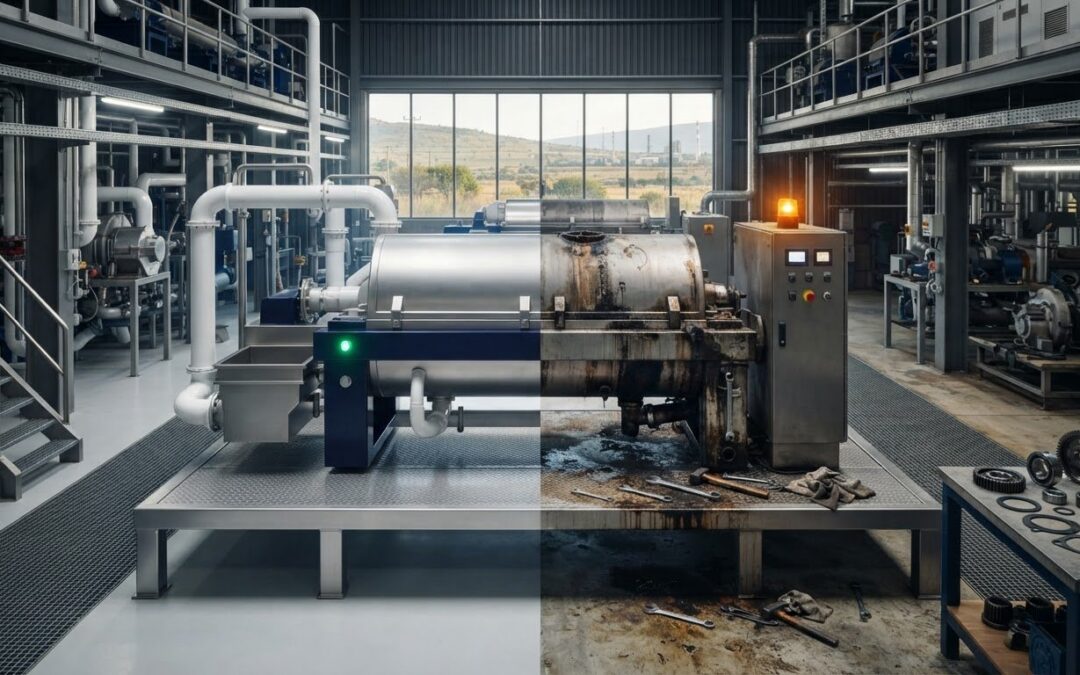
A cheap industrial separator may cost more over its working life than a higher-priced option matched to the process. The hidden costs of cheap industrial separators can emerge after installation, when energy use, maintenance, unplanned downtime or poor separation performance affects production or recovered material. A quotation may look clear, but differences in feed, throughput, operating hours and separation targets can make equipment difficult to compare fairly.
It’s understandable to focus on purchase price, especially when budgets are under pressure. A sound decision also considers how well the equipment suits the process and what it takes to operate, maintain and refurbish it over time. This guide explains how to compare industrial separators using consistent process and ownership assumptions. It covers costs that may be missed in an initial quotation, from installation and energy to repairs, downtime and separation losses, and explains why process-specific solutions matter in applications such as mining and food and beverage processing.
Key Takeaways
- Use the hidden costs of cheap industrial separators as a prompt to look beyond the quotation and map the full ownership picture.
- Build a fair comparison by aligning equipment scope, process duty, site integration and lifecycle assumptions.
- Compare decanter centrifuges and disk stack separators only when they suit the same separation duty.
- Base lifecycle estimates on process requirements and site operating records, and make the assumptions behind each option clear.
- Include refurbishment when assessing whether existing equipment remains a practical part of your long-term separation strategy.
Why cheap industrial separators can cost more to operate
A lower quotation can look attractive during procurement, but it may cover only the equipment. Installation, process integration, operation and maintenance can sit elsewhere in the project budget. Those additional costs depend on the equipment scope, site requirements and process. Compare equivalent scopes before treating the lowest initial price as the most economical option.
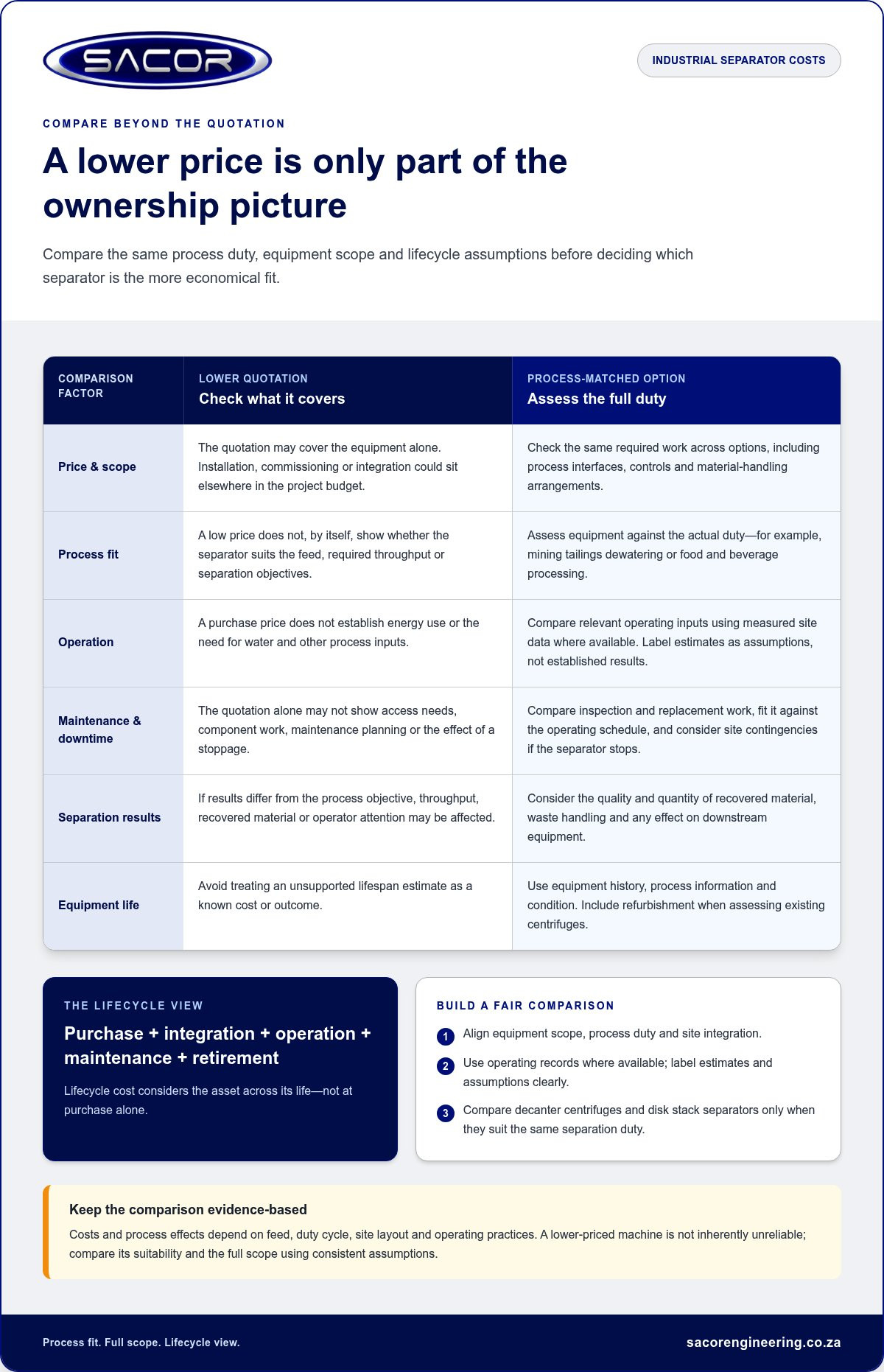
Lifecycle cost is the total cost of purchasing, integrating, operating, maintaining and eventually retiring an industrial separator. This broader view follows the principles of life-cycle cost analysis, which considers costs across an asset’s life rather than at purchase alone. A lower-priced separator may be genuinely economical if it suits the process. The concern is a low price that leaves necessary work or expenditure out of the initial scope.
What does the purchase price leave out?
Separate the equipment price from the work and responsibilities needed to make the system operational. Depending on the project, these may include installation, commissioning and integration with existing process equipment, controls or material-handling arrangements. Compare the quotation with the plant’s requirements: are the necessary process interfaces included, or allowed for elsewhere? Record any scope gaps so they can be accounted for consistently across options.
Why process fit matters as much as price
Equipment selection should reflect feed characteristics, required throughput and separation objectives. A mining duty focused on tailings dewatering, for example, has different requirements from food and beverage processing. If a separator is mismatched to its duty, the operation may face compromises in throughput, separation results or recovered material. This can require more operator attention and affect the wider process. It doesn’t mean a lower-priced machine is inherently unreliable; it means the decision should be based on process evidence as well as price.
For a decanter application, assess the duty and selection factors together rather than relying on a headline capacity or quotation. Sacor Engineering’s decanter centrifuge selection criteria guide provides a framework for considering process requirements. Once fit and scope are clear, buyers can make a more meaningful comparison between purchase price and the costs of operating the separator over time.
Where hidden lifecycle costs arise in centrifugal separation
The hidden costs of cheap industrial separators aren’t a fixed set of charges. They depend on how a machine interacts with its feed, duty cycle, site layout and operating practices. Separate the main cost categories, then test each against process records and realistic operating assumptions.
Separator lifecycle costs depend on process conditions and operating assumptions, not equipment price alone.
Operating and process costs beyond the machine
Assess energy use as one operating input, bearing in mind that its importance depends on the application and how the equipment is run. Water or other process inputs may also be relevant to the separation duty. Use measured site data where available. For a purchase comparison, label estimates clearly and don’t present quotation-stage assumptions as established operating results.
Look beyond the separator, too. The quality and quantity of recovered material, the volume or handling needs of waste streams, and the demands placed on downstream equipment can all affect process economics. For example, a change in separation results may alter the load on a later handling stage. These effects depend on the material and process, so assess them against the plant’s objectives rather than assuming a universal benefit or penalty.
Maintenance, downtime and refurbishment implications
Compare planned maintenance requirements alongside practical site considerations: access to the machine, the work needed to inspect or replace critical components, and how maintenance tasks fit the operating schedule. These factors affect planning and resource needs, but they don’t establish a fixed maintenance cost or service interval. Record the assumptions used for each option, including any differences in access or maintenance scope.
Production interruption is a risk to evaluate, not a guaranteed result of selecting lower-priced equipment. Consider how the process would be affected if maintenance or a component issue required the separator to stop, and whether the site has an operating contingency. For existing centrifuges, refurbishment may also form part of the lifecycle decision. Sacor Engineering’s industrial centrifuge life extension guide explains how refurbishment can be considered as part of an equipment-life assessment.
Equipment life and operating practice
Consider equipment life in relation to the duty it performs and how it is operated and maintained. Feed conditions, operating patterns, site integration and maintenance practices all shape the ownership picture. Avoid relying on an unsupported lifespan estimate. Use available equipment history and process information, and make clear where a comparison depends on assumptions.
Sacor Engineering supplies tailored separation solutions and provides centrifuge refurbishment services. These can be considered in relation to the process requirements and equipment condition being assessed. Explore Sacor Engineering’s separation solutions alongside the equipment and lifecycle factors relevant to your operation.
How to compare a cheap separator with a process-matched option
A fair comparison starts by asking each quotation to address the same process brief. The lowest price isn’t automatically poor value, and a higher initial quote isn’t automatically better. The decision depends on whether each option suits the required duty and what its scope and operating assumptions include.
What should an industrial separator comparison table include?
Use a comparison table to expose gaps before weighing the figures. Keep confirmed information separate from estimates and claims that need evidence. If two quotations describe different duties or scopes, mark them as non-equivalent rather than treating them as like-for-like.
| Scope of comparison | What to record for each option |
|---|---|
| Process duty | Feed characteristics and the separation objective the equipment is intended to meet. |
| Throughput basis | The stated throughput and the conditions or assumptions attached to it. |
| Equipment and project scope | Included equipment, installation interfaces, integration and commissioning assumptions. |
| Operating assumptions | Expected duty cycle and relevant process inputs, identifying estimates separately from measured site data. |
| Maintenance and lifecycle | Maintenance access, service planning, critical components and any applicable refurbishment considerations. |
Label entries as “confirmed”, “estimated” or “not comparable” so decision-makers can see what supports each figure. Don’t fill information gaps with assumptions that make one option appear more favourable.
Compare equipment suited to the same duty
Technology type matters. A decanter centrifuge and a disk stack separator perform distinct separation duties, so their quotations shouldn’t be ranked against each other simply because both use centrifugal force. First define the required outcome, then compare options that can address the same duty. For mining applications involving tailings, Sacor Engineering’s tailings dewatering equipment guide offers relevant context for defining the process requirement.
When is a low-cost option still the right choice?
A lower-cost option may be appropriate when its scope, operating conditions and integration requirements align with a clearly defined process. Test the available evidence against the required output and site conditions, and record estimates separately. This helps reveal the hidden costs of cheap industrial separators without assuming that a low price signals poor reliability or that a higher quote guarantees better value.
How to assess total cost before buying an industrial separator
A consistent assessment gives procurement, operations and maintenance teams a shared basis for reviewing quotations. It also separates costs supported by site data from risks that require an estimate, making uncertainty visible rather than burying it in a single total.
Quotation comparisons are meaningful only when each option is assessed against equivalent scope, process duty and operating assumptions.
- Define the duty. Record feed characteristics, required throughput and the separation objective. These requirements provide the basis for assessing whether each option is suitable.
- Standardise the scope. Align what each quotation includes, including equipment, integration and commissioning assumptions. Mark exclusions clearly instead of treating different scopes as equivalent.
- Map lifecycle categories. List relevant purchase, integration, operating, maintenance, downtime and end-of-life considerations. Include only inputs that apply to the project.
- Validate assumptions. Use site operating records and process requirements to support estimates. Separate measurable costs from uncertain risks, and note the source and assumptions behind each figure.
- Compare on the same basis. Review the aligned information, highlight gaps and identify which assumptions most affect the decision.
Build a defensible lifecycle-cost baseline
Start with available records, such as operating hours, process inputs, maintenance history and production requirements. Choose a consistent assessment period for every option, but don’t assume a standard equipment lifespan where project evidence isn’t available. Document data sources, exclusions and estimates so stakeholders can understand what the comparison includes and revisit it when better information becomes available.
This approach helps expose the hidden costs of cheap industrial separators without presenting estimates as confirmed outcomes. For example, if a quotation assumes different operating hours from the site’s records, flag the discrepancy before comparing projected operating costs.
Stress-test assumptions before procurement approval
Test the expected operating case and a less favourable scenario using project-specific information. Apply maintenance, downtime and integration assumptions consistently across the options. The aim isn’t to predict every event, but to see whether the decision changes when uncertain inputs shift.
Identify unknowns that could materially affect suitability or lifecycle cost, then include them in engineering review before approval. A process-led discussion can clarify the duty and comparison basis. Explore Sacor Engineering’s separation solutions in the context of your application.
How Sacor Engineering approaches industrial separator decisions
A separator decision should begin with the process, not a preferred machine type or headline quotation. Sacor Engineering supplies and customises decanter centrifuges, centrifugal separators and disk stack separators, alongside tailored separation solutions. The appropriate option depends on the material being processed, the separation objective and the project requirements. Assessing these factors helps buyers consider the hidden costs of cheap industrial separators without assuming price alone predicts suitability.
Match separation equipment to the process
Mining and food and beverage operations have different feed materials, process goals and operating contexts. These requirements inform the equipment type and any customisation needed for the application. A mining project focused on tailings dewatering, for instance, calls for consideration of the specific dewatering duty; food and beverage processing brings its own product and process requirements. Sacor Engineering matches separation solutions to these needs rather than relying on claims of universal performance.
Decanter centrifuges, centrifugal separators and disk stack separators aren’t interchangeable simply because each is used for separation. Let the duty guide the comparison. Relevant considerations include the feed, desired separation result, required throughput and how the equipment must integrate with the process. Bringing these requirements together helps teams define a clear scope and assess options on an equivalent basis. Where the duty calls for a tailored approach, Sacor Engineering customises separation solutions for the industrial application.
Consider refurbishment as part of the lifecycle decision
Replacement isn’t the only lifecycle route to assess. Sacor Engineering provides centrifuge refurbishment services for existing centrifugal equipment, making refurbishment an option to evaluate alongside new equipment where technically appropriate. Base the comparison on the equipment’s condition, intended duty and project requirements. These factors help establish whether refurbishment or replacement is more suitable; neither should be presumed to be the right answer before the evidence is considered.
For mining and food and beverage operators, a useful engineering discussion connects process requirements with equipment scope and lifecycle considerations. Sacor Engineering supplies and customises decanter centrifuges, centrifugal separators, disk stack separators and tailings dewatering equipment, and provides refurbishment services. Share the separation challenge and the operating requirements that matter to your project to start a focused conversation.
Discuss your industrial separation requirements.
Make your next separator decision with confidence
The hidden costs of cheap industrial separators are easier to assess when quotations use the same process duty, scope and operating assumptions. A meaningful lifecycle comparison also considers maintenance, potential production interruptions and process fit. Use site records to distinguish measured costs from estimates, and consider refurbishment alongside replacement when equipment condition and duty make it relevant.
Sacor Engineering supplies and customises centrifugal separation equipment for mining and food and beverage processing applications, and provides centrifuge refurbishment services. The right approach depends on your process requirements, equipment condition and project priorities, not price alone.
Discuss your industrial separation requirements with Sacor Engineering and take the next step towards a solution that fits your operation. A clear, evidence-led comparison can help you plan with greater confidence.
Frequently Asked Questions
What are the hidden costs of cheap industrial separators?
The hidden costs of cheap industrial separators can include installation and integration work, operating inputs, maintenance, production interruptions, process losses and eventual refurbishment or replacement. Which items matter depends on the separator, feed characteristics, duty cycle and site requirements. Not every category applies to every project. Use operating records and engineering estimates where possible, and compare equipment against consistent assumptions rather than treating potential costs as inevitable.
How do you calculate the total cost of ownership for an industrial separator?
Start by defining the assessment period and operating duty, then record the purchase and project scope, expected operating inputs, planned maintenance, downtime assumptions and relevant process impacts. Separate measured data from estimates, document exclusions and state the assumptions behind each figure. Compare options on an equivalent basis. There isn’t one universal calculation for every industrial separator because applications, site conditions and operating requirements differ.
Can a cheap industrial separator be the right choice?
Yes. A lower-cost separator can be the right choice if it suits the process and the quoted scope meets the required duty. Purchase price alone doesn’t prove good value or poor quality. Compare process fit, integration requirements, operating assumptions and maintenance implications with suitable alternatives. Base the decision on project-specific evidence rather than assuming cheaper equipment always costs more or a higher quotation is automatically better.
What should I compare when evaluating industrial separator quotations?
Compare equivalent scope, process duty, throughput assumptions, separation objectives, integration requirements and maintenance considerations. Record what each quotation includes and excludes, and flag estimates based on different assumptions. For centrifugal equipment, first establish that the options suit the same application: a decanter centrifuge and a disk stack separator aren’t automatically comparable. Aligning the technical and commercial basis helps prevent scope differences from being mistaken for differences in value.
How can poor process fit increase separator costs?
Poor process fit may require additional integration work or operational adjustments, and could affect the separation outcome. The impact depends on feed characteristics, operating conditions and required output, so don’t assume a specific cost or performance penalty without evidence. Define the duty clearly and assess process requirements before comparing purchase prices or lifecycle estimates. Site data can help distinguish measured effects from risks that still need engineering review.
Is centrifuge refurbishment worth considering instead of replacement?
Refurbishment can be worth assessing when the existing equipment’s condition, process requirements and proposed work make it technically appropriate. Compare the refurbishment scope and operating implications with those of replacement using project-specific information. Neither route is automatically preferable. Sacor Engineering provides centrifuge refurbishment services for existing centrifugal equipment, alongside the supply and customisation of separation equipment. An evidence-based assessment can help identify which option best suits the required duty.