
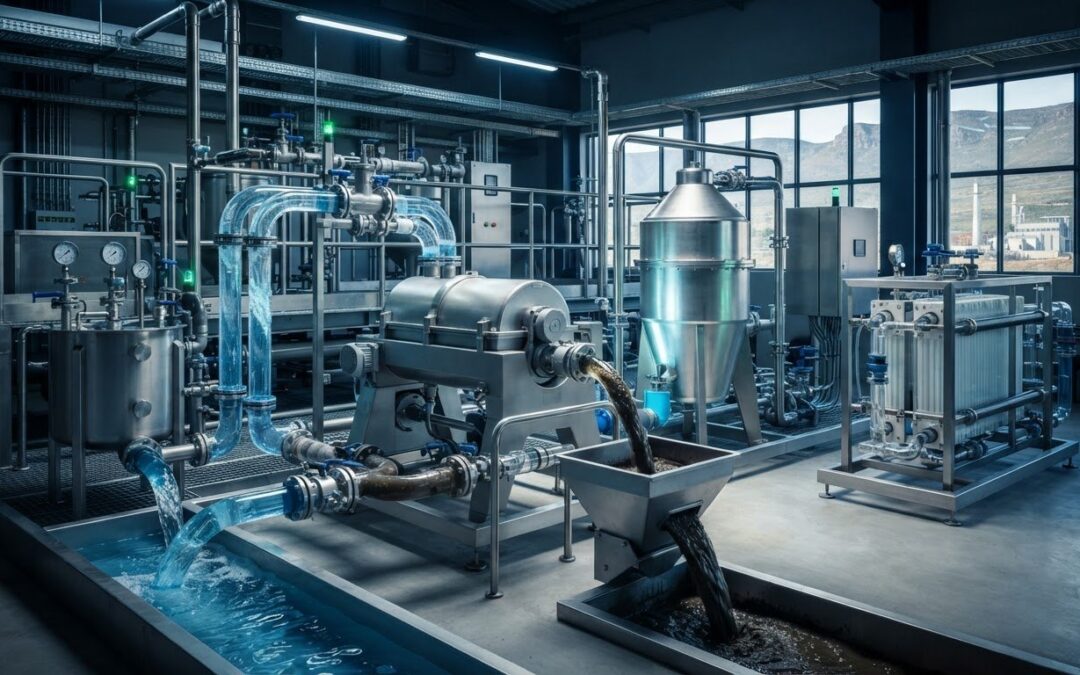
The most powerful separator may be the wrong first choice. For industrial water separation, start by characterising the process stream, then match the method to what you need to recover or remove. Solids concentration, particle size, oil content and changes in flow can all affect equipment selection and the separation result.
Choosing a system can be difficult when water-recovery goals haven’t been translated into measurable equipment requirements. This guide compares the main approaches, including centrifugal separation, membrane filtration and chemical treatment, and explains the different roles they can play. You’ll find which feed and process details to gather before specifying equipment, what operating factors to assess, and when a decanter centrifuge or centrifugal separator may be worth evaluating. The aim is to help you compare options against your process, without assuming one machine suits every stream or guarantees a particular result.
Key Takeaways
- Start with the separation objective: removing solids, recovering water and preparing a stream for another process are distinct goals.
- For industrial water separation, feed solids, flow variation and operating conditions help determine which process options are worth assessing.
- Settling, filtration and centrifugal separation have different roles. Compare them against the feed and required outputs rather than treating them as interchangeable.
- Before specifying equipment, define the target outputs, gather process data and check site constraints so you can assess options against relevant criteria.
- Decanter centrifuges, centrifugal separators and tailings dewatering equipment may suit particular industrial streams, subject to a process-specific assessment.
Industrial water separation: define the objective before choosing equipment
Industrial water separation is the process of separating water from solids or other components in an industrial process stream to meet a defined process objective. It describes a separation stage, not necessarily complete wastewater treatment, final polishing or confirmation that recovered water is suitable for reuse. Those may require additional processes and checks. For broader context on industrial wastewater and treatment approaches, see Industrial wastewater treatment.
This distinction matters when specifying equipment. A separator may split a stream into a liquid fraction and a concentrated solids fraction, but the result must be assessed against the next process step. The required water quality depends on whether the liquid will return to production, enter another treatment stage or be managed in another way. Define that intended use first. Separation alone doesn’t establish that water is suitable for reuse or discharge.
Which industrial water-separation objectives matter most?
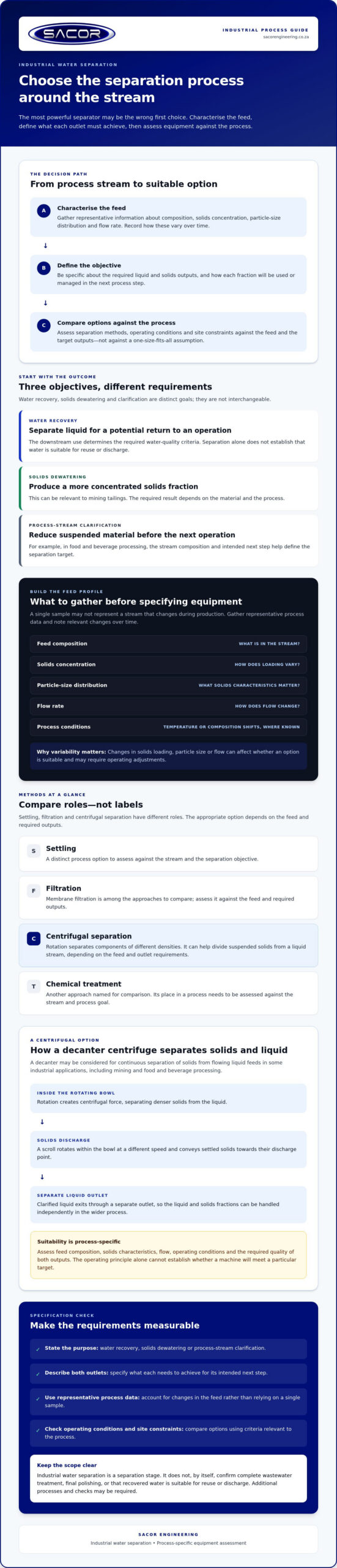
Three objectives often guide process selection, and they aren’t interchangeable:
- Water recovery: Separate liquid from a process stream for potential return to an operation, subject to the quality requirements of that downstream use.
- Solids dewatering: Remove liquid from a solids-rich feed to produce a more concentrated solids fraction. This can be relevant to mining tailings, although the required result depends on the material and process.
- Process-stream clarification: Reduce suspended material in a liquid stream before it proceeds to another operation. In food and beverage processing, the stream composition and intended next step help define the separation target.
A useful specification describes what each outlet needs to achieve rather than simply asking for “clean water”. For example, state whether the priority is a target solids condition, a clarified process stream or water that can be considered for a defined reuse step. The downstream process must determine the necessary quality criteria.
What does the process need to separate?
Start by characterising the feed. Record its composition, solids concentration, particle-size distribution and flow rate, including how each varies over time. Note relevant process conditions, such as changes in temperature or composition, where known. These details help narrow the equipment options and identify operating conditions that need further assessment.
Feed variability can affect how a separation system behaves. A shift in solids loading, particle size or flow may change whether an option is suitable or require operating adjustments. Avoid choosing a machine based on a single sample if the stream changes during production. Gather representative process data, define the required outputs, then assess equipment against both the feed and the operating objective.
How centrifugal separation supports industrial water recovery
Centrifugal separation uses rotation to separate components of different densities, moving denser material away from lighter material under centrifugal force. In an industrial water separation process, this can help divide suspended solids from a liquid stream. Whether it suits a particular application depends on the feed and what each outlet needs to achieve.
A decanter centrifuge is one option for continuous separation of solids from liquid feeds. It may be considered where a process needs to handle a flowing stream and discharge separated solids and liquid as operations continue. This makes it relevant to some industrial applications, including mining and food and beverage processing, but it isn’t a universal solution for water recovery or wastewater treatment.
How a decanter centrifuge separates solids from liquid
Inside a decanter centrifuge, a rotating bowl creates the force that separates denser solids from the liquid. A scroll rotates within the bowl at a different speed and conveys the settled solids towards their discharge point. The clarified liquid exits through a separate outlet, allowing the two fractions to be handled independently in the wider process.
Suitability depends on the feed’s composition, solids characteristics, flow and operating conditions, as well as the required quality of both outputs. Assess those details before selecting or specifying equipment. The operating principle alone can’t establish whether a machine will meet a particular process target.
Where centrifugal separators may fit in a process
“Centrifugal separator” covers equipment configured for different duties, so designs shouldn’t be treated as interchangeable. A decanter centrifuge is associated with separating solids from liquid feeds, while a disk stack separator is a distinct equipment category used for other separation requirements. It shouldn’t be assumed to be the default choice for tailings or any other solids-rich stream.
Equipment selection is also part of a wider process and waste-management plan. The U.S. Environmental Protection Agency’s EPA’s Guide for Industrial Waste Management offers general guidance for assessing industrial waste-management systems. It doesn’t replace checks against applicable South African requirements. For further equipment context, explore this guide to industrial separation solutions.
If you’re considering centrifugal equipment, reviewing the feed and intended outputs with Sacor Engineering’s separation equipment team can help frame a process-specific assessment.
Industrial water separation methods compared by feed and process goal
For industrial water separation, start with the feed and required duty, not a preferred machine. Settling, filtration and centrifugal separation work in different ways. Use this comparison for initial screening, then confirm potential options through process testing and engineering review.
| Approach | Typical role | Feed considerations | Strengths and limitations |
|---|---|---|---|
| Settling | Separates particles from liquid by gravity. | Consider whether solids settle and how flow and solids concentration vary. | Can provide a straightforward separation stage, but performance depends on settling behaviour and may not meet the process objective on its own. |
| Filtration | Retains particles as a stream passes through a filter medium. | Assess particle size, solids loading and the required filtration stage. | Provides a solids-removal step, but the medium and operating conditions must suit the feed. Retained solids also need to be managed. |
| Centrifugal separation | Uses rotation to separate components of different densities. | Assess feed composition, solids characteristics, flow and operating conditions. | May suit continuous solids-dewatering duties, but equipment configuration and achievable outputs depend on the application. |
These methods aren’t interchangeable. A process may need several stages, such as primary separation followed by filtration if fine particles remain or the next operation has additional quality requirements. That still doesn’t confirm the separated water is ready for reuse or discharge. Define and verify those requirements separately with qualified technical professionals.
When to assess decanter centrifuges for water and solids separation
A decanter centrifuge may be worth assessing for continuous separation of solids from a liquid feed. In mining, tailings dewatering is a relevant application, although outputs depend on the material and operating conditions. For further mining-specific detail, see the tailings dewatering equipment guide.
When another separation stage may be needed
Fine particles or downstream quality requirements may call for additional processing. Identify what each stage must achieve, then confirm options through testing and engineering review. Check applicable South African discharge or reuse criteria with qualified technical professionals. Solids separation alone doesn’t establish compliance.
How to assess an industrial water separation system
A structured assessment turns a process requirement into a clear basis for comparing proposals. Record the operating context as well as the separation duty, so equipment can be assessed for its technical role and its fit with the site and day-to-day operation.
- Define the goal. State what the separation stage must accomplish and how its success will be assessed.
- Characterise the feed. Document composition, solids concentration, particle characteristics, flow patterns and known variations.
- Specify the outputs. Describe the required liquid and solids characteristics in terms of the next process stage.
- Assess site constraints. Check available space, integration requirements, maintenance access and operator needs.
- Validate options. Confirm what testing or engineering review is appropriate before settling on equipment.
Verify any technical threshold, discharge criterion or applicable standard for the specific application. Confirm relevant South African requirements with qualified professionals rather than relying on an unverified figure or assumption in a proposal.
What process data should operators gather first?
Collect representative feed samples and note how flow and feed composition change during normal operation. Record production shifts or other known conditions that affect the stream. Document what the next process stage requires from both outputs, including any quality criteria already established internally. Ask the project engineer whether laboratory analysis, pilot testing or another validation method is suitable for the feed and duty.
How should equipment proposals be evaluated?
Give each supplier the same process information, then compare proposals against consistent assumptions. Ask suppliers to explain the intended duty, limitations, maintenance requirements and any supporting process stages that may be needed. Review site integration and service access as well as separation claims. The decanter centrifuge selection criteria guide provides a focused framework for evaluating that equipment category.
Checklist: Set the goal, document representative operating data, define output criteria, confirm site needs and validate proposals against shared assumptions.
To discuss centrifugal equipment in the context of your process data, contact Sacor Engineering about separation equipment.
How Sacor Engineering can support industrial water separation
Once the separation duty and process requirements are clear, assess equipment that could suit the feed and site. Sacor Engineering supplies customised centrifugal separation equipment for industrial applications, including mining and food and beverage processing. Its services support relevant equipment and separation-solution requirements, rather than providing a complete water-treatment plant or determining reuse suitability for every process.
Matching Sacor equipment categories to a separation duty
A decanter centrifuge may be considered for a process that needs to separate solids from a liquid feed. For mining applications, Sacor also supplies tailings dewatering equipment. Suitability depends on the material, operating conditions and required outputs. Neither category should be selected on the basis of the application label alone; feed details and process objectives matter.
Centrifugal separators and disk stack separators are other equipment categories in Sacor’s range. Their roles differ, so they need application-specific evaluation rather than being treated as interchangeable alternatives. Start the discussion with the duty the equipment must perform and how its outputs fit into the wider process.
If you already have a centrifuge, refurbishment may be relevant when the project involves restoring equipment rather than selecting a new unit. Whether refurbishment fits the requirement depends on the equipment’s condition and the process duty it must meet.
Taking the next step with a process-specific assessment
Before discussing equipment, prepare a concise process brief. Include representative feed information, expected flow patterns, known changes in operating conditions and the required characteristics of both the liquid and solids outputs. Note site constraints, including available space, integration needs and maintenance access. This gives the equipment discussion a practical basis and helps identify details that may still need testing or engineering review.
Recommendations should follow from those application details. A proposal needs to account for the actual feed, operating assumptions and downstream requirements. No equipment category should be treated as a guaranteed fit in advance. Clarify what the proposed machine is intended to separate, what limitations apply and whether other process stages fall outside the equipment scope.
For industrial water separation requirements involving centrifugal equipment, share your process objective and available feed data to begin a focused discussion. Discuss your industrial separation requirements with Sacor Engineering to explore whether its equipment categories warrant further assessment for your application.
Move from process data to a confident equipment decision
A sound industrial water separation decision starts with a clear process objective and a realistic picture of the feed. Compare equipment against the same operating information, define the required outputs and verify whether additional process stages or testing are needed. This keeps selection grounded in your specific duty rather than assumptions about what a machine can achieve.
Sacor Engineering supplies and customises centrifugal separation equipment for industrial applications, and provides centrifuge refurbishment and maintenance services. Serving industrial customers nationally across South Africa, the company can support a process-specific discussion about equipment fit, whether you’re assessing a new separation requirement or existing centrifuge equipment.
Prepare your feed characteristics, process objectives and site constraints before taking the next step. Discuss your industrial separation requirements with Sacor Engineering. A clear brief is a practical starting point for exploring suitable options and making an informed decision.
Frequently Asked Questions
What is industrial water separation?
Industrial water separation separates water from solids or other components in a process stream to meet a defined operational objective. That objective might be recovering liquid, dewatering solids or clarifying a stream before another process step. It describes a separation stage, not necessarily complete wastewater treatment. Assess the separated water against its intended next use. Separation alone doesn’t confirm that it’s suitable for reuse or discharge.
How does a centrifuge separate water from solids?
A centrifuge rotates the feed, using centrifugal force to move denser solids away from the liquid. In a decanter centrifuge, solids collect against the rotating bowl and a scroll conveys them towards a separate discharge, while liquid exits through another path. This is a mechanical separation principle, not a guarantee of a particular output. Results depend on feed characteristics, operating conditions and process requirements.
Which equipment is suitable for separating water from mining tailings?
A decanter centrifuge or other tailings dewatering equipment may be considered for separating solids from liquid in a mining tailings stream. The appropriate option depends on the tailings’ composition, solids concentration, particle characteristics, flow and required outputs. Provide representative feed information before assessing equipment. No machine should be assumed to achieve a specific water-recovery result without application-specific evaluation and, where appropriate, testing.
Can separated industrial water be reused immediately?
Not necessarily. A separation step may reduce solids or divide a stream into liquid and solids fractions, but that doesn’t establish whether the liquid is suitable for a particular reuse application. The next process may require further treatment or testing against its own quality criteria. Define the intended use and confirm the necessary water-quality requirements with qualified technical professionals before directing separated water back into production.
What is the difference between a decanter centrifuge and a disk stack separator?
A decanter centrifuge is commonly assessed for continuous separation of solids from liquid feeds. Its rotating bowl separates denser solids, while an internal scroll conveys them towards a solids outlet. A disk stack separator is a different equipment category with a distinct configuration and separation duty. They aren’t interchangeable by default. Selection depends on the feed, the components to be separated and the required process outputs.
What information is needed to select industrial water separation equipment?
Start with representative feed samples and record flow rates, flow variation, solids concentration, particle characteristics and known changes in process conditions. Define what the next stage requires from both the liquid and solids outlets. Also document site space, integration needs, maintenance access and operator requirements. This information helps compare equipment on consistent assumptions. An engineer can advise whether laboratory or pilot testing is appropriate.
Does a centrifuge replace a complete industrial wastewater treatment process?
No. A centrifuge performs a specific mechanical separation duty, such as separating solids from a liquid stream. Complete wastewater treatment may involve additional stages, depending on the contaminants present and the required final water quality. A centrifuge doesn’t by itself confirm compliance with discharge criteria or suitability for reuse. Assess the full process requirement separately and verify any applicable South African criteria with qualified professionals.