
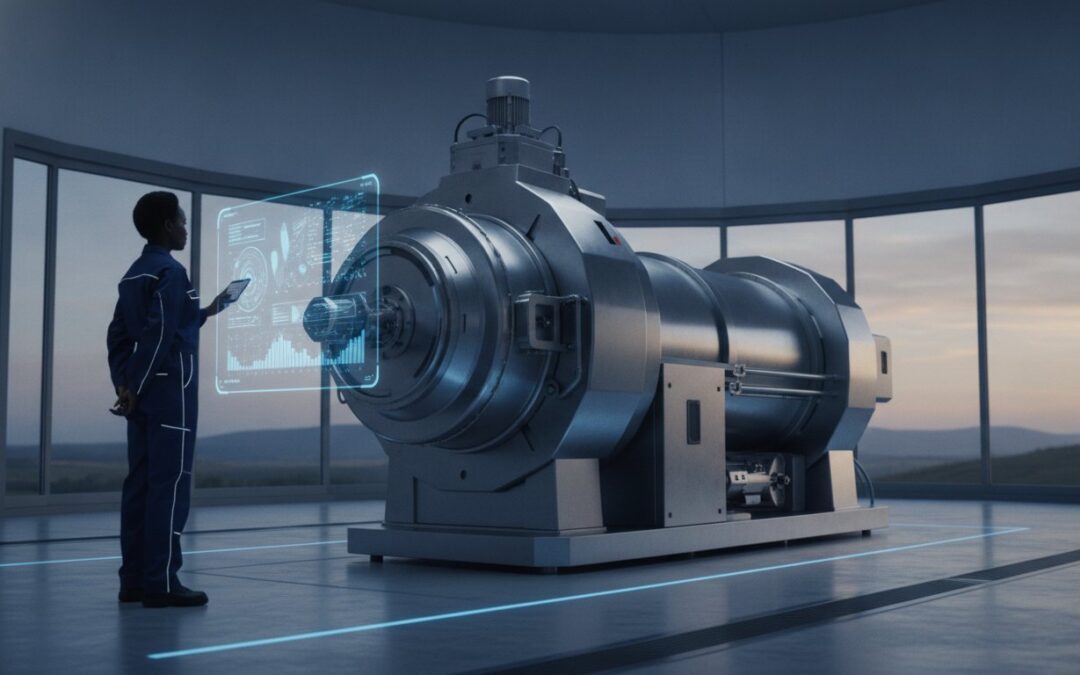
With 67.6% of South Africa’s wastewater treatment plants currently classified as high or critical risk, the pressure on industrial operators to manage their waste streams has reached a turning point. You probably recognise that equipment downtime and inefficient tailings management are no longer just operational hurdles; they’re direct threats to your bottom line. When searching for decanter centrifuge suppliers South Africa, the goal is to find more than a vendor. You need a partner who understands that achieving high-purity separation in food processing or reducing moisture in mining solids requires precision engineering rather than off-the-shelf products.
This guide demonstrates how modern centrifugal technology and bespoke engineering can transform your processing efficiency and waste management strategy. You’ll learn how to increase yields and lower the total cost of ownership through advanced hardware and strategic refurbishment. We’ll examine the latest 2026 separation trends, from energy-efficient decanter models to the growing importance of resource recovery, providing a clear roadmap for optimising your industrial output whilst meeting the nation’s evolving environmental standards.
Key Takeaways
- Understand the “Solid Load Rule” to accurately choose between decanter centrifuges and disk stack separators for your liquid-solid separation needs.
- Evaluate the economic benefits of professional refurbishment; it’s a process that returns existing hardware to OEM standards whilst supporting your sustainability goals.
- Learn how to select the right decanter centrifuge suppliers South Africa by focusing on consultative engineering and long-term operational support.
- Discover how tailings dewatering technology drastically reduces waste volume and moisture content in mining and industrial processing.
- See why customised separation engineering outperforms off-the-shelf solutions when processing complex materials for food and beverage production.
Understanding Industrial Separation Solutions and Their Strategic Importance
Industrial separation is the mechanical process of isolating distinct phases within a feed material, typically separating solids from liquids or partitioning two immiscible liquids. In a production environment, this isn’t just a technical requirement; it’s a strategic necessity. By isolating these components, plants can recover valuable products, remove contaminants, and manage waste streams with precision. Efficiency in this area acts as a hidden lever for profitability. Even a minor improvement in separation clarity can lead to significant savings in downstream processing and disposal costs.
The primary hardware used to achieve these results includes disk stack separators, tailings dewatering equipment, and decanter centrifuges. Partnering with specialised decanter centrifuge suppliers South Africa allows industries to move beyond basic sedimentation toward high-velocity processing. This transition is essential for modern facilities that require high throughput without sacrificing the purity of the output.
The Mechanics of Centrifugal Separation
Centrifugal separation works by multiplying the effect of gravity through high-speed rotation, creating a force often measured in thousands of Gs. This G-force accelerates the natural sedimentation process, allowing phases to separate in seconds rather than the hours or days required by static settling tanks. A decanter centrifuge leverages this principle by using a solid-wall bowl and an internal scroll to continuously discharge separated solids. Centrifugal sedimentation relies on density variances to drive particles toward a solid bowl wall; conversely, centrifugal filtration employs a perforated basket to mechanically strain liquids from solid matter. Achieving high-purity output depends heavily on the density differential between the materials, making the calibration of the bowl speed and scroll differential critical to success.
Economic and Environmental Drivers
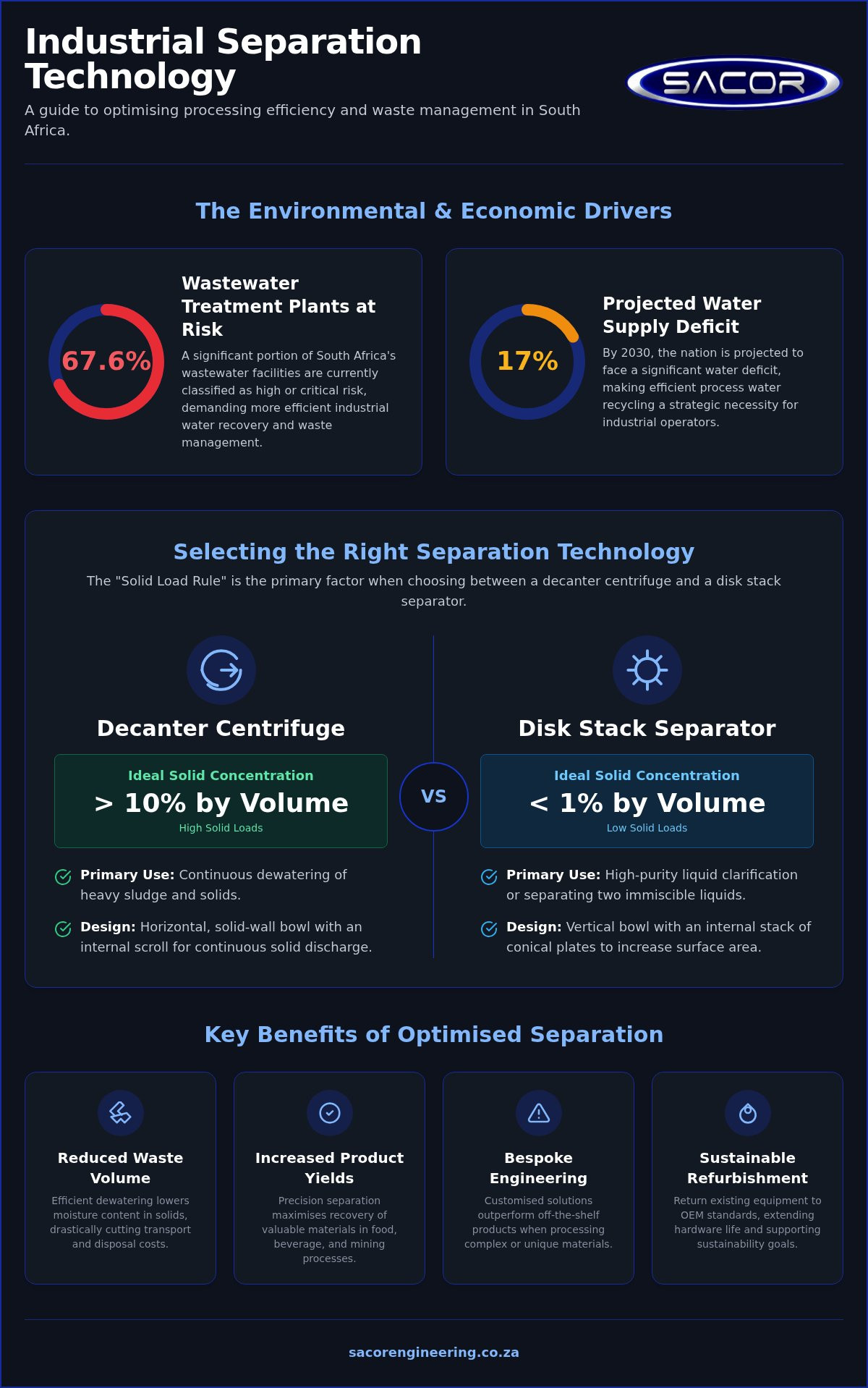
Environmental compliance and resource scarcity are now central to industrial strategy. South Africa faces a projected 17% water supply deficit by 2030, a reality that has prompted the government’s National Water Action Plan launched in July 2026. Efficient separation technology is a primary tool for water recovery, allowing plants to recycle process water and reduce their reliance on municipal supplies. This is particularly vital given that 67.6% of the country’s wastewater treatment plants are currently categorised as high or critical risk. For a comprehensive understanding of how centrifugal technology addresses these challenges, our decanter centrifuge for industrial water treatment reference guide provides detailed technical and regulatory context for 2026.
Beyond compliance, the economics of separation are compelling. Reducing the moisture content in waste solids directly lowers transport and disposal fees. In high-value sectors like food and beverage production, increasing the yield by even a fraction of a percent can result in substantial annual revenue growth. By working with expert decanter centrifuge suppliers South Africa, operators can implement bespoke engineering solutions that optimise these yields whilst ensuring long-term mechanical reliability.
Decanter Centrifuges vs. Disk Stack Separators: Selecting the Right Technology
Selecting the correct separation technology requires a deep understanding of your feed material’s physical properties. It’s not a matter of one being “better” than the other; rather, it’s about matching the machine’s mechanical capabilities to the specific process requirements. These decisions are rooted in fundamental engineering principles that balance centrifugal force with residence time to achieve the desired clarity.
The “Solid Load” Rule serves as the primary diagnostic tool for engineers. As a general guideline, decanter centrifuges are preferred when the solid concentration in the feed exceeds 10% by volume. Conversely, disk stack separators excel when solids are below 1% or when liquid-liquid separation is the priority. Leading decanter centrifuge suppliers South Africa often use this rule to narrow down equipment options during the initial consultative phase. Architecture also plays a vital role. Decanters utilise a horizontal, solid-wall bowl designed for continuous discharge of heavy sludge. Disk stack separators employ a vertical orientation with a series of conical plates that increase the effective settling area, allowing for the removal of microscopic particles that a decanter might miss.
Solid Bowl Decanter Centrifuge: The Heavy Lifter
The solid bowl decanter is the preferred choice for applications involving high solid concentrations, often handling feeds with up to 60% solids. Its robust, horizontal design allows it to process large particle sizes without clogging, making it indispensable for mining tailings and industrial wastewater sludge. For a deeper dive into technical specifications, refer to our solid bowl decanter centrifuge guide. In South Africa, these machines are critical for coarse food processing and municipal dewatering where high throughput is mandatory.
Disk Stack Separators: Precision and Clarity
When the goal is “polishing” a liquid or separating two immiscible liquids like oil and water, the disk stack separator is the superior tool. These machines operate at significantly higher speeds than decanters, generating the extreme G-forces necessary to clarify beverages or purify oils. Because they utilise a stack of disks to create a massive settling surface within a compact bowl, they’re perfect for dairy processing and fine chemical applications. For a comprehensive technical breakdown of how these systems achieve sub-micron precision and how to select between purifier and clarifier configurations, our guide to high speed disk stack separators provides the specialised detail operators need. Consulting with experienced decanter centrifuge suppliers South Africa ensures your choice aligns with the specific density and viscosity of your production fluids. Matching the right machinery to your feed consistency don’t just improve yield; it protects your hardware from premature wear.
The Economics of Separation: New Equipment vs. Professional Refurbishment
Deciding between purchasing new hardware and restoring existing assets is a pivotal choice for any plant manager. Whilst the allure of new technology is strong, the economic reality often favours a strategic refurbishment programme. Professional restoration doesn’t merely fix broken parts; it returns the machine to its original OEM performance levels. This approach allows you to extend the operational life of your hardware whilst avoiding the significant capital outlay associated with a full replacement. Expert decanter centrifuge suppliers South Africa provide a consultative perspective, helping you weigh the total cost of ownership against your immediate production requirements.
From a sustainability standpoint, refurbishment is a powerful tool for reducing your operation’s carbon footprint. Manufacturing a new decanter involves intensive energy use and raw material extraction. By choosing to restore a solid-bowl decanter or a disk stack separator, you’re directly contributing to a circular industrial economy. This choice aligns with the broader national focus on resource responsibility and environmental compliance mentioned earlier in this guide. It’s a practical way to achieve ESG goals without compromising on mechanical reliability.
The Centrifuge Refurbishment Process
The centrifuge life extension guide outlines the precision required for successful restoration. The process begins with high-speed bowl balancing to eliminate vibration and ensure operational safety. Scroll refurbishment follows, where wear-resistant coatings are reapplied to maintain efficient solids transport. Gearbox restoration completes the cycle, ensuring the differential speed remains precise. This level of engineering ensures that refurbished units can handle the same rigorous duty cycles as their brand-new counterparts. Safety remains the priority, as precision-balanced components are essential for high-speed separation machinery.
When to Buy New: Innovation and Capacity
There are instances where investing in new equipment is the only logical path forward. If your current machinery cannot meet the throughput demands of an expanding facility, or if the frame’s structural integrity is compromised, replacement becomes necessary. Modern centrifuges, such as those introduced in early 2026, feature integrated smart controls and automated dewatering cycles. These systems can reduce operational energy consumption by 10% to 20%, as seen in recent energy-recovery impeller designs. When growth targets require a leap in capacity or a radical shift in energy efficiency, partnering with leading decanter centrifuge suppliers South Africa ensures you select hardware that fits your long-term roadmap. New equipment offers the benefit of the latest material science, which can be critical for achieving high-purity separation in sensitive food processing applications.
Industry-Specific Applications: From Mining Tailings to Food Processing
Separation technology isn’t a static tool; it’s a dynamic engineering solution that must adapt to the specific rheology and regulatory requirements of different sectors. Whilst a mining operation prioritises massive volume throughput and extreme wear resistance, a food processing plant demands surgical precision and strict adherence to hygiene standards. Identifying the right decanter centrifuge suppliers South Africa involves finding a partner capable of navigating these distinct operational worlds with equal competence. The ability to pivot from heavy-duty sludge management to delicate beverage clarification is what defines a true industrial separation expert.
Mining and Tailings Management
In the mining sector, the primary challenge is the sustainable management of vast waste streams. Effective dewatering reduces the volume of slurry sent to Tailings Storage Facilities (TSF), which directly extends the lifespan of these critical assets and mitigates environmental risk. Our tailings dewatering equipment guide details how centrifugal force can achieve dry cake solids that are far easier to handle and transport. Beyond waste reduction, technology like coal tailings recovery allows mines to reclaim fine coal particles that were previously lost, effectively turning a traditional waste stream into a viable revenue source. For mineral processing operations evaluating their dewatering options, our analysis of decanter centrifuge vs filter press for slurry dewatering provides a detailed comparison to help you select the most cost-effective technology for your specific slurry characteristics. This dual focus on environmental protection and resource recovery is essential for modern mining profitability.
Beverage and Food Processing
The requirements for the food and beverage industry are fundamentally different, focusing on clarity, shelf stability, and the preservation of nutritional integrity. High-speed separators are used to clarify fruit juices, wine, and beer by removing yeast and proteins without stripping the product of its essential flavours. For instance, the wine clarification guide highlights how centrifugal separation provides a faster, more consistent alternative to traditional fining agents. These machines must be designed with specialised materials and Clean-In-Place (CIP) capabilities to ensure food-grade hygiene and prevent cross-contamination between batches. Achieving this level of clarity whilst maintaining product quality requires a nuanced understanding of centrifugal G-forces.
Environmental management ties these various sectors together. Whether it’s managing industrial sludge from a manufacturing plant or treating wastewater to meet increasingly stringent discharge permits, the goal remains the same: efficient phase separation. Leading decanter centrifuge suppliers South Africa provide the bespoke engineering needed to bridge the gap between heavy-duty industrial dewatering and high-precision clarification. If you’re looking to optimise your specific process, you can consult with our separation specialists to explore a tailored solution for your facility.
Optimising Your Process with Customised Separation Engineering
Standard, off-the-shelf separation hardware often falls short in complex industrial environments because it’s designed for theoretical averages rather than real-world variables. In practice, no two slurries are identical. A machine that performs adequately for one mining operation might suffer from catastrophic wear or poor recovery rates at another due to subtle differences in particle morphology. This is why the most effective decanter centrifuge suppliers South Africa offer more than just equipment; they provide a comprehensive engineering service that tailors the machinery to the specific rheology of your feed material.
Designing for Specific Slurry Characteristics
Successful separation hinges on understanding variables such as particle abrasiveness, viscosity, and temperature. For example, processing coal tailings requires heavy-duty wear protection and specific torque control to manage dense solids. In contrast, refining vegetable oil requires precise temperature management to maintain fluid viscosity and prevent product degradation. Scroll pitch and bowl speed are customised for specific outcomes by adjusting the residence time and the mechanical force applied to the solids. By fine-tuning these parameters, engineers ensure the machine delivers the exact moisture content or clarity required for your specific production goals. This bespoke approach transforms a standard centrifuge into a precision instrument capable of handling the most challenging industrial feeds.
The Partnership Approach to Engineering
Achieving long-term operational success requires moving away from a simple vendor relationship toward a technical partnership. The initial supply of hardware is only the beginning of the journey. To maintain peak efficiency, facilities need a partner who understands the mechanical nuances of their specific installation. This involves proactive maintenance programmes, the rapid supply of precision-engineered spare parts, and ongoing process optimisation as feed characteristics evolve over time. Sacor Engineering bridges the gap between hardware supply and process optimisation by offering a holistic support structure. This ensures your investment continues to deliver a low total cost of ownership whilst meeting your performance targets. If you’re ready to move beyond standard solutions, you can consult with our engineering team for a customised separation solution that fits your unique operational needs.
Future-Proofing Your Industrial Separation Strategy
Navigating the complexities of modern industrial separation requires a shift from simple procurement to strategic engineering. The path to peak efficiency lies in matching the right centrifugal technology to your specific slurry characteristics whilst balancing the economic benefits of professional refurbishment. Whether you’re managing mining tailings or achieving food-grade clarity, the goal is to reduce waste and maximise yield through precision-calibrated hardware. It’s about ensuring your facility remains resilient against evolving environmental and operational demands.
Selecting the right decanter centrifuge suppliers South Africa means finding a partner who understands the local landscape and the technical nuances of high-speed machinery. Sacor Engineering has provided specialist South African engineering since 1986, offering deep expertise in both mining and food-grade separation alongside national technical support and refurbishment services. By prioritising bespoke solutions over generic hardware, you protect your bottom line and your long-term mechanical reliability. Optimise your industrial process with Sacor Engineering and take the next step toward a more sustainable, profitable future for your production facility.
Frequently Asked Questions
What is the main difference between a decanter centrifuge and a disk stack separator?
Decanter centrifuges are horizontal machines designed for high solid concentrations, typically above 10% by volume. They use an internal scroll to continuously discharge heavy sludge. In contrast, disk stack separators are vertical units that utilise a series of conical plates to create a massive settling area. This design makes them ideal for removing fine particles or separating immiscible liquids where solid content is below 1%.
How does tailings dewatering improve mining efficiency?
Tailings dewatering improves mining efficiency by mechanically removing water from waste slurries, which reduces the total volume sent to storage facilities. This process extends the lifespan of tailings dams and facilitates the recovery of process water for reuse in the plant. Additionally, technology like coal tailings recovery allows mines to reclaim fine minerals that would otherwise be lost, effectively transforming a waste stream into a viable revenue source.
Can a refurbished centrifuge perform as well as a new one?
A professionally refurbished unit can achieve the same operational efficiency and mechanical reliability as a brand-new machine. Leading decanter centrifuge suppliers South Africa use precision engineering to restore critical components like the bowl and scroll to OEM specifications. This process includes dynamic balancing and gearbox restoration, ensuring the equipment handles rigorous duty cycles whilst offering a significantly lower total cost of ownership than purchasing new hardware.
What maintenance is required for high-speed centrifugal separators?
High-speed separators require a methodical maintenance programme to ensure operational safety and longevity. Key tasks include regular lubrication of high-speed bearings and consistent vibration monitoring to detect early signs of imbalance. Wear-prone components, such as the scroll flights and discharge ports, must be inspected for erosion. Precision balancing remains the most critical factor, as even minor imbalances can lead to significant mechanical failure at high G-forces.
How do I determine the right size of decanter for my plant?
Sizing depends on your specific feed flow rate and the volume of solids needing removal. Engineers calculate the required bowl diameter and length based on the residence time needed for effective phase separation. To ensure accuracy, most decanter centrifuge suppliers South Africa recommend a detailed mass balance analysis of your process. Pilot testing is often the most reliable way to verify performance before committing to a full-scale installation.
What are the environmental benefits of using decanter centrifuges?
These machines provide substantial environmental advantages by enabling closed-loop water systems. By separating solids from process water, plants can recycle the liquid phase and drastically reduce their reliance on fresh municipal supplies. Additionally, the resulting dry cake reduces the volume of waste requiring transport, which lowers the overall carbon footprint of the operation. This efficiency is vital for meeting modern sustainability targets and stringent discharge regulations. For a deeper exploration of these applications, our guide on decanter centrifuge for industrial water treatment covers the latest 2026 regulatory requirements and optimisation strategies in detail.
How long does a typical centrifuge refurbishment take?
A comprehensive refurbishment typically takes between four and eight weeks, depending on the machine’s initial condition and the availability of specialised parts. The process involves a complete teardown, chemical cleaning, and NDT testing of structural components. Following the repair of the scroll and bowl, the unit undergoes high-speed dynamic balancing and a series of performance tests to ensure it meets original factory standards before it is returned to service.