

What if a centrifuge that appears to save money becomes the source of unplanned repairs, process delays or poor separation results? The risks of buying used industrial centrifuges go beyond visible wear. A machine may have hidden damage, incomplete maintenance records or a configuration that does not suit your feed and operating requirements.
A lower purchase price tells only part of the story. Refurbishment, transport, installation, commissioning, replacement parts, energy use and downtime can all affect the total cost of ownership. Even a well-maintained machine may be the wrong fit for your process.
This 2026 buyer’s guide explains how to assess condition, application fit and lifecycle risk before committing. You’ll learn what to check in critical components and service records, which questions to ask the seller, and how to compare used, refurbished and new equipment on an equivalent basis. It also sets out a documented due-diligence process for South African industrial operations, including mining and food and beverage processing.
Key Takeaways
- The risks of buying used industrial centrifuges are easier to manage when condition claims are backed by records, inspection findings and relevant performance evidence.
- Have suitably qualified centrifuge specialists assess critical components and confirm that the machine’s identity and configuration match the seller’s documents.
- Compare used, refurbished and new equipment by refurbishment scope, application fit and support, not by label alone.
- Define feed characteristics, separation objectives, operating duty and throughput before comparing your process with verified machine specifications.
- Use the evidence available and your tolerance for uncertainty to decide whether to pursue a used machine, assess refurbishment or specify a tailored separation solution.
Risks of buying used industrial centrifuges: where uncertainty starts
A used centrifuge is not automatically unsuitable. Its risk depends on what you can verify about its condition, operating history and suitability for the intended duty. A low purchase price may look attractive, but it does not show whether the machine can deliver the required separation or operate reliably in your process.
The Industrial scale centrifuges overview provides general context on industrial centrifuge applications. For a buyer, the practical question is more specific: does this machine, in its present condition and configuration, suit the actual feed and operating requirements? Hidden wear, a process mismatch, incomplete records and uncertain access to support can all affect its lifecycle value.
What can be difficult to verify before purchase?
Photographs and brief descriptions can show external condition, but they may reveal little about internal wear or the quality of earlier repairs. Operating history also matters. Materials processed, duty pattern, storage conditions and maintenance records all help inform an assessment. Missing records do not prove a machine is defective, but they reduce confidence in claims about its condition.
Separate documented evidence from seller assurances. Request records that support material claims, including the machine’s identity and configuration, maintenance and repair history, and any available inspection or operating-test results. If a claim cannot be evidenced, treat it as an open question to resolve before purchase, not as an established fact.
Why centrifuges need a process-specific assessment
Separation performance depends on the feed, the required result, the machine’s configuration and its operating duty. Consider relevant process characteristics, including solids content and particle behaviour, alongside the required throughput and operating conditions. A machine that performed adequately on a previous process may not meet your requirements.
Equipment types also perform different separation roles. A decanter centrifuge and a disk stack separator are not interchangeable. The right choice depends on the separation objective and feed. Confirm that the machine type, capacity and configuration align with your process instead of relying on a broad description such as “industrial centrifuge”.
Assess the decision by risk-adjusted lifecycle value, not purchase price alone. Consider what remains uncertain, what evidence is available, and whether the machine can be supported and maintained for the intended duty. The risks of buying used industrial centrifuges become clearer when the purchase price is weighed against operational suitability and the work needed to reach an acceptable condition.
Inspect centrifuge condition: components, records and performance evidence
A credible assessment goes beyond a visual check. Arrange for a suitably qualified centrifuge specialist to inspect the machine, with safe access and appropriate isolation arrangements in place. Do not allow access to internal components or testing of rotating equipment without the necessary controls and expertise.
Start by matching the machine’s identification details and configuration to the seller’s documents. Check that the stated model, installed components and operating history align with the records. Clarify and document any discrepancy before it affects an acceptance decision.
Which mechanical areas deserve close attention?
The inspection should reflect the centrifuge design and its previous duty. A bowl or rotor needs specialist assessment for visible damage, wear, corrosion and signs of earlier repair. For a decanter, include the scroll, gearbox and wear surfaces. Bearings, drives and seals also need attention, along with safety-related components such as guards and interlocks.
Visual observations alone may not establish whether a component is fit for continued operation. Ask the specialist to record findings, explain their significance and identify any further checks required. The report should distinguish items that need repair from those that can be accepted, and explain the reasoning. Have safety-related components assessed against the requirements applicable to your site in South Africa.
What records and tests should support the sale?
Request available maintenance, repair, operating and component-replacement records. Ask for relevant inspection, balancing and test documentation, then confirm what each record covers and when it was produced. Compare this evidence with the seller’s written specification and the machine presented for inspection. Keep missing documents and inconsistencies visible in your purchase assessment rather than relying on verbal reassurance.
If the machine is demonstrated, agree what the test is intended to show. Where practical and safe, test conditions should reflect relevant process requirements, and findings should be recorded against agreed criteria. A brief run can provide useful evidence about operation under those conditions, but it cannot establish long-term reliability or performance on a different feed.
These steps turn the risks of buying used industrial centrifuges into documented questions with clear outcomes: accept, investigate further, repair before acceptance or decline. If refurbishment is under consideration, centrifuge refurbishment services can provide a useful point of comparison when assessing the scope of work and lifecycle implications.
Used, refurbished or new centrifuge: compare the real trade-offs
“Used”, “refurbished” and “new” describe different purchase routes, not guaranteed levels of reliability. Compare the evidence for each option against the same process requirements, support expectations and acceptance criteria. A refurbished label is meaningful only when the completed work, components addressed and acceptance results are documented.
| Comparison point | Used | Refurbished | New |
|---|---|---|---|
| Condition evidence | Depends on inspection findings and available history. | Depends on documented inspection and refurbishment scope. | Confirm specifications, testing and acceptance documentation. |
| Work completed | May require assessment or repairs; establish what is included. | Check which parts were inspected, repaired, replaced or retained, and why. | Clarify the supplied configuration and any commissioning or acceptance scope. |
| Application fit | Verify suitability for the feed, separation objective and duty. | Confirm the refurbished configuration meets the same process requirements. | Specify the required application and configuration before procurement. |
| Support | Check parts access, technical expertise and maintenance options. | Confirm what support is available and what it covers. | Agree the support arrangements relevant to the purchase. |
The risks of buying used industrial centrifuges may be manageable when the configuration matches the process, condition evidence is sufficiently complete and appropriate parts and technical expertise are accessible. If uncertainty could disrupt planned throughput, product quality or operational continuity, identify it before committing and decide how it will be resolved.
How does refurbishment change the comparison?
Refurbishment can address identified condition issues, but the term alone does not show what was done or establish suitability for a particular duty. Request a written scope identifying inspected, repaired, replaced and retained components, together with relevant test evidence and acceptance criteria. Compare this with the machine’s condition and your process requirements. For broader considerations, see the industrial centrifuge refurbishment guide.
Do not assume equipment is ready for use because it is available. A used machine may still need parts, modifications, assessment or preparation before it can serve the process. A new or customised solution may require a different specification and procurement pathway. Compare realistic readiness and application fit, not just the apparent speed of purchase.
Reliability depends on verifiable condition, suitable duty and competent support. No purchase category removes the need to check these factors. Choose the route whose evidence and remaining uncertainties align with your operating requirements and tolerance for risk.
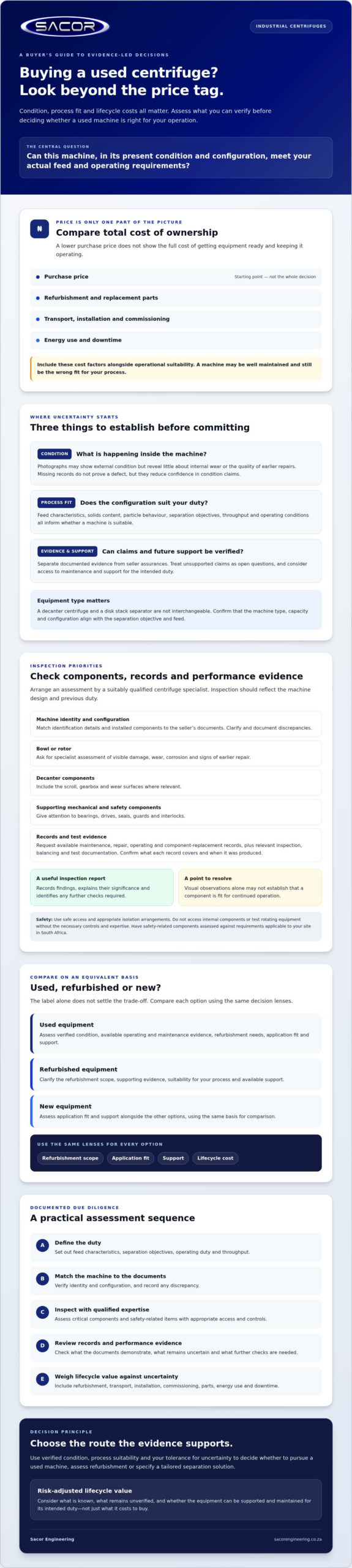
A due-diligence checklist for buying a used industrial centrifuge
Use a documented sequence to move from process needs to a clear purchase decision. The risks of buying used industrial centrifuges are easier to assess when each claim, inspection finding and unresolved question has a defined next step.
How should buyers verify application fit?
Start with your own process data, not the machine’s sales description. Record the feed properties, separation objective, operating pattern and required throughput, then compare them with verified specifications for the exact machine and configuration. For mining processes, the tailings dewatering equipment guide offers relevant application context.
- Define the duty. Document feed characteristics, separation targets, required process capacity and expected operating conditions.
- Verify the machine. Match its identity, configuration and available performance data to the seller’s documents. Resolve gaps between the stated specifications and the machine offered.
- Review the history. Gather available operating, maintenance, repair and component-replacement records. Note missing information as an open issue.
- Arrange technical inspection. Have a suitably qualified centrifuge specialist assess the machine with safe access and isolation arrangements in place. Record findings, their priority and any recommended further checks.
- Agree remedial work and tests. Specify who will complete identified work, what evidence will be supplied and which application-relevant checks must be passed.
- Set acceptance criteria. Write down measurable or otherwise verifiable conditions for acceptance, including how unresolved defects or test results will be handled.
- Assess site readiness separately. Check installation and commissioning requirements against the intended site, utilities, interfaces and operating arrangements. Machine acceptance alone does not confirm site readiness.
Which commercial protections reduce uncertainty?
Before committing, ensure the purchase documents identify the exact machine, included components, stated condition and agreed scope. Record inspection access, responsibility for remedial work, test evidence and acceptance conditions in writing. Clarify which technical support and parts arrangements are available, who provides them and whether they are included in the sale. Do not treat either as included unless the documents say so.
Keep a due-diligence log linking each open question to an evidence request, responsible party and decision. This makes it easier to pause or decline if a critical issue remains unresolved, rather than letting purchase momentum replace engineering judgement.
For an application-led review of centrifuge options, discuss your separation requirements with Sacor Engineering, which supplies and customises industrial centrifuges and separation solutions.
Choose a lower-risk centrifuge route with engineering support
The right purchase route depends on the strength of the condition evidence, how closely the equipment matches your process, the support available and how much uncertainty your operation can tolerate. A used machine may be worth pursuing when its configuration and condition are well evidenced. If important details remain unclear, compare it with professionally refurbished equipment or a newly specified solution before deciding.
- Consider used equipment when inspection findings, records and relevant performance evidence support its suitability, and parts and technical expertise are accessible.
- Assess refurbished equipment when the machine may suit the application but needs condition-led work, with scope and acceptance evidence clearly documented.
- Consider a new or customised solution when available configurations do not meet process requirements or the remaining uncertainty is difficult to accept.
None of these routes guarantees a particular outcome. The risks of buying used industrial centrifuges depend on the specific machine and duty, not simply its age or purchase category. Compare evidence and support arrangements against your operating priorities, including throughput, product quality and continuity.
When should buyers consider refurbishment or a tailored solution?
Refurbishment is worth assessing when an existing centrifuge appears suitable for the process but needs restoration based on its actual condition. A customised separation solution may be more appropriate if standard configurations do not clearly match the feed, separation objective or operating requirements. For decanter-specific selection factors, consult the decanter centrifuge selection criteria guide.
How can Sacor Engineering support the decision?
Sacor Engineering provides centrifuge refurbishment services and supplies and customises industrial centrifuges and separation solutions, including decanter centrifuges, centrifugal separators and disk stack separators. This experience can inform a comparison of condition, refurbishment requirements and process fit, but it does not establish that any particular used machine is suitable. Any recommendation depends on the machine’s condition, your process requirements and the evidence available.
For a technical discussion, share your process requirements and the equipment details you have, such as machine identity, configuration, operating history and inspection records. Discuss your centrifuge requirements with Sacor Engineering to explore which route may align with your application.
Make your centrifuge decision with confidence
The risks of buying used industrial centrifuges are best managed through evidence, not assumptions. Verify the machine’s condition and history, then confirm that its configuration suits your feed, separation objective and operating duty. Compare used, refurbished and new equipment on the same basis, including the work and support required to put it into service.
If inspection identifies restoration needs, professional refurbishment may be worth assessing. If available configurations do not align with your process, a customised separation solution may be a better route. Sacor Engineering provides centrifuge refurbishment and supplies customised industrial separation solutions for mining and food and beverage applications. Any recommendation should reflect the machine’s condition, your process requirements and the evidence available.
Share your process requirements and equipment details to begin a focused technical discussion. Discuss your centrifuge requirements with Sacor Engineering. A clear, documented assessment helps you choose the route that best supports your operation.
Frequently Asked Questions
Are used industrial centrifuges reliable?
A used industrial centrifuge can be reliable when its condition, operating history and suitability for the process are supported by evidence. The risks of buying used industrial centrifuges cannot be judged by age or appearance alone. Review maintenance and repair records, have critical components assessed by a suitably qualified specialist, and compare available performance evidence with your required duty. Record limitations and remedial work before deciding whether to accept the machine for service.
What should I inspect before buying a used industrial centrifuge?
Start by checking the machine’s identity, configuration, operating history and maintenance records. A suitably qualified centrifuge specialist should assess the bowl or rotor, bearings, drives, seals and safety-related components. For a decanter, include the scroll, gearbox and wear surfaces. Request relevant inspection and test documentation, then compare the findings with the seller’s written specification and your process requirements. Document differences and resolve material questions before purchase.
How can I tell whether a centrifuge has been properly refurbished?
Ask for a written refurbishment scope identifying which components were inspected, repaired, replaced or retained, and why. Request dated inspection and test records, including the criteria used to assess the machine. The word “refurbished” alone does not explain the work completed or confirm suitability for your operating duty. Check for remaining limitations, excluded work and outstanding remedial items, then compare the documented results with your application requirements before accepting the equipment.
Is a refurbished centrifuge safer to buy than a used one?
Not automatically. Refurbishment can reduce uncertainty when the work is technically appropriate, clearly documented and supported by relevant testing. However, the label does not confirm which components were assessed or whether the machine suits your process. Compare the refurbishment scope, test evidence and remaining limitations with the findings from an assessment of the used alternative. In either case, have condition and safety-related components reviewed by a suitably qualified specialist before deciding.
What hidden costs should I consider when buying a used centrifuge?
Consider potential inspection, repair and replacement-part requirements, along with transport, installation, commissioning and planned downtime. The work involved depends on the machine’s condition, site requirements and process fit, so generic estimates may not reflect your situation. Record known tasks, unresolved issues and support arrangements, then assess their implications alongside the purchase decision. This gives you a more useful lifecycle comparison than considering the initial price in isolation.
Should I buy a used centrifuge or refurbish my existing machine?
Compare the condition and process fit of your existing machine with the used option, including the evidence available, work required and support you can access. Refurbishment may be worth assessing if your current centrifuge’s configuration remains suitable but its condition needs attention. A used machine may be an option if it matches your duty and has verifiable condition evidence. A technical evaluation can help clarify uncertainties before you commit to either route.
How do I check whether a used centrifuge suits my process?
Define your feed characteristics, separation objectives, operating pattern and required capacity before comparing equipment. Then check those requirements against verified specifications for the exact machine and configuration, not a general product description. Decanter centrifuges and disk stack separators have different designs and separation roles, so assess the characteristics relevant to your application. Ask a technical specialist to review missing data, assumptions or any mismatch between the specifications and your process.