

The most cost-effective route to securing “as-new” separation performance isn’t always found in a new equipment catalogue. When an existing decanter or disk stack separator begins to show signs of degrading efficiency or frequent mechanical failure, the instinct is often to brace for a heavy capital expenditure. However, a strategic programme of industrial centrifuge life extension through professional refurbishment can often achieve the same operational benchmarks for a fraction of the cost.
We understand that unplanned downtime and the rising price of new machinery put immense pressure on your operational budget. It’s frustrating to watch a once-reliable asset become a liability. This guide will demonstrate how professional refurbishment transforms ageing machinery back into high-precision assets, effectively reducing your total cost of ownership. We’ll explore the technical stages of the restoration process and how customisation during refurbishment can even surpass the machine’s original specifications whilst ensuring long-term reliability.
Key Takeaways
- Learn how a systematic engineering overhaul restores high-speed separation machinery to “as-new” performance levels.
- Understand the strategic financial advantages of refurbishment by comparing capital expenditure with reduced operational costs and shorter lead times.
- Discover the critical role of non-destructive testing in identifying hidden structural fatigue and ensuring the long-term safety of rotating components.
- Implement a comprehensive programme for industrial centrifuge life extension to restore peak efficiency whilst significantly lowering your total cost of ownership.
- Identify the proactive maintenance strategies and high-quality spare parts essential for maximising the reliability of your decanter or disk stack separator.
Understanding Industrial Centrifuge Wear and the Need for Life Extension
Industrial centrifuges are high-precision engineering assets designed to withstand immense gravitational forces. Over years of continuous operation, however, the structural integrity of these machines inevitably begins to decline. We define industrial centrifuge life extension as a comprehensive engineering overhaul that goes far beyond routine servicing to restore ageing machinery to its original factory specifications. This process targets the primary drivers of mechanical failure, specifically abrasion, corrosion, and material fatigue within high-speed rotating components. When these factors are left unaddressed, separation efficiency drops significantly, forcing the motor to work harder and increasing energy consumption. Industrial centrifuge life extension is a strategic alternative to capital replacement, providing a cost-effective pathway to operational excellence.
The Mechanics of Wear in Decanter Centrifuges
In decanter centrifuges, the constant movement of abrasive slurries acts like liquid sandpaper on internal surfaces. This erosion typically targets the scroll flights and bowl liners, gradually stripping away the protective hard-facing and altering the internal geometry required for precise separation. Vibration is another silent killer of efficiency. Even a microscopic imbalance in the rotating assembly can accelerate bearing and gearbox failure, leading to a cascade of mechanical issues. In specialised sectors like food and beverage processing, the challenge shifts toward chemical corrosion. Constant exposure to acidic products or aggressive cleaning chemicals can compromise stainless steel components, leading to pitting that weakens the metal. Understanding the specific operating principles of Industrial Centrifuges helps in diagnosing these complex wear patterns before they result in catastrophic failure.
Signs Your Separation Machinery Requires Professional Refurbishment
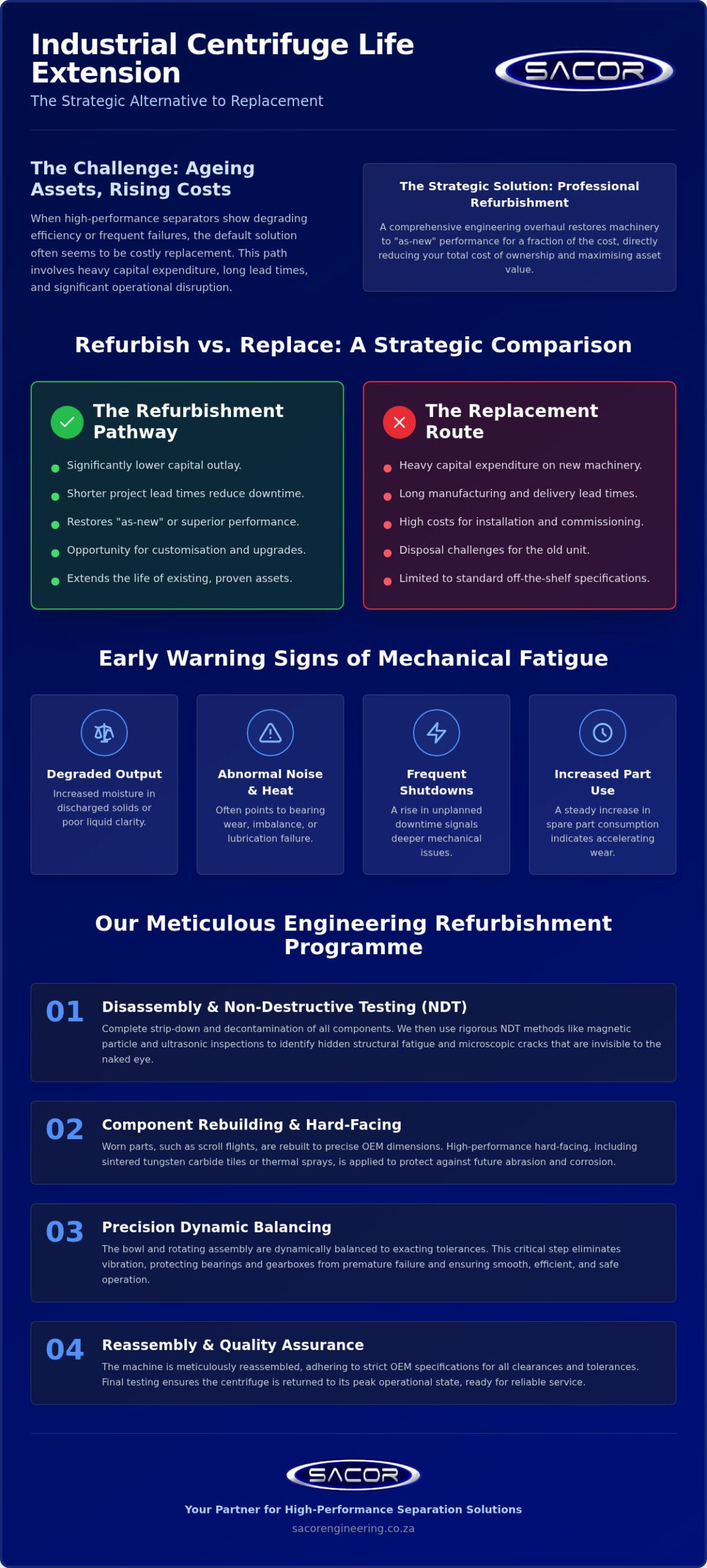
Recognising the early symptoms of mechanical fatigue can save your facility from a total production halt. A primary indicator is a degradation in output quality, such as increased moisture content in the discharged cake or solids. This suggests the conveyor is no longer effectively removing the liquid from the slurry. Operators should also be vigilant regarding abnormal noise levels or excessive heat generation during a shift. These symptoms often point to bearing wear or lubrication failure within the gearbox. If your maintenance team reports frequent unplanned shutdowns or a steady rise in the consumption of spare parts, it’s unlikely that basic repairs will suffice. At this stage, a professional refurbishment is the only reliable way to restore the machine’s “as-new” performance and secure its future operational life.
The Engineering Mechanics of Centrifuge Refurbishment Services
Refurbishing high-performance separation machinery requires a methodical engineering approach that mirrors the original manufacturing process. It begins with a complete strip-down and thorough decontamination of all wetted parts. We then employ rigorous non-destructive testing (NDT) protocols, including magnetic particle and ultrasonic inspections, to identify hidden structural fatigue or microscopic cracks. These flaws, if left undetected, pose a severe risk during high-speed rotation. By adhering to strict original equipment manufacturer (OEM) tolerances, we ensure the machine returns to its peak operational state. This engineering phase is also the ideal time to integrate customised separation solutions, where we can modify the internal configuration to better suit your evolving production needs.
Centrifuge Scroll Refurbishment and Hard-Facing
The scroll conveyor is fundamental to solids transport and overall separation efficiency. During an industrial centrifuge life extension programme, our engineers rebuild worn scroll flights to their precise original dimensions using specialised welding techniques. To ensure longevity against abrasive slurries, we apply high-performance hard-facing, such as sintered tungsten carbide tiles or thermally sprayed coatings. The precision of this rebuild is critical; even minor deviations in flight height or pitch can disrupt the laminar flow and reduce solids recovery rates. For a detailed examination of the metallurgical methods and exact tolerances involved, our guide to professional centrifuge scroll refurbishment techniques outlines the full restoration process from initial assessment through to completion. A correctly restored scroll ensures the machine maintains the necessary torque and differential speed for optimal performance.
Bowl Repair and Precision Dynamic Balancing
A centrifuge bowl operating at high G-force must maintain perfect rotational symmetry to function safely. We utilise advanced dynamic balancing equipment to eliminate operational vibration, which otherwise leads to rapid bearing degradation and structural stress. Professional centrifuge bowl balancing services are a fundamental requirement for operational safety, as an unbalanced bowl can cause critical bearings to fail three to five times faster than a properly calibrated machine. The refurbishment process also involves precision machining of bowl hubs, seal faces, and wear liners to ensure a perfectly airtight and leak-proof operation. A meticulously balanced bowl doesn’t just run quieter; it extends the operational life of the entire drive train, ensuring the machine remains reliable under the most demanding industrial conditions.
Gearbox Overhaul and Bearing Replacement
The gearbox is a complex, high-torque assembly that requires expert calibration and deep technical knowledge. Our overhaul process involves a complete internal inspection of the planetary or cycloidal gears and the replacement of all seals with upgraded, chemically resistant materials. We only use high-grade bearings specifically rated for the high radial and axial loads found in continuous centrifugal separation. These technical upgrades, combined with enhanced lubrication systems, significantly reduce the risk of premature failure and ensure the gearbox can handle the rigours of modern industrial workflows without frequent intervention.
Refurbish vs. Replace: A Strategic Framework for Asset Managers
Asset managers often face a difficult choice when separation efficiency begins to wane. The decision between investing in new machinery or committing to a programme of industrial centrifuge life extension requires a balanced analysis of financial and operational factors. A new industrial centrifuge represents a significant capital expenditure (CAPEX), often involving lengthy approval cycles and complex financing. Refurbishment, however, is typically categorised as operational expenditure (OPEX). This allows for faster financial approval and more flexible budget management. Beyond the initial cost, lead times for new machinery are currently substantial, whereas a professional overhaul can be completed in a fraction of the time, ensuring your facility returns to full capacity much sooner.
Refurbishing also supports corporate sustainability goals. By reusing the heavy structural components of the machine, you significantly reduce the carbon footprint associated with manufacturing and transporting new high-speed equipment. This process isn’t just about repair; it’s an opportunity for modernisation. Integrating contemporary control systems and advanced sensors during refurbishment can bring older units in line with the latest automation standards, improving both safety and data collection capabilities.
Calculating the ROI of Centrifuge Life Extension
To determine the true return on investment, we recommend evaluating the cost-per-tonne of separation. If an ageing machine consumes excessive energy or fails to recover solids efficiently, the operational costs quickly become unsustainable. Refurbishment restores these efficiencies, often paying for itself through reduced energy consumption and improved product recovery. Managers should also calculate the value of avoided production downtime. If a new unit takes several months to arrive, the lost revenue during that period can be staggering. Finally, it’s worth considering the tax implications; expensing a refurbishment as maintenance can sometimes offer more immediate relief than the multi-year depreciation of a new capital asset.
When is Replacement the Only Option?
While most machines are excellent candidates for restoration, certain red flags indicate that replacement is the only viable path. Catastrophic structural failure, such as severe cracking in the main bowl or frame that exceeds safe engineering limits, is a primary concern. Obsolete technology also plays a role. If the original manufacturer no longer exists and spare parts are entirely unavailable, maintaining the unit becomes an unacceptable operational risk. If your process requirements have changed significantly, such as a massive increase in throughput that the current frame cannot accommodate, then exploring the decanter centrifuge selection criteria for a new unit is necessary. We act as a consultative partner to help you identify when a machine has truly reached the end of its safe operational life. Organisations evaluating new equipment procurement can also benefit from reviewing the latest guidance on decanter centrifuge suppliers South Africa to understand how bespoke engineering partnerships differ from standard vendor relationships.
Proactive Maintenance Strategies to Maximise Operational Lifespan
Implementing a rigorous preventative maintenance programme’s the most effective way to protect your engineering investment. Whilst industrial centrifuge life extension provides a vital reset for ageing machinery, consistent care ensures these restored assets reach their full potential. This starts with the uncompromising use of high-quality industrial centrifuge spare parts. Choosing sub-standard components might save costs initially, but it often leads to accelerated wear on the entire rotating assembly. Operator training’s equally critical; an informed team can prevent mechanical abuse by recognising the subtle shifts in machine behaviour that signal an impending issue. Regular technical audits by seasoned engineers serve as a final layer of protection, catching minor misalignments before they escalate into expensive failures.
Predictive Maintenance and Condition Monitoring
Modern separation technology allows us to move beyond simple schedules into the territory of predictive health monitoring. Vibration analysis and regular oil sampling provide a clear window into the internal condition of bearings and gearboxes without requiring a full shutdown. By integrating advanced centrifuge control systems, your technical team can receive real-time alerts if operational parameters deviate from the norm. This data-driven approach transforms maintenance from a reactive chore into a strategic advantage. Continuous 24/7 monitoring significantly reduces the risk of catastrophic failure by identifying thermal or rotational anomalies before they cause permanent damage.
Optimising Feed Conditions for Wear Protection
The longevity of internal components’s heavily influenced by the quality of the material being processed. Effective pre-treatment and grit removal are essential for protecting the bowl and scroll from premature erosion. High concentrations of abrasive solids can strip away hard-facing much faster than anticipated. Maintaining a consistent feed concentration ensures stable operation and prevents the torque spikes that strain the gearbox. This level of feed management’s particularly vital for tailings dewatering equipment, where the material’s inherently aggressive. By controlling the input, you directly extend the interval between major overhauls.
To keep your machinery in peak condition, you can book a technical audit with our engineering specialists to identify potential efficiency gains.
Partnering with Sacor Engineering for High-Performance Separation
Sacor Engineering serves as a trusted expert guide for organisations seeking to optimise their separation processes across South Africa. We don’t just provide mechanical repairs; we offer a consultative partnership designed to align your existing assets with your long-term operational goals. By choosing a specialist in industrial centrifuge life extension, you ensure that every component is evaluated through the lens of precision engineering and mechanical reliability. Our approach centres on restoring maximum efficiency whilst significantly reducing the capital burden associated with equipment replacement. We believe that a well-executed refurbishment is a strategic investment in your facility’s future productivity.
Expert Refurbishment for Mining and Food Sectors
Mining operations and food producers face distinct challenges that require specialised technical knowledge. In the mining sector, our expertise in tailings dewatering equipment allows us to refurbish machinery to withstand the most abrasive environments found in mineral processing. For the food and beverage industry, we focus on maintaining the highest standards of hygiene and separation precision in disk stack separators and decanters. A key advantage of our service is the ability to customise separation technology during the refurbishment process. This means your “as-new” machine can be engineered to perform better than it did on its first day of operation, specifically tailored to the unique demands of the South African industrial landscape. Our commitment to engineering tradition ensures that every refurbished unit meets the most rigorous performance benchmarks. For producers in the wine industry, a refurbished centrifuge for wine clarification can recover significantly more juice whilst reducing reliance on traditional sedimentation methods.
Get Started with a Technical Assessment
The journey toward restored performance begins with a comprehensive technical assessment of your current machinery. Our engineering team conducts a thorough audit of your existing centrifugal equipment to identify performance bottlenecks and mechanical vulnerabilities. This data-driven evaluation allows us to pinpoint exactly where efficiency is being lost and where structural integrity might be compromised. Following this assessment, we provide a tailored refurbishment proposal that outlines the specific engineering steps required to achieve your desired outcomes. This structured process ensures complete transparency and allows your team to plan for a scheduled overhaul rather than reacting to an unplanned and costly failure.
If you’re ready to enhance the reliability of your separation workflow and reduce your total cost of ownership, our specialists are available to discuss your specific requirements. We invite you to contact our engineering team today to schedule your professional technical audit and take the first step toward securing the long-term operational life of your industrial assets.
Securing the Future of Your Separation Infrastructure
Refurbishing ageing machinery is a strategic engineering decision that transcends simple repair. It offers a clear pathway to restoring peak performance whilst protecting your capital budget from the high costs and long lead times associated with new equipment. By prioritising a programme of industrial centrifuge life extension, you transform a degrading asset back into a reliable, high-precision tool. We’ve explored how precision balancing, advanced metallurgy, and proactive condition monitoring work together to ensure your decanter or disk stack separator remains a productive part of your workflow for years to come.
As specialists in high-speed centrifugal separators, we provide comprehensive technical support across South Africa. Our team brings deep expertise in both decanter and disk stack technology to every project, ensuring your specific industrial needs are met with engineering excellence. Don’t wait for a mechanical failure to disrupt your production schedule. Take a proactive step toward operational stability and restore your separation efficiency with Sacor Engineering refurbishment services. We’re here to help you achieve long-term success through dependable mechanical reliability.
Frequently Asked Questions
What is the typical lifespan of an industrial decanter centrifuge?
An industrial decanter centrifuge typically has an operational lifespan of 15 to 20 years, though this can be extended significantly through professional engineering. The actual duration depends heavily on the abrasiveness of the processed material and the rigour of the preventative maintenance programme. Regular inspections ensure that structural components remain within safe tolerances. By committing to an industrial centrifuge life extension programme, many operators successfully maintain peak performance well beyond the two-decade mark.
How much can I save by refurbishing a centrifuge instead of buying new?
Refurbishing a centrifuge can offer substantial savings, often costing significantly less than a new capital purchase. A widely used industry benchmark suggests that if the cost of an overhaul is less than 50% of the replacement value, refurbishment is the more strategic financial decision. This approach allows facilities to restore “as-new” performance whilst avoiding the heavy capital expenditure and lengthy approval processes associated with procuring entirely new separation machinery for their operations.
How long does a professional centrifuge refurbishment service take?
The duration of a professional centrifuge refurbishment typically ranges from a few weeks to a couple of months, depending on the complexity of the mechanical repairs required. This is considerably faster than the current lead times for new industrial equipment, which can often stretch to several months or even a year. A scheduled overhaul allows for planned downtime, ensuring that your production schedule is protected whilst the machinery is restored to factory specifications.
Can an older centrifuge be upgraded with modern features during refurbishment?
Yes, older centrifuges are excellent candidates for technological upgrades during the refurbishment process. We can integrate modern control systems, advanced vibration sensors, and automated lubrication units to bring legacy models in line with current industry standards. These enhancements improve data collection and operational safety, allowing older machines to operate with the same precision and efficiency as contemporary models. It’s a cost-effective way to modernise your facility’s separation capabilities.
What types of centrifuges are eligible for life extension programmes?
Most high-speed separation machinery is eligible for life extension programmes, including decanter centrifuges, disk stack separators, and centrifugal separators. Whether the equipment’s used for tailings dewatering in mining or liquid-solid separation in the food and beverage sector, the core engineering principles of restoration remain applicable. Our specialists evaluate the structural integrity of the bowl and frame to ensure the machine can safely return to high-speed operation after the overhaul’s complete.
Is it possible to refurbish a centrifuge that has been out of service for years?
It’s entirely possible to refurbish a centrifuge that has been out of service for several years, provided the main structural components remain sound. We perform rigorous non-destructive testing (NDT) to check for deep-seated corrosion or cracks that might’ve developed during storage. If the core frame and bowl are intact, we can replace all seals, bearings, and electrical components, effectively breathing new life into an idle asset and returning it to full productivity.
How often should a centrifuge bowl be dynamically balanced?
A centrifuge bowl should be professionally balanced during every major overhaul or whenever vibration levels exceed the manufacturer’s specified limits. High-speed rotation generates immense centrifugal forces; even a minor imbalance can lead to rapid bearing wear and potential structural failure. Regular condition monitoring via vibration analysis helps identify when rebalancing’s necessary. Ensuring the bowl’s perfectly balanced is critical for maintaining mechanical reliability and extending the machine’s overall operational lifespan. Learn more about the technical standards and procedures involved in professional centrifuge bowl balancing services to understand how ISO 21940-11 compliance protects your rotating assets.
What are the most common parts replaced during a centrifuge overhaul?
The most common parts replaced during a comprehensive overhaul include high-grade bearings, elastomeric seals, and specialised wear protection components. We frequently replace or rebuild tungsten carbide tiles on the scroll flights to restore solids transport efficiency. Gearbox components, such as planetary gears and drive belts, are also carefully inspected and replaced if they show signs of fatigue. Using high-quality industrial centrifuge spare parts during this process is essential for ensuring long-term reliability.