
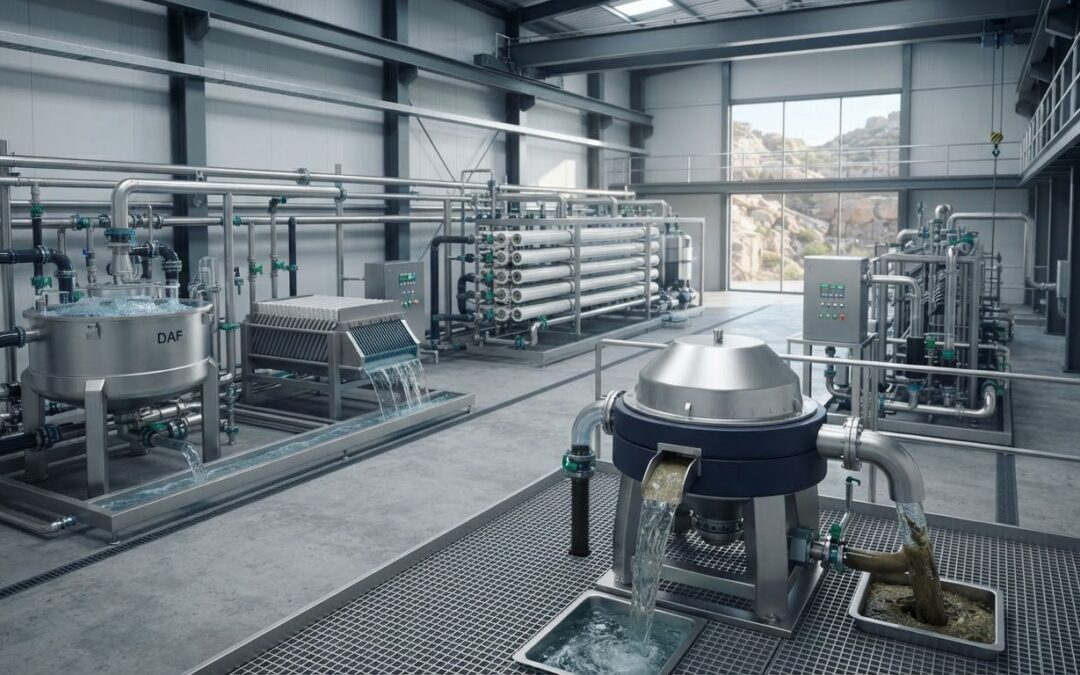
A larger sedimentation tank isn’t always the right answer when a process needs more throughput, a smaller footprint or a different separation result. The alternatives to traditional sedimentation tanks use different separation principles, so the right choice depends on the feed, the required output and how separated solids will be handled.
Start with the material being processed, not a technology label. Particle size, solids concentration, liquid properties and changes in feed composition all affect separation. Define the required liquid quality or solids concentration, then consider flow rate, available space, operating demands and downstream handling.
This guide compares dissolved air flotation, membrane filtration, lamella clarification and centrifugal separation. It explains what each method does, the kinds of separation duties it may suit and the trade-offs to assess. You’ll also find a practical selection process and guidance on where decanter centrifuges or disk stack separators could complement or replace a settling stage.
Key Takeaways
- Assess alternatives to traditional sedimentation tanks by matching the separation method to the feed, solids and process objective.
- Compare flotation, filtration, lamella clarification and centrifugal separation by how they separate material and the outputs they produce.
- Consider footprint and solids handling alongside separation performance when weighing process fit.
- Use a structured selection process: define the objective, characterise the feed, set constraints, shortlist options and validate the preferred approach.
- Explore where decanter centrifuges or disk stack separators may fit, while accounting for equipment complexity, maintenance and downstream solids handling.
Why consider alternatives to traditional sedimentation tanks?
Conventional sedimentation separates suspended solids from liquid using gravity. Particles settle, clarified liquid is drawn from the upper zone and accumulated solids are removed from the bottom. The principle is straightforward, but performance depends on the feed and process conditions. Particle size, density and concentration influence settling behaviour. Flow rate and available residence time determine how long particles have to settle before liquid leaves the tank.
Alternatives to traditional sedimentation tanks are worth assessing when output is inconsistent, the feed changes, or land and throughput constraints limit the settling stage. The right response may be to replace settling, add another step before or after it, or improve the wider process. The duty matters: separating solids from dilute wastewater is different from concentrating a process slurry or dewatering mining tailings. For a broad overview of industrial separation processes, see the range of methods used to separate materials in industrial settings.
What can limit a conventional sedimentation tank?
Changes in feed composition can affect how quickly particles settle and how consistently solids collect. Fine or low-density particles may remain suspended for longer, while a change in solids concentration can alter the behaviour of the mixture. A tank designed around one feed condition may therefore produce variable results when the feed changes.
Gravity separation also needs sufficient tank area and residence time. If either is constrained, the process may not meet its separation objective at the required flow. The tank may not be the only cause: upstream changes to the feed or downstream limits on solids removal can also affect performance. Identify whether the constraint lies in settling, feed preparation or solids handling before choosing a replacement.
Start with the separation duty, not a technology label
Define the result the process needs. Is the priority clearer liquid, more concentrated solids, recovery of a useful fraction, or a combination? Then characterise the feed and how it varies. Dilute wastewater, process slurry and mining tailings present different separation duties, even when all contain suspended solids.
Next, map where the separated liquid and solids go. A change in solids concentration or discharge consistency can affect conveyance, storage and further processing. Use representative feed data and assess performance under relevant operating conditions before making a process change. This helps determine whether an alternative should replace settling, operate alongside it or prepare the feed for a later separation stage.
Which alternatives to traditional sedimentation tanks suit different solids?
Alternatives to traditional sedimentation tanks use different physical principles and produce different liquid and solids outputs. Dissolved air flotation (DAF), filtration, lamella clarification and centrifugal separation each suit particular feed conditions and objectives. None is a universal replacement. Compare the material being separated, the required result and the way the process operates.
Flotation, lamella clarification and filtration
DAF releases fine air bubbles into the liquid. Suspended particles, oils and other material that attach to the bubbles rise to the surface, where they can be removed as a floating layer. It may suit feeds with buoyant or difficult-to-settle material when the feed and process conditions support effective bubble attachment. Consider where the floated solids will be collected and how they will be handled.
Lamella clarifiers use inclined plates to provide additional settling surfaces in a compact arrangement. Solids still separate under gravity, so this is a variation on conventional clarification rather than a different separation principle. Consider a lamella arrangement when gravity settling suits the feed but space or settling capacity is a constraint. Performance still depends on feed behaviour and system design.
Filtration passes liquid through a porous medium that retains solids. The medium, its opening size and operating conditions determine what is captured. As solids accumulate, they can restrict flow, so cleaning or media replacement may be part of operation. Filtration may suit a process that needs a defined level of particle removal, but assess media selection, solids loading and fouling behaviour together.
Centrifugal separation for industrial slurries
Centrifuges use rotational motion to separate material according to differences in density. A decanter centrifuge can perform continuous solid-liquid separation, conveying separated solids towards discharge. It may suit industrial slurries where continuous processing and a concentrated solids output are important, including some mining tailings dewatering duties.
A disk stack separator is generally used for liquid clarification and separation duties where handling a large solids load is not the primary requirement. Choose between centrifuge types based on the feed, required liquid clarity and solids output. In food and beverage processing, the objective may be to clarify a liquid or recover a product fraction, so the duty should guide equipment selection.
Sacor Engineering supplies and customises decanter centrifuges, centrifugal separators and related processing equipment for industrial separation requirements, including mining and food and beverage applications. Explore tailored separation solutions to match equipment to the process duty.
Monitoring and automation can help operators track conditions, alarms and performance, but they don’t change the physical separation mechanism. They support operation; the separation equipment determines how solids and liquid are divided.
Sedimentation tanks versus alternatives: compare performance and process fit
Each method separates solids differently. Compare the output and operating demands as well as the mechanism. This table is a starting point, not a performance ranking. Actual results depend on feed characteristics, equipment design and operating conditions.
| Method | Mechanism and likely process fit | Footprint considerations | Typical solids output |
|---|---|---|---|
| Sedimentation | Gravity settling; suited to feeds where suspended particles can settle within the available process time. | Tank area and residence time influence layout and capacity. | Settled sludge removed from the tank. |
| Flotation | Particles attach to rising bubbles; may suit certain suspended solids, oils or buoyant material. | Assess the flotation unit and its associated feed, air and solids-removal arrangements. | Floated solids skimmed from the surface. |
| Filtration | Liquid passes through a medium that retains solids; useful where the required separation suits the selected medium. | Allow for the filter, access and any cleaning or media-handling requirements. | Retained solids, which may form a filter cake. |
| Centrifugal separation | Rotational force separates material by density; may suit continuous industrial solid-liquid duties. | Consider the equipment and the space needed for feed, discharge and maintenance access. | Solids discharged from the centrifuge, with concentration depending on feed and operating conditions. |
Compare separation outcomes and solids handling
The output affects more than the separation stage. Settled sludge, floated material, filter cake and centrifuge-discharged solids differ in consistency and handling needs. Trace each stream to its next step: conveyance, storage, further processing or disposal. Don’t assume a target solids concentration or liquid clarity from the technology name alone. Quantified results require representative feed data and validation under relevant conditions.
Compare footprint, operation and lifecycle considerations
Available installation space matters, but so do throughput, process continuity and access for operation and maintenance. Sedimentation requires sludge management; flotation systems need bubble generation and surface solids removal; filters may need cleaning or media replacement; centrifuges require attention to wear and maintenance. None is maintenance-free. Assess these demands alongside process integration and equipment lifecycle rather than relying on purchase decisions or generic cost ranges alone.
Use the comparison to shortlist alternatives to traditional sedimentation tanks that match your duty. Check the shortlist against feed behaviour, required outputs and operating conditions before changing the process.
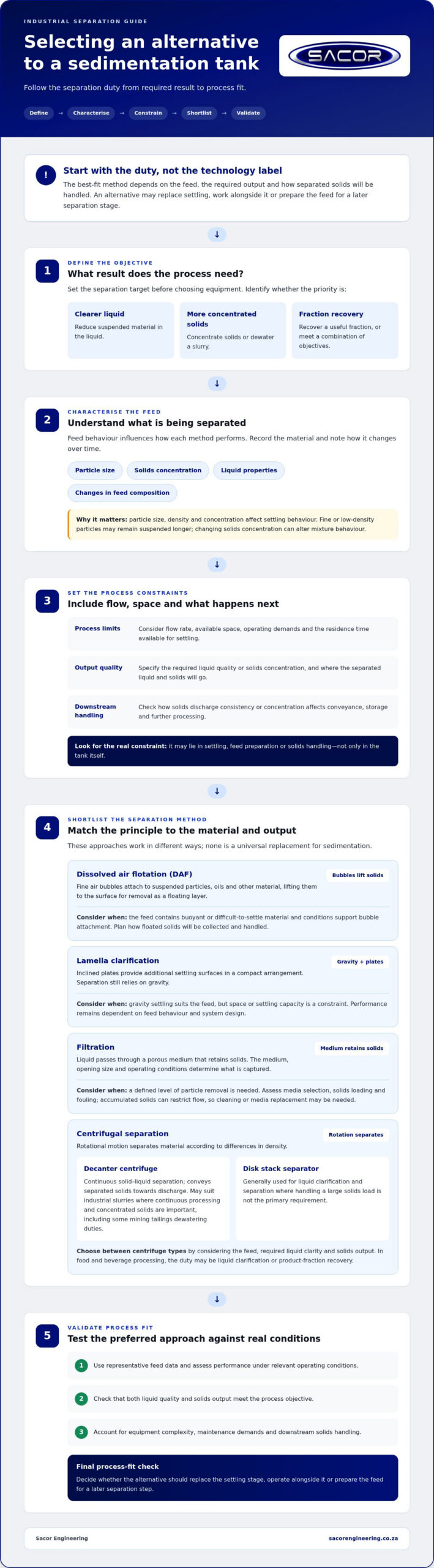
Selecting a sedimentation tank alternative for your process
A reliable selection starts with the separation duty, then tests whether the technology can meet it under actual operating conditions. Use this five-step framework to compare alternatives to traditional sedimentation tanks without choosing by equipment label alone.
- Define the objective. Specify whether you need clearer liquid, more concentrated solids, recovery of a useful material or preparation for a downstream process.
- Characterise the feed. Record flow rate, solids concentration, particle size and characteristics, and how these vary over time. Use measured data where available, and mark assumptions clearly.
- Set the constraints. Document available installation space, utilities, throughput, process continuity, operator capability and maintenance requirements. Include how separated solids and liquid will be handled downstream.
- Shortlist suitable methods. Match the feed and target output to plausible separation approaches. Decide whether a technology should replace, supplement or precede settling.
- Validate the choice. Use representative feed testing or an engineering review to assess expected outputs and integration requirements before committing to a full-scale change.
In short: define the separation objective, characterise the feed, set site and operating constraints, shortlist suitable technologies, then validate the preferred option.
Characterise the feed and define the target output
Useful feed data includes flow conditions, solids loading, particle size and the degree of variation between normal and changing operating conditions. Define the required liquid quality, solids concentration, recovery or disposal objective alongside those inputs. Keep measured process data distinct from estimates. An unverified assumption about particle behaviour, for example, can lead to an unsuitable shortlist. If the feed varies, record that variation rather than relying on a single sample or operating snapshot.
Assess integration, validation and operating needs
Review how a proposed system would connect to existing equipment, utilities and downstream solids handling. A separation stage that meets its own target may still create a problem if its discharge is difficult to convey, store or process. Account for installation access, maintenance tasks, operator requirements and the availability needed from the overall process. Testing with representative material or a detailed engineering assessment can help establish whether the proposed separation duty fits actual operating conditions.
If a centrifuge is on your shortlist, explore these decanter centrifuge selection criteria to assess its fit against your process requirements. For tailored industrial separation equipment, discuss your separation requirements with Sacor Engineering.
Where centrifugal separation fits among sedimentation tank alternatives
Centrifugal separation is one of the alternatives to traditional sedimentation tanks when the feed and process objective suit separation by rotational force. It isn’t a universal replacement for gravity settling. Assess solids loading, particle behaviour, required liquid quality and the solids discharge needed by the rest of the process.
A decanter centrifuge can support continuous solid-liquid separation, conveying separated solids towards discharge. This can be relevant when a process needs a continuous feed and a concentrated solids stream. Consider whether the discharged solids can be transferred, stored or processed effectively downstream, and how the separated liquid will be managed.
When a decanter centrifuge may be a suitable option
Mining tailings dewatering is one industrial duty where centrifuge selection can be assessed against the feed and solids-handling objective. The same principle applies in food and beverage processing, where the duty may involve separating solids from a process stream. In both cases, feed variation and the required output should guide equipment assessment. For mining-specific context, see this tailings dewatering equipment guide.
Compared with settling equipment, a centrifuge introduces rotating machinery and associated operating and maintenance requirements. Include wear, maintenance access, operator capability and integration with existing equipment in the assessment. Solids handling matters too: a concentrated discharge is useful only if downstream systems can manage it reliably.
Plan for equipment performance over its working life
Technology selection should account for more than initial process fit. Maintenance planning helps identify the inspection and upkeep needed to support continued operation. Refurbishment may also be relevant when assessing existing centrifuge equipment as part of lifecycle planning. The appropriate approach depends on equipment condition and process duty. Read the industrial centrifuge refurbishment guide for further lifecycle considerations.
Sacor Engineering supplies and customises decanter centrifuges, centrifugal separators and tailored separation solutions for industrial applications, including mining and food and beverage processing. Share your feed characteristics, separation objective and solids-handling requirements to discuss an industrial separation solution suited to your process.
Choose a separation approach that fits your process
The right alternative to settling depends on the separation duty, feed characteristics and what happens to the separated solids and liquid next. Compare options against the required output, available space, throughput and operating needs. Validate the shortlist against representative process information before making a full-scale change.
Centrifugal separation may suit industrial processes where continuous solid-liquid separation aligns with the feed and solids-handling requirements. Sacor Engineering supplies and customises decanter centrifuges and centrifugal separators for applications including mining and food and beverage processing. Centrifuge refurbishment and maintenance support can also inform equipment lifecycle planning.
Ready to assess an equipment option against your process objectives? Discuss your industrial separation requirements with Sacor Engineering. A clear understanding of your feed, target output and operating priorities is a practical starting point for a suitable separation solution.
Frequently Asked Questions
What are the main alternatives to traditional sedimentation tanks?
The main options include dissolved air flotation, filtration, lamella clarification and centrifugal separation. Flotation uses bubbles to carry suitable particles to the surface; filtration retains solids in a medium; and centrifuges use rotational force to separate solids and liquid. Lamella clarifiers increase settling surface area but still rely on gravity. The right option depends on the feed, target output, available space and how separated solids will be handled.
Is a centrifuge better than a sedimentation tank?
Not in every process. A centrifuge may suit continuous solid-liquid separation when feed characteristics and the required solids discharge align with centrifugal separation. A sedimentation tank may remain appropriate where particles settle adequately and the process can accommodate its residence-time and space requirements. Compare both against flow rate, solids concentration, required liquid quality, maintenance needs and downstream handling. Representative feed testing or engineering assessment can help establish the better fit.
How does dissolved air flotation differ from sedimentation?
Dissolved air flotation separates material by attaching suitable suspended particles to fine bubbles, which rise and form a surface layer for removal. Sedimentation relies on gravity to move settleable particles downwards, where they collect as sludge. The methods produce solids in different locations and forms. Flotation may suit feeds containing oils or particles that don’t settle readily, but suitability depends on feed behaviour and the required process output.
Can a lamella clarifier replace a traditional sedimentation tank?
A lamella clarifier can provide a compact arrangement for gravity settling, but it doesn’t use a fundamentally different separation principle. Inclined plates provide additional settling surfaces within the unit. Whether it can replace a conventional tank depends on the feed, required throughput, settling behaviour, site layout and solids-removal arrangements. Assess these conditions together rather than assuming the clarifier will deliver a particular result based on its configuration alone.
What information is needed to choose a sedimentation tank alternative?
Start with the separation objective: define the required liquid quality, solids concentration, material recovery or disposal outcome. Then record flow rate, solids loading, particle characteristics and how the feed varies, using measured data where available. Include site space, utilities, process continuity, maintenance needs and downstream handling for both liquid and solids. Mark assumptions clearly. Feed testing or an engineering review can help validate a shortlist before a full-scale process change.
Are sedimentation tank alternatives suitable for mining tailings?
Some alternatives may suit mining tailings, depending on their characteristics and the dewatering objective. A decanter centrifuge can be considered where continuous solid-liquid separation and concentrated solids discharge fit the process. The discharge must also be manageable within the downstream system. Sacor Engineering supplies tailings dewatering equipment and customised centrifugal separation solutions for industrial applications. Select equipment based on representative feed information and assessment of the intended process conditions.