
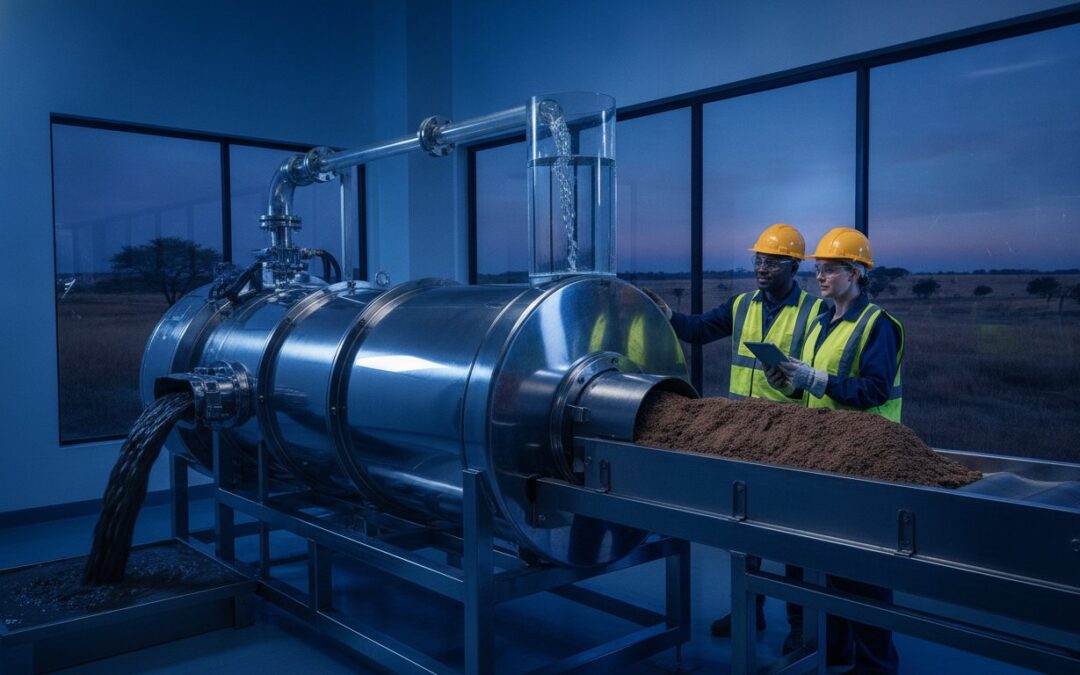
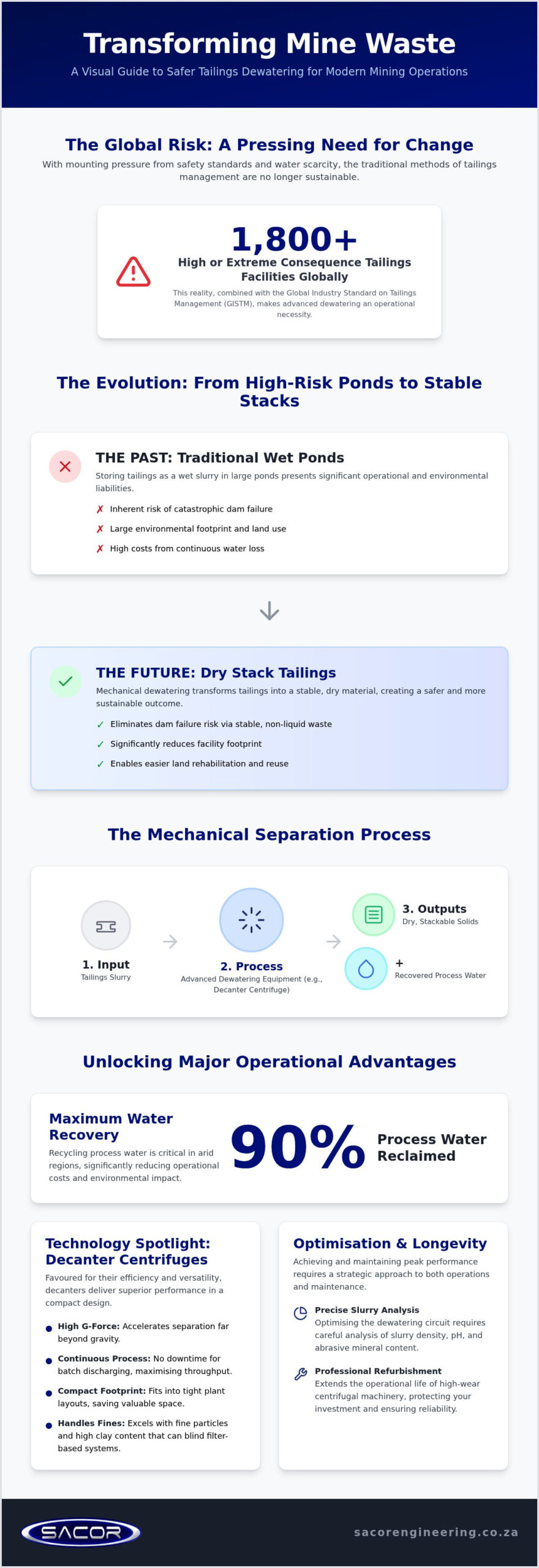
More than 1,800 tailings storage facilities globally are currently classified as high or extreme consequence structures, a reality that places immense pressure on South African mining operations to evolve. You likely recognise the mounting tension between maintaining safety standards and managing the high costs of water loss in our arid regions. With the Global Industry Standard on Tailings Management (GISTM) now a firm benchmark, the risk of traditional wet ponds is becoming an operational liability you can no longer ignore.
This guide demonstrates how modern tailings dewatering equipment transforms hazardous mine waste into stable, dry-stackable material whilst recovering critical process water for immediate reuse. We’ll explore the mechanical separation technologies, including decanter centrifuges and thickeners, that allow you to reclaim land and reduce environmental risk. You’ll discover a strategic path toward higher water recovery rates and a stable waste product that ensures your site remains compliant and efficient throughout 2026 and beyond.
Key Takeaways
- Learn how to mitigate environmental liability by transitioning from traditional wet slurry storage to advanced mechanical separation methods.
- Evaluate the performance of different tailings dewatering equipment, comparing decanter centrifuges against filter presses to maximise water recovery.
- Discover how to recover up to 90% of process water, significantly reducing operational costs in water-scarce South African mining regions.
- Gain insights into optimising your dewatering circuit through precise slurry analysis of density, pH, and abrasive mineral content.
- Understand the financial and operational advantages of professional refurbishment services to extend the life of high-wear centrifugal machinery.
Understanding Tailings and the Critical Need for Dewatering
Tailings are the inevitable byproduct of mineral extraction. They consist of finely ground rock, process water, and chemical reagents used during the separation of valuable minerals from ore. Understanding Tailings is essential for any site manager, as these materials present significant storage challenges. Traditionally, mines stored this waste as a wet slurry in large ponds. This method carries inherent physical and environmental risks, particularly regarding the stability of upstream dams. In South Africa’s mining heartlands, where land is scarce and water costs are rising, the shift toward more efficient tailings dewatering equipment is a matter of both safety and fiscal responsibility.
Recovering process water directly reduces the intake from local utilities. For a large-scale operation, the ability to recycle water can save millions of Rands annually. Beyond the balance sheet, dewatering is the primary catalyst for achieving “Dry Stack” tailings management. This approach eliminates the risk of catastrophic dam failure by creating a stable, non-liquid waste product that you can stack and rehabilitate more easily. It’s a proactive strategy that addresses the long-term environmental liability of the mine site.
The Evolution from Wet Ponds to Dry Stacking
The Global Industry Standard on Tailings Management (GISTM) has fundamentally changed how we view waste storage. To meet these benchmarks by 2026, mines are moving away from liquid slurry toward paste and filtered tailings. Slurry is easily pumped but requires massive containment. Paste has a lower water content but remains unstable. Filtered tailings, however, are dry enough to be moved by conveyor and stacked. This transition significantly reduces the facility’s footprint and virtually removes the threat of liquefaction during seismic events or heavy rainfall.
The Role of Mechanical Separation in Modern Mining
Gravity thickening in large tanks was once the standard, yet it’s often insufficient for today’s high-throughput requirements. Mechanical force is necessary to accelerate the solid-liquid separation process beyond what natural sedimentation can achieve. Tailings dewatering is the mechanical process of removing water from mineral waste to reach a stable state. By integrating advanced tailings dewatering equipment into your circuit, you can achieve precise moisture targets that gravity alone cannot reach. This mechanical intervention ensures your waste product is ready for immediate disposal or potential repurposing in construction materials.
Primary Types of Tailings Dewatering Equipment
Selecting the correct tailings dewatering equipment requires a methodical understanding of the moisture removal hierarchy. This process typically begins with thickening to increase solids concentration, followed by filtration or centrifugal separation to achieve a stable cake. The specific Effects of Mineralogy and Particle Size dictate which machine will perform most reliably. For instance, ultra-fine particles with high clay content behave differently under pressure than coarse mineral sands, necessitating a bespoke approach to hardware selection.
Dosing with flocculants and coagulants is another critical factor. These chemical additives aggregate fine particles into larger flocs, allowing the mechanical equipment to capture solids more efficiently. Without precise chemical conditioning, even the most advanced machinery will struggle with poor recovery rates and dirty process water. The goal is always to balance throughput with the desired cake dryness to ensure the waste is stackable and safe.
Decanter Centrifuges: The High-Performance Choice
Decanter centrifuges are increasingly favoured for their ability to deliver high G-force in a continuous, high-speed process. This mechanical force accelerates the separation of solids from liquids far beyond what gravity or simple pressure can achieve. One of the primary advantages of decanters is their compact footprint. Unlike sprawling filter beds, a centrifuge fits into tight plant layouts whilst maintaining impressive throughput. They’re particularly suited for fine coal tailings and mineral slurries where high clay content often leads to the “blinding” of filter cloths. For a comprehensive look at how this technology maximises water recovery and reduces waste volume in coal operations specifically, the guide on decanter centrifuge for coal tailings provides detailed operational insights. Because the process is continuous, there’s no downtime for batch discharging, which streamlines the entire waste circuit.
Filter Presses and Belt Filters
Filter presses and vacuum belt filters rely on pressure-driven filtration to remove water. These systems are robust and well-suited for large-scale operations where massive volumes of material must be processed. However, there are distinct operational trade-offs to consider:
- Filter Presses: These operate in batch cycles. Whilst they can achieve exceptional cake dryness, the intermittent flow can complicate downstream conveyor systems.
- Vacuum Belt Filters: These provide a continuous flow but often require a larger physical area and may struggle to reach the low moisture levels required for true dry stacking of ultra-fines.
- Maintenance: Filter presses require frequent monitoring and replacement of filter cloths. In contrast, centrifugal systems focus maintenance on the internal scroll and bowl, which are often protected by specialised wear linings.
If you’re evaluating which technology aligns with your site’s specific throughput and moisture targets, consulting on customised separation solutions can help bridge the gap between technical theory and operational reality.
Comparing Operational Efficiency: Centrifuges vs. Traditional Methods
When you evaluate tailings dewatering equipment, it’s essential to look beyond the initial capital expenditure. A true assessment of value requires a deep dive into the Total Cost of Ownership (TCO). This calculation includes energy consumption, chemical dosing requirements, and the long-term savings generated by reduced water procurement. Whilst traditional thickeners have lower power demands, they often fall short in water recovery and land conservation. Modern mechanical solutions, though more power-intensive per tonne, provide a far more compact footprint and significantly lower environmental risk profiles.
Mechanical dewatering allows for a drastic reduction in land use. By producing a stable cake instead of a liquid slurry, you can reclaim valuable surface area that would otherwise be consumed by sprawling tailings storage facilities. In South Africa, where land acquisition and rehabilitation costs are escalating, this spatial efficiency translates directly into Rands saved. High-performance decanters are designed to handle these massive volumes with precision, ensuring that the energy consumed is offset by the recovery of high-value process water and the elimination of expensive dam expansions.
Because these mechanical separation systems require stable and efficient power delivery, the quality of your electrical infrastructure is paramount. You can learn more about the medium-voltage switchgear and transformers that Africa Switchgear & Transformers provides to support heavy industrial mining operations.
Maximising Water Recovery in Arid Regions
Water scarcity is a defining challenge for South African mining. Advanced centrifugal systems can recover up to 90% of process water, returning it to the plant for immediate reuse. This capability is strategic. It doesn’t just lower utility bills; it secures your social licence to operate by reducing the mine’s impact on local water tables. When you recycle water at this scale, the quality of the recovered liquid is often high enough to improve downstream mineral processing, as it contains fewer dissolved solids than many raw water sources. The complete technical roadmap for centrifugal dewatering of mineral slurries outlines how to align operational parameters to achieve maximum water recovery whilst significantly lowering costs per tonne. For sites requiring ultra-pure water, integrating industrial reverse osmosis systems ensures that even the most sensitive processes are supported. This circular approach helps you meet stricter environmental permits and ensures operational continuity during drought conditions.
Cake Dryness and Stackability
The success of a dry-stacking operation depends on the material’s shear strength and moisture content. To be considered truly “stackable”, the tailings must reach their plastic limit, allowing them to support their own weight and the weight of following layers. High G-force centrifugal separation is particularly effective at reaching these targets, even with challenging fine-particle slurries. Decanter centrifuges achieve consistent cake dryness regardless of feed fluctuations by automatically adjusting the differential speed of the internal scroll based on the real-time torque load. This consistency is vital for maintaining the physical integrity of the stack and preventing the dangerous liquefaction risks associated with traditional wet storage methods.
Selecting and Optimising Your Dewatering Circuit
Designing an efficient dewatering circuit begins with a rigorous analysis of the slurry’s physical and chemical properties. You must evaluate the feed density, pH levels, and abrasive mineral content before selecting your tailings dewatering equipment. Abrasive solids, common in South African gold and platinum ores, can cause rapid internal wear if the machinery isn’t correctly specified. By conducting a thorough slurry analysis, you ensure that the mechanical components are matched to the specific rheology of your waste stream, preventing unplanned downtime and extending the service life of the entire system.
Scaling for throughput requires a precise balance of bowl diameter and scroll speed. Larger bowl diameters allow for higher volume processing, whilst the scroll speed dictates the residence time and the resulting cake dryness. Integrating these mechanical variables into your existing plant control systems is essential for real-time optimisation. Modern decanters use sophisticated sensors to adjust to feed fluctuations automatically, ensuring consistent performance without constant manual intervention. This level of automation is vital for maintaining the stability of dry-stack operations and maximising water recovery rates across the site.
Key Considerations for Mining Environments
In the harsh conditions of a heavy industrial mine, wear protection is a non-negotiable requirement. High-wear areas within the centrifuge, such as the feed zone and the scroll flights, must be protected with tungsten carbide tiling or specialised hard-facing. These materials provide the necessary resistance against the scouring action of abrasive mineral particles. Failure to account for these factors often leads to premature equipment failure and inflated maintenance costs. For a deeper look at the technical parameters required for your site, refer to our decanter centrifuge selection criteria to ensure your procurement aligns with long-term operational goals.
Reprocessing Tailings for Secondary Value
Turning waste into a revenue stream is a growing trend in the South African mining sector. Proactive reprocessing of old Tailings Storage Facilities (TSFs) allows mines to recover fine minerals and coal fines that were previously lost to traditional wet ponds. Using disk stack separators alongside your primary tailings dewatering equipment enables the capture of ultra-fine particles that standard circuits might miss. This process doesn’t just improve the mine’s bottom line; it also aids in environmental remediation by reducing the volume of legacy waste. Recovering coal fines from wash plant waste, for example, provides a saleable product whilst simultaneously cleaning up the site’s environmental footprint. If you are looking to transform your waste management into a value-adding process, you can explore our customised separation solutions to find the right fit for your mineral recovery goals.
Maintaining Performance: The Case for Professional Refurbishment
Operating tailings dewatering equipment in heavy industrial mining applications presents a unique set of mechanical challenges. High G-forces combined with abrasive mineral solids create an environment where wear is not just expected; it’s a constant reality. Over time, the internal components of a decanter centrifuge, particularly the scroll flights and discharge ports, experience significant erosion. Ignoring these signs of wear leads to decreased separation efficiency and higher moisture content in the cake. For South African mines, the choice between refurbishment and total replacement is a critical financial decision. Professional refurbishment often provides a superior return on investment, allowing you to restore high-value machinery to original OEM specifications at a fraction of the cost of a new unit. A structured approach to industrial centrifuge life extension through professional restoration can achieve the same operational benchmarks as new equipment whilst significantly reducing capital expenditure.
Operational safety is inextricably linked to mechanical precision. At the high rotational speeds required for effective dewatering, even a minor imbalance in the bowl or scroll can lead to catastrophic mechanical failure. Precision balancing and scroll restoration are essential services that ensure the longevity of your assets. By addressing wear proactively through a structured maintenance programme, you prevent the vibration issues that can damage bearings and gearboxes; this ultimately secures the stability of your entire dewatering circuit.
Extending Operational Lifespan
The technical refurbishment process is a methodical undertaking that begins with a complete strip-down and decontamination of the unit. Every component is inspected for structural integrity before the restoration of wear-resistant surfaces begins. This is also an opportune time to upgrade legacy machines with modern control systems and advanced wear materials, such as improved tungsten carbide tiling. These enhancements can often result in a machine that performs more efficiently than when it was first commissioned. Regular maintenance prevents the unplanned downtime that can halt production, ensuring your site remains compliant with environmental regulations whilst managing waste effectively.
Sacor Engineering: Your Partner in Separation Excellence
Partnering with a specialist allows you to move beyond simple hardware procurement toward a consultative relationship. Sacor Engineering provides national-scale support for both decanter centrifuges and disk stack separators, ensuring that your tailings dewatering equipment remains operational across all South African provinces. Our expertise lies in customising separation technology to meet the specific demands of diverse mineral suites, from coal fines to platinum tailings. We don’t just offer repairs; we provide long-term reliability through specialised engineering and bespoke separation solutions. This commitment to technical excellence ensures that your operation achieves its sustainability goals whilst maintaining a robust bottom line.
Future-Proofing Your Mining Operations with Advanced Separation
The shift toward dry-stacking is no longer a choice but a necessity for modern mining sites. By integrating high-performance tailings dewatering equipment, you secure your site against the physical risks of traditional wet storage whilst significantly lowering your environmental liability. We’ve explored how mechanical separation doesn’t just manage waste; it recovers critical process water and unlocks secondary value from legacy tailings.
Maintaining this machinery is equally vital for long-term success. Through specialised centrifuge refurbishment and national engineering support across South Africa, you can extend the operational life of your assets without the expense of total replacement. Sacor Engineering provides customised separation technology tailored to your specific mineral suite, ensuring your circuit remains efficient and reliable.
If you’re ready to optimise your waste management and water recovery strategies, consult with our engineering experts for tailored tailings solutions. We look forward to helping you achieve a more stable and sustainable operation.
Frequently Asked Questions
What is the most effective equipment for tailings dewatering?
Decanter centrifuges are generally considered the most effective solution for high-throughput tailings dewatering equipment, especially when dealing with fine mineral particles. These machines utilise intense centrifugal force to achieve rapid solid-liquid separation in a continuous process. Unlike static thickening tanks, they occupy a minimal physical footprint whilst delivering a consistent, dry cake that is suitable for immediate stacking or transport. This efficiency is vital for maintaining high production rates in modern mineral processing plants.
How does a decanter centrifuge differ from a filter press in mining?
The primary difference lies in the operational flow; decanter centrifuges provide continuous processing whilst filter presses operate in batch cycles. Centrifuges use high-speed rotation to generate G-force for separation, making them highly automated and compact. In contrast, filter presses rely on mechanical pressure to force liquid through filter cloths. Whilst filter presses can achieve high cake dryness, they often require more manual intervention and frequent cloth replacement compared to centrifugal systems.
Can tailings dewatering equipment help in coal recovery?
Yes, advanced tailings dewatering equipment plays a critical role in coal fines recovery from wash plant waste. By processing the ultra-fine material that traditional circuits miss, mines can reclaim valuable coal that was previously lost to slurry ponds. This process transforms a waste liability into a saleable product, improving the overall yield of the operation. It also reduces the environmental impact by decreasing the volume of fine waste requiring long-term storage. For a detailed operational guide on this application, explore how a decanter centrifuge for coal tailings can turn your slurry dams into a recoverable asset.
What are the benefits of dry stacking tailings over traditional dam storage?
Dry stacking offers superior safety by eliminating the risk of liquefaction and catastrophic dam failure associated with wet ponds. This method creates a stable, non-liquid waste product that reduces the total land area required for storage. In South Africa, this approach simplifies environmental permitting and land rehabilitation efforts. It also supports compliance with international safety standards like the GISTM, protecting both the local community and the mine’s social licence to operate.
How much water can be recovered using mechanical dewatering systems?
Modern mechanical dewatering systems can recover up to 90% of process water from mineral slurries. This high recovery rate is a strategic asset for mines operating in arid South African regions, where water costs and scarcity are significant operational hurdles. By recycling water directly back into the processing circuit, mines can drastically reduce their intake from local utilities. This circular approach lowers utility expenses and ensures operational continuity during periods of restricted water supply.
Why is refurbishment important for tailings dewatering machinery?
Refurbishment is essential because it restores high-wear machinery to original specifications for a much lower cost than purchasing new units. In the abrasive mining environment, components like scrolls and bowls eventually erode, leading to decreased efficiency. Professional refurbishment includes precision balancing and the application of advanced wear materials, which extends the operational lifespan of the equipment. This approach allows mines to maintain high performance whilst managing capital expenditure more effectively. For a comprehensive overview of how this process works in practice, the strategic guide to industrial centrifuge life extension details how ageing machinery can be restored to surpass its original specifications.
What maintenance is required for high-speed centrifugal separators?
High-speed separators require a rigorous maintenance programme focused on precision balancing and wear monitoring. Technicians must regularly inspect tungsten carbide tiles and hard-facing on the scroll flights to prevent erosion of the base metal. Lubrication of high-speed bearings and monitoring of vibration levels are also critical to avoid mechanical failure. Proactive maintenance ensures that the machine operates safely at peak efficiency, preventing the high costs associated with emergency repairs and production halts.
Is mechanical dewatering cost-effective for small-scale mining operations?
Mechanical dewatering can be highly cost-effective for small-scale mines when the total cost of ownership is considered. While the initial capital may seem high, the savings from water recovery and reduced land requirements often provide a strong return on investment. Many smaller operations opt for refurbished tailings dewatering equipment to access advanced technology at a reduced price point. This allows them to meet environmental regulations and improve site safety without overextending their budgets.