
What if the slurry currently filling your tailings dams wasn’t a mounting liability, but a recoverable asset waiting to be reclaimed? In South Africa’s competitive mining landscape, water is more than a resource; it’s the lifeblood of your operation. You’re likely already feeling the pressure of escalating dam maintenance costs and the strict 2026 ESG disclosure mandates that demand unprecedented environmental transparency. Managing the sheer volume of waste whilst trying to maintain a lean bottom line is a constant, expensive struggle.
This is where a high-performance decanter centrifuge for coal tailings transforms the operational equation. By reading this guide, you’ll discover how this technology revolutionises tailings management by maximising water recovery and significantly reducing waste volume. We’ll explore the mechanical precision of high-G separation, the shift toward sustainable dry-stacking solutions, and how bespoke engineering helps you turn a costly waste stream into a reliable, closed-loop water source. This isn’t just about waste disposal; it’s about engineering a more resilient and profitable future for your mine.
Key Takeaways
- Understand how to significantly reduce tailings dam footprints whilst recovering process water, a critical advantage in South Africa’s water-scarce mining regions.
- Learn how a high-performance decanter centrifuge for coal tailings utilises centrifugal force to achieve superior cake dryness compared to traditional dewatering methods.
- Compare the compact footprint and continuous operation of decanter centrifuges against belt and plate-and-frame presses to optimise plant space.
- Identify the key operational variables, such as feed slurry consistency and precise flocculant dosing, that ensure maximum separation efficiency and lower costs.
- Discover the value of bespoke engineering and refurbishment services in extending the operational lifespan of your separation hardware to OEM standards.
What is a Decanter Centrifuge for Coal Tailings?
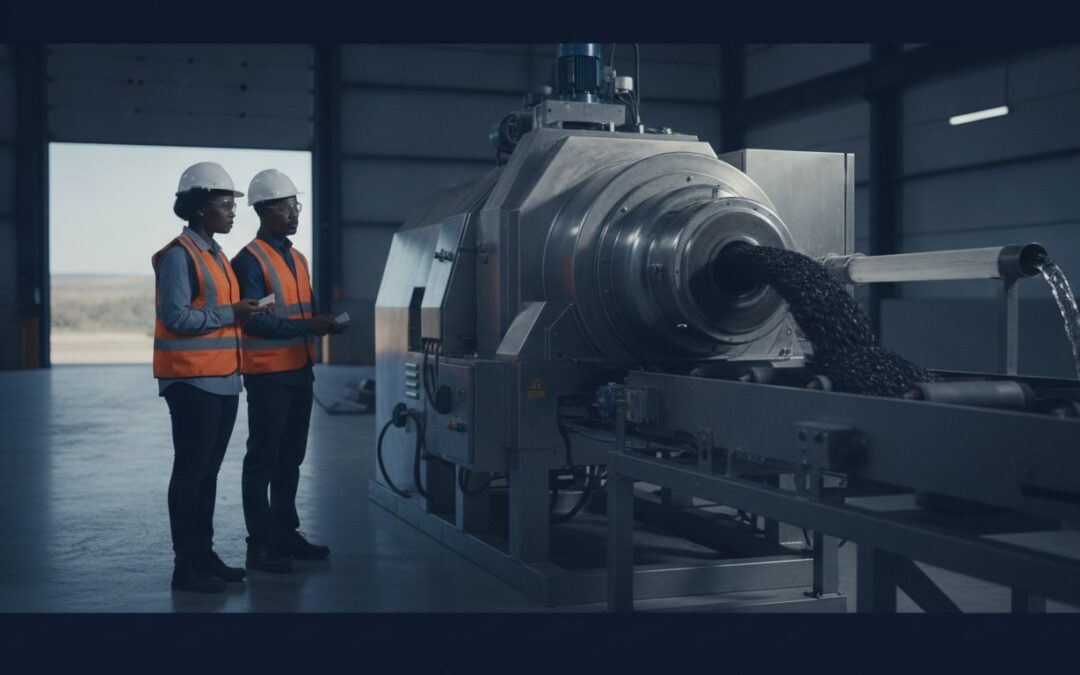
A decanter centrifuge is a horizontal separation device that employs high-velocity centrifugal force to accelerate the sedimentation of solids from liquids. In the context of coal mining, the decanter centrifuge for coal tailings is specifically engineered to handle the high volumes of ultra-fine particles generated during coal washing and preparation. Unlike simple settling ponds that rely on the slow pull of gravity, these machines use rapid rotation to achieve separation in seconds.
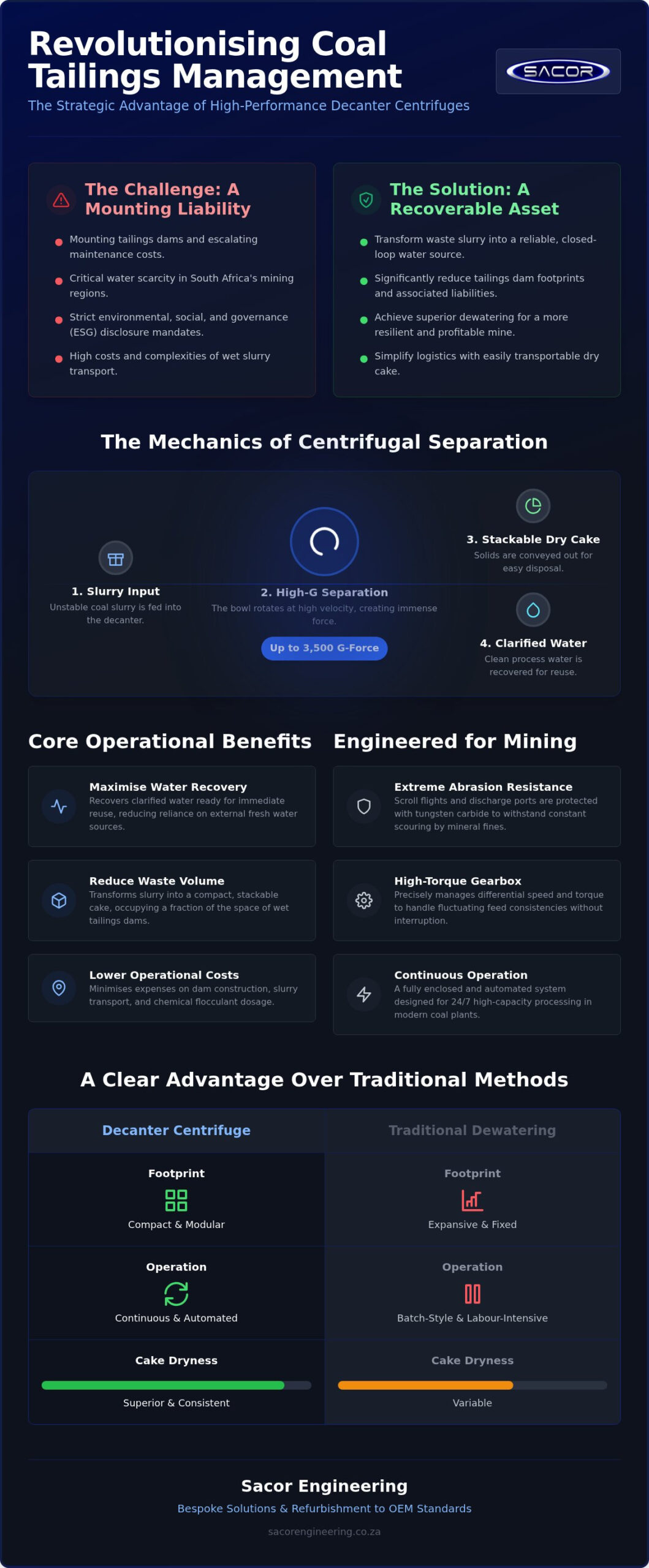
The primary role of this technology is to transform unstable coal slurry into two manageable streams: a stackable dry cake and clarified process water. This transition is vital for South African mines looking to reduce their reliance on expansive tailings dams. Because coal tailings are notoriously abrasive, solid-bowl designs are the industry standard. These robust shells withstand the constant scouring of mineral fines, ensuring the machine remains operational in harsh environments whilst maintaining high throughput.
The Mechanics of Centrifugal Separation
Centrifugal separation works by rotating a horizontal bowl at high speeds, creating a force many times stronger than gravity. For coal tailings, machines typically reach forces up to 3,500G. This immense pressure causes heavy coal particles to settle against the inner wall of the bowl almost instantly. Inside the bowl, an internal screw conveyor, or scroll, rotates at a slightly different speed to the bowl itself. This mechanical delta allows for the continuous removal of solids. Because the process is entirely enclosed and automated, it offers a steady, uninterrupted flow that fits perfectly into modern, high-capacity coal plants. It’s a significant upgrade over batch-style processes that require frequent downtime for cleaning or discharge.
Key Components for Mining Applications
Mining environments are unforgiving. To combat the wear caused by silica and other abrasive minerals, critical areas like the scroll flights and discharge ports are protected with tungsten carbide tiles or specialized spray-on coatings. The gearbox acts as the brain of the assembly; it precisely manages the torque and speed required to handle varying slurry densities. In this context, differential speed is the specific difference in rotational velocity between the centrifuge bowl and the internal scroll that facilitates the constant removal of dewatered solids. This precision ensures that the decanter centrifuge for coal tailings remains efficient even when the feed consistency fluctuates. By using bespoke materials and high-torque drives, these units provide the reliability required for 24-hour mining operations.
The Operational Benefits of Decanter Centrifuges in Coal Processing
South Africa’s mining sector faces unique challenges, particularly regarding water scarcity and the high costs of waste management. A decanter centrifuge for coal tailings addresses these pressures by providing a high-capacity, automated solution for solid-liquid separation. The primary benefit is the dramatic reduction in tailings volume. By removing the liquid phase, the remaining solids occupy a fraction of the space required by wet slurry. This allows mines to extend the life of existing dams or avoid the significant capital expenditure involved in constructing new ones.
Beyond volume reduction, the production of a stackable cake simplifies logistics. Transporting wet slurry is expensive and technically challenging; a dry cake can be moved using standard conveyors or trucks, which significantly lowers transport costs. Additionally, decanter centrifuges are often more efficient with chemical usage. Because the high G-force assists the separation process, the amount of flocculant needed is often lower than in static thickening tanks. This reduces the chemical footprint and the overall cost per tonne of processed waste.
Maximising Water Recovery and Recycling
Recovered water is often the most valuable output of the dewatering process. The clarified water, or centrate, produced by a centrifuge is typically clear enough to be reused immediately in the coal washing circuit. This reduces the total volume of fresh water required from external sources, which is a significant advantage in regions where water tariffs are high or supply is inconsistent. Improving the water balance through efficient separation doesn’t just lower costs; it enhances the environmental profile of the entire operation, making it a more sustainable partnership between industry and the environment. For a deeper technical understanding of how to maximise these results across your entire operation, our guide on centrifugal dewatering of mineral slurries provides a complete implementation roadmap.
Reducing Environmental Liabilities
Traditional wet tailings storage facilities carry inherent risks, including seepage and the potential for catastrophic wall failure. Transitioning to dry-stacking through mechanical dewatering mitigates these liabilities. By producing a stable, dry cake, operators can comply with increasingly strict South African environmental regulations. Effective dewatering coal tailings ensures that waste is handled in a way that protects local ecosystems and groundwater. To understand how this fits into a wider waste management strategy, you can explore our comprehensive guide on tailings dewatering equipment.
Our experts at Sacor Engineering can partner with you to implement these solutions, ensuring your operation remains both compliant and efficient over the long term.
Decanter Centrifuges vs. Traditional Dewatering Methods
Traditional dewatering strategies often rely on filtration or gravity. Whilst these methods served the industry for decades, modern coal processing demands higher throughput and greater precision. A decanter centrifuge for coal tailings offers a compact, automated alternative to the sprawling footprints of belt presses and thickeners. It’s particularly effective for ultra-fine particles below 45 microns. These fines often blind the filter cloths in traditional systems, leading to frequent downtime and reduced efficiency. Centrifuges bypass this issue by using G-force rather than physical pores to achieve separation.
Operational efficiency is another area where decanters outshine the competition. Plate-and-frame presses, for example, operate in batches. This requires constant cycles of filling, pressing, and cake discharge, which is labour-intensive. Decanters provide a continuous flow, allowing your plant to run 24/7 without the interruptions inherent in batch processing. This shift from reactive waste management to a proactive, industrialised process significantly lowers the risk of bottlenecks in your production line. For mines evaluating the full financial case for upgrading their dewatering infrastructure, the 2026 operational efficiency guide on mining waste dewatering outlines how advanced centrifuge technology for mine water management delivers measurable cost reductions and closed-loop water recycling benefits.
Decanter vs. Belt Filter Press
Belt filter presses are open systems. They’re often prone to splashing and require a constant supply of wash water to keep the belts clean. In contrast, a decanter is fully enclosed. This design creates a safer, cleaner working environment and prevents the loss of process water through evaporation or leaks. Regarding performance, decanters typically achieve a higher solids concentration in the final cake. Maintenance is also more streamlined; you don’t have belts that stretch, misalign, or tear, which reduces the long-term cost of spares and specialised labour.
Decanter vs. Static Thickeners
Static thickeners rely on gravity and time. They require massive surface areas to allow particles to settle, often taking hours to achieve what a centrifuge completes in minutes. For a South African mine with limited space, replacing a thickener with a decanter can reclaim hectares of land. The speed of the centrifugal process also means you can respond to changes in feed slurry almost instantly. If you’re weighing these options, it’s vital to look at decanter centrifuge selection criteria to ensure the machine matches your specific coal grade. Choosing the right technology is the first step toward a more resilient and sustainable operation.
Optimising Coal Tailings Recovery: Key Factors
Achieving the best results with a decanter centrifuge for coal tailings requires more than just high-quality hardware. It’s about fine-tuning operational variables to match the specific characteristics of your slurry. Stability is everything. If the feed slurry consistency fluctuates wildly, the machine has to work harder to maintain cake dryness. Aiming for a consistent solids concentration ensures the centrifuge operates within its design parameters, preventing surges that could lead to imbalance or poor centrate clarity.
Chemical dosing is often the largest ongoing operational cost. Optimising flocculant use involves finding the minimum dose that still produces clear water. Too much chemical is a waste of money; too little leads to “dirty” water that can’t be reused in the wash plant. Similarly, adjusting the G-force is a balancing act. While higher forces improve clarity, they also increase power consumption and mechanical wear. Finding the “sweet spot” reduces operational expenditure without sacrificing performance. Understanding how these parameters interact across different mineral types is covered in detail in the technical guide on centrifugal dewatering of mineral slurries, which outlines a complete implementation framework for achieving maximum solid-liquid separation.
Managing Abrasive Coal Solids
Coal tailings are inherently abrasive. Centrifuge wear protection for coal applications involves the strategic application of hardened materials, such as tungsten carbide tiles or sintered ceramics, to internal components to mitigate the erosive effects of mineral fines. These specialised coatings on the scroll flights are essential. Without them, the high-speed movement of coal solids would quickly erode the metal, leading to a loss of efficiency. Regular inspection of the discharge ports is equally vital, as these areas experience the highest velocities and are most susceptible to wear. Proactive management here extends the time between major refurbishments.
Automation and Control Systems
Modern centrifuges are no longer “set and forget” machines. When managing a decanter centrifuge for coal tailings, advanced torque control systems monitor the load on the scroll in real-time. If the solids feed becomes too thick, the system automatically adjusts the differential speed to prevent a blockage. Integrating these units with plant-wide SCADA systems allows for remote monitoring and data logging. This connectivity enables predictive maintenance, where vibration and temperature sensors alert engineers to potential issues before they cause a breakdown. It’s a shift from reactive repairs to precision engineering management.
If you’re looking to optimise your tailings recovery process, our technical team can provide the expert guidance needed to fine-tune your separation variables for maximum efficiency.
Sacor Engineering: Bespoke Solutions and Refurbishment
Sacor Engineering understands that no two coal seams are identical. The mineralogy of coal in the Waterberg differs significantly from that in the Mpumalanga coalfields, requiring a highly tailored approach to separation. We don’t just provide off-the-shelf hardware; we engineer a decanter centrifuge for coal tailings that is specifically configured for your site’s unique slurry profile. This bespoke approach ensures that solids discharge is consistent whilst energy consumption remains lean. By positioning ourselves as a partner for long-term operational goals, we help mines navigate the complex shift toward sustainable, closed-loop water management.
Extending Operational Life Through Refurbishment
In an era of capital expenditure constraints, the decision to refurbish rather than replace is often the most strategic financial move for a mine manager. Our specialised refurbishment services are designed to restore high-performance separation equipment to OEM standards, providing a significant extension to the machine’s lifespan at a fraction of the cost of a new unit. The process is rigorous and methodical. We perform precision bowl balancing to eliminate vibration and apply advanced scroll hard-facing to resist the abrasive nature of coal fines. A complete gearbox overhaul ensures the differential speed remains precise, which is crucial for maintaining reliability in demanding 24/7 mining operations. This restorative work doesn’t just fix problems; it optimises the machine for the current demands of your plant.
Technical Support and Spares
Minimising downtime is a priority that we share with our clients. We maintain a comprehensive inventory of critical spares across our South African service centres, ensuring that a minor component failure doesn’t lead to a major production bottleneck. Our engineering teams also conduct on-site technical audits to assess your current separation performance. By analysing the clarity of your centrate and the dryness of your cake, we can recommend precise adjustments to G-force or chemical dosing that improve your overall water recovery. We’re committed to the lifecycle management of your equipment, providing the localised support needed to keep your operation running at peak efficiency.
Contact Sacor Engineering for a tailored tailings audit and discover how we can enhance your dewatering workflow.
Securing Operational Longevity Through Precision Dewatering
Coal tailings management is no longer just about disposal; it’s about resource reclamation. By adopting high-G separation technology, you can drastically reduce your tailings dam footprint whilst securing a reliable stream of clarified process water. We’ve explored how these systems outperform traditional methods, particularly when handling ultra-fine particles that often compromise plant efficiency. Implementing a high-performance decanter centrifuge for coal tailings represents a commitment to both environmental compliance and operational resilience.
Sacor Engineering stands as a trusted partner in this transition. As specialists in South African mining separation technology, we offer a national technical support network and expert refurbishment to OEM standards to keep your operation running 24/7. Our bespoke approach ensures that your equipment is perfectly matched to your specific coal grade and site conditions. Consult Sacor Engineering for a Bespoke Coal Tailings Solution to begin optimising your dewatering workflow today. Your path to a more sustainable and profitable mine starts with the right separation partner.
Frequently Asked Questions
How does a decanter centrifuge handle high-clay coal tailings?
A decanter centrifuge handles high-clay coal tailings by applying high G-forces and managing torque through a variable speed drive. Clay particles are notoriously difficult to settle due to their small size and surface charge. By increasing the rotational speed, the machine forces these fines to the bowl wall. Precise torque control is essential here to prevent the scroll from plugging as the clay-rich cake becomes increasingly viscous.
What is the typical moisture content of coal tailings cake after centrifuging?
The typical moisture content for dewatered coal tailings cake ranges between 25% and 35% by weight. This result depends heavily on the feed’s particle size distribution and the mineralogy of the coal. A decanter centrifuge for coal tailings consistently produces a cake that’s dry enough for conveyor transport or dry-stacking. This significantly reduces the volume of waste compared to thickened slurry which often remains in a liquid state.
Can a decanter centrifuge operate without flocculants in coal processing?
Whilst a centrifuge can separate larger particles without chemicals, fine coal tailings almost always require flocculants to achieve clear centrate. Flocculants bind ultra-fine particles into larger flocs, allowing them to settle rapidly under centrifugal force. Without these chemicals, the recovered water would likely remain turbid and unsuitable for immediate reuse in the wash plant. Modern automated dosing systems help mines balance chemical costs with the required water clarity.
How often does a decanter centrifuge require refurbishment in a mining environment?
In a standard 24/7 mining environment, a decanter centrifuge typically requires a major refurbishment every 12 to 24 months. This interval varies based on the abrasiveness of the coal and the quality of the internal wear protection. Regular technical audits and vibration monitoring help identify when the bowl needs balancing or the scroll flights require hard-facing. Proactive maintenance prevents catastrophic failures and extends the total lifecycle of the separation hardware.
What are the power requirements for a coal tailings decanter?
Power requirements vary based on the throughput capacity, typically ranging from 55kW for smaller units to over 300kW for high-capacity industrial machines. Modern units use Variable Frequency Drives (VFDs) to optimise power consumption by adjusting motor speeds to match the actual load. This energy-efficient approach is vital for South African mines looking to manage rising electricity costs whilst maintaining high-performance separation in their tailings circuits.
Is a decanter centrifuge suitable for both fine and coarse coal tailings?
Decanter centrifuges are primarily designed for fine coal tailings, typically those with particle sizes below 0.5mm. Coarser coal is generally handled more cost-effectively by vibrating screens or cyclones. However, a decanter centrifuge for coal tailings is the ideal solution for the “slimes” that these other technologies can’t capture. It’s particularly effective for the ultra-fine fractions that would otherwise end up as a mounting liability in a tailings dam.
How does the decanter centrifuge improve water recovery in coal mines?
A centrifuge improves water recovery by providing a highly efficient, enclosed separation process that prevents losses through evaporation or seepage. Unlike settling ponds, the machine captures the maximum possible volume of liquid from the slurry in a matter of seconds. This clarified water is then immediately available for recycling back into the plant. This closed-loop system is essential for maintaining a sustainable water balance in water-stressed regions of South Africa.
What are the main causes of wear in coal tailings centrifuges?
The main causes of wear are the abrasive minerals, such as silica and pyrites, found within the coal stream. These hard particles scour the internal surfaces of the bowl and scroll flights during the separation process. High differential speeds also accelerate this erosion. To mitigate this, we use specialised tungsten carbide tiles and hard-facing. Without these protections, the abrasive nature of the tailings would quickly degrade the machine’s mechanical integrity and separation efficiency.