

The true cost of a tailings dam isn’t just the land it occupies; it’s the millions of Rand lost to unrecovered process water and perpetual maintenance liabilities. As global safety standards like the Global Industry Standard on Tailings Management (GISTM) tighten, relying on traditional settling ponds is no longer a viable financial strategy for South African mines. Implementing advanced centrifuge technology for mine water management has transformed from a technical choice to a baseline requirement for any site aiming for genuine operational longevity and safety.
You’re likely facing the relentless pressure of rising water management fees and the logistical headache of handling abrasive, high-volume slurries that frequently cause equipment downtime. This 2026 guide provides a comprehensive roadmap for selecting dewatering systems that deliver drier cake for easier transport and effective closed-loop recycling. We’ll explore how integrating smart sensors and variable frequency drives can reduce power consumption by up to 20 per cent, ensuring your separation process remains both profitable and environmentally responsible through high-performance engineering and strategic refurbishment.
Key Takeaways
- Understand how modern centrifuge technology for mine water management facilitates the transition from high-risk tailings dams to safer, more efficient dry stack disposal.
- Compare the advantages of continuous decanter centrifuge operation against batch-based filter presses to optimise throughput in space-constrained mining environments.
- Discover how high-performance separation machinery uses thousands of Gs to accelerate sedimentation, providing precise control over moisture levels in diverse mineral slurries.
- Learn why professional refurbishment of high-speed separation components is a critical strategy for extending equipment lifespan and reducing long-term operational costs.
- Explore the necessity of bespoke separation solutions tailored to your site’s specific mineralogy to achieve maximum water recovery and tailings volume reduction.
The Critical Role of Centrifuge Technology for Mine Water Management
Effective water management in mining isn’t just a matter of operational convenience; it’s a fundamental pillar of modern site profitability and safety. At its core, centrifuge technology for mine water management refers to the mechanical processes designed to extract water from mineral concentrates and mining tailings. By applying high centrifugal forces, these systems separate solids from liquids with a precision that traditional gravity-based methods cannot match. This separation is vital because water adds substantial weight and volume to waste products without contributing any commercial value.
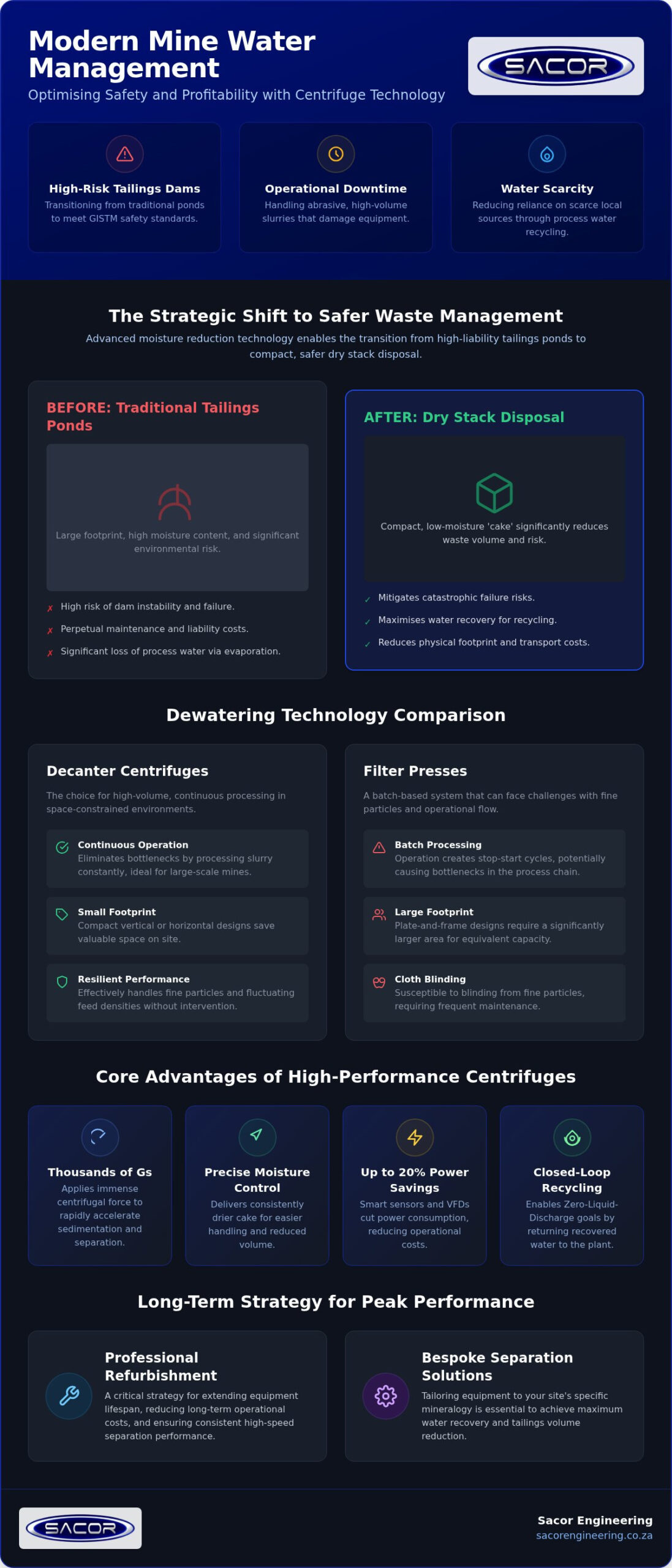
The industry is currently undergoing a significant shift. Traditional tailings ponds, once the standard, are being replaced by dry stack disposal methods. This transition is driven by the need to minimise environmental liabilities and the adoption of the Global Industry Standard on Tailings Management (GISTM). High moisture content in waste doesn’t just increase the risk of storage facility instability; it also inflates transportation costs and can negatively impact downstream metallurgical processes. Every litre of water recovered is a litre that doesn’t need to be purchased or pumped from scarce local sources, directly protecting the bottom line.
Reducing Mining Waste Volume for Safer Storage
Managing the physical footprint of tailings storage facilities (TSFs) is a primary concern for South African mine managers. Advanced moisture reduction techniques allow for the creation of a drier cake, which significantly reduces the volume of waste requiring storage. By using high-performance tailings dewatering equipment, sites can mitigate the catastrophic risks associated with dam failures. Ensuring waste is properly dewatered isn’t just about safety; it’s also a critical step in maintaining national environmental compliance and securing the social licence to operate amongst local communities.
Water Scarcity and the Closed-Loop Processing Circuit
In the arid environments typical of many South African mining regions, water is a precious and expensive resource. The economic necessity of recycling process water has never been higher. High-efficiency solid-liquid separation technologies allow mines to reduce their freshwater intake by returning recovered water directly to the processing plant. These centrifugal systems are essential components in achieving zero-liquid-discharge (ZLD) goals, transforming waste management into a sustainable, closed-loop circuit. This approach doesn’t just save money on water procurement; it shields the operation from the volatility of local water tariffs and supply disruptions, ensuring that every Rand spent on processing goes further.
Comparing Decanter Centrifuges and Filter Presses for Tailings
Selecting the most effective dewatering technology requires a nuanced understanding of slurry behaviour and site-specific constraints. Centrifuge technology for mine water management is often preferred in the South African market for its small physical footprint and ability to handle varying feed densities without manual intervention. Whilst both systems aim to remove water, their operational philosophies differ significantly. Centrifuges operate on a continuous basis, whereas filter presses rely on batch processing, which can create operational bottlenecks if not managed with extensive surge tankage.
The technical principles of centrifugation for water treatment demonstrate that centrifugal systems excel at handling fine particles that might otherwise blind a filter cloth. This makes them particularly resilient in environments where mineralogy fluctuates. For space-constrained sites, the vertical or compact horizontal orientation of a centrifuge provides a distinct advantage over the expansive footprint required for a plate-and-frame filter press of equivalent capacity.
Decanter Centrifuges: The Choice for Continuous High-Volume Dewatering
Continuous operation is the hallmark of the decanter centrifuge, making it the superior choice for large-scale mining operations that run 24/7. In applications like a decanter centrifuge for coal tailings, the system maintains a steady-state flow, which simplifies the integration into existing processing circuits. These systems are inherently easier to automate, requiring significantly less labour than filter presses, which often need manual oversight during the cake discharge and cloth washing cycles. This high level of automation reduces the risk of human error and ensures consistent water recovery rates throughout the production shift.
Filter Presses: When Residual Moisture is the Primary Metric
Filter presses are typically considered when the primary objective is achieving the absolute lowest residual moisture content, sometimes reaching levels below 10 per cent. This extreme dryness can justify the batch-process nature of the technology in specific scenarios where cake transport costs are prohibitively high. However, filter presses often require heavy dosing of chemical flocculants to maintain performance. Furthermore, highly abrasive mineral slurries can cause rapid wear on filter cloths and plates, leading to frequent maintenance stops and increased operational expenditure. For many South African mines, the continuous, low-maintenance profile of a centrifuge offers a better balance of moisture reduction and uptime. If you’re evaluating which system fits your specific mineralogy, a customised separation analysis can provide the technical clarity needed for a sound investment.
Technical Advantages of High-Performance Decanter Centrifuges
High-performance decanter centrifuges represent a peak in mechanical engineering, offering a level of precision that traditional settling methods simply cannot reach. This centrifuge technology for mine water management relies on the fundamental principle of centrifugal force to achieve rapid separation. By spinning the mineral slurry at extreme speeds, these machines accelerate the sedimentation process by several thousand Gs. This immense force effectively squeezes water from the solids, achieving in seconds what would otherwise take hours or even days in a gravity thickener.
To handle the diverse and often unpredictable nature of mineral slurries, modern systems feature adjustable bowl speeds and differential speeds. The bowl speed determines the total G-force applied, whilst the differential speed-the difference between the bowl and the internal scroll-controls the residence time and how quickly solids are discharged. This dual-axis flexibility allows operators to fine-tune the machine for specific moisture targets, ensuring the system remains efficient even when the feed characteristics change during a shift.
Mining is a brutal environment for any machinery, and high-speed centrifuges are no exception. Components are protected by advanced wear technologies, including tungsten carbide tiling and specialised hard-facing on the scroll flights. These materials are essential for resisting the abrasive action of South African minerals like quartz, coal fines, or iron ore. By using these bespoke protection methods, sites can significantly extend the time between service intervals and reduce the total cost of ownership.
The internal scroll isn’t a one-size-fits-all component. Bespoke scroll designs are engineered to match the specific rheology of the slurry, ensuring maximum solids discharge efficiency. A well-designed scroll prevents “plugging” within the machine and ensures that the maximum volume of dry cake is moved out of the bowl consistently, which is vital for maintaining high-throughput operations.
Centrifugal Dewatering of Mineral Slurries
High-density mineral slurries demand extreme torque and robust mechanical handling. Modern centrifugal systems use sophisticated planetary or hydraulic gearboxes to manage these heavy loads without sacrificing rotational speed. Our comprehensive guide on centrifugal dewatering of mineral slurries explains how this torque management ensures consistent output quality. These machines handle variable feed concentrations seamlessly, preventing the operational downtime often seen with less robust dewatering equipment when slurry density spikes.
Three-Phase Separation: Recovering Oil, Water, and Solids
In specialised mining processes, separation isn’t limited to just solids and liquids. Three-phase decanters allow for the simultaneous recovery of oil, water, and solids from a single feed stream. This technology is particularly useful in solvent extraction circuits or when treating waste oil streams on-site. By streamlining these complex waste streams into distinct, value-added outputs, mines can recover process liquids with high purity levels. This allows for immediate reuse in the circuit, further reducing the site’s environmental footprint and procurement costs.
Optimising Dewatering Efficiency through Professional Refurbishment
The longevity of centrifuge technology for mine water management depends heavily on a proactive restoration strategy. In the abrasive environments of South African mining, even the most robust machinery eventually succumbs to the relentless wear of mineral slurries. Professional refurbishment offers a critical pathway to extending the operational life of separation equipment without the prohibitive lead times or capital expenditure associated with purchasing entirely new units. By focusing on the restoration of high-speed components, mines can maintain peak performance levels throughout the equipment’s lifecycle.
Choosing to refurbish rather than replace is often the most fiscally responsible decision for a site manager. Industry data indicates that remanufactured or professionally refurbished models typically cost between 40 per cent and 60 per cent of the price of a new machine. This significant saving allows for the reallocation of capital to other critical infrastructure whilst still securing equipment that performs to original OEM specifications. Precision balancing is the cornerstone of this process; even a minor imbalance in a high-speed bowl can lead to catastrophic failure or excessive vibration that compromises water recovery efficiency.
Centrifuge Scroll and Bowl Refurbishment
The scroll and bowl are the primary contact points for abrasive mining waste. Over time, the internal geometry of the bowl can erode, disrupting the laminar flow necessary for precise solid-liquid separation. Refurbishment involves re-tipping and hard-facing the scroll flights with tungsten carbide to restore their ability to move dense solids efficiently. Before any mechanical work begins, technicians utilise non-destructive testing (NDT) to identify structural fatigue or microscopic cracks in the heavy hardware. This ensures the structural integrity of the components before they are returned to service, mitigating the risk of mid-cycle breakdowns.
Gearbox Modernisation and Control System Upgrades
A refurbished centrifuge also presents an opportunity for technical modernisation. Legacy gearboxes can be upgraded to handle modern, high-torque requirements, ensuring they don’t become a bottleneck as production volumes increase. Integrating automated control systems and Variable Frequency Drives (VFDs) can reduce power consumption by up to 20 per cent compared to older fixed-speed drives. These upgrades allow for real-time performance monitoring, where sensors track vibration and temperature to provide data for predictive maintenance. By using high-grade spare parts and expert engineering, sites can transform an older machine into a high-efficiency asset. If your current separation machinery is showing signs of wear or decreased efficiency, our centrifuge refurbishment services can restore your equipment to peak operational condition.
Bespoke Dewatering Solutions for the Mining Sector
Mining operations aren’t static environments. They evolve as new ore bodies are accessed and throughput requirements shift. This reality makes bespoke engineering a necessity rather than a luxury. Sacor Engineering focuses on delivering industrial centrifugal separation solutions that are purpose-built for the rigours of the field. We don’t just sell hardware; we offer a long-term operational partnership designed to enhance your site’s overall efficiency through expert guidance and technical precision.
Initiating a process audit is the first step in identifying dewatering bottlenecks within your existing circuits. This audit allows our team to pinpoint exactly where your current system is losing value, whether it’s through excessive freshwater consumption or the high cost of tailings dam maintenance. By identifying these specific operational pains, we can configure our centrifuge technology for mine water management to address the root cause of the inefficiency, ensuring that every Rand spent on separation contributes to your bottom line. For a deeper examination of how centrifugal technology addresses these financial pressures, our guide on reducing tailings management costs with centrifuges provides a strategic framework for transforming waste liabilities into recoverable resources.
Selecting the Right Decanter for Your Mineral Type
Selecting the right decanter for your mineral type is a nuanced exercise in mechanical balancing. For instance, coal tailings require different torque settings and wear protection compared to iron ore or precious metal concentrates. Adhering to strict decanter centrifuge selection criteria during the early feasibility stages prevents costly retrofits later. We ensure that every system we deploy is capable of scaling alongside your future production goals, providing a future-proof investment that maintains high-purity water recovery even as throughput increases.
Partnering for Long-Term Separation Excellence
Achieving separation excellence requires more than just high-speed machinery; it requires a support network that understands the local context. Sacor Engineering provides national technical support and ensures rapid spare parts availability to minimise downtime in critical operations. Our approach combines the latest innovations in centrifugal separation with established engineering reliability, grounded in practical, industrial reality. By partnering with a separation specialist, you move from simply managing waste to actively recovering valuable resources. The final step toward a more profitable, closed-loop circuit is a detailed consultation to design a customised dewatering strategy that fits your unique operational footprint.
Future-Proofing Your Mining Operation for 2026 and Beyond
The landscape of mining waste management is shifting toward greater accountability and resource efficiency. Transitioning from traditional tailings dams to dry stack disposal isn’t just a regulatory necessity; it’s a strategic move to recover process water and reduce land liabilities. By prioritising continuous operation and high-torque performance, sites can maintain steady-state productivity even as mineralogy varies. This approach ensures that your operation remains resilient against fluctuating water costs and environmental pressures.
Successfully implementing centrifuge technology for mine water management requires a partner that understands the specific demands of South African industrial conditions. Sacor Engineering provides a unique blend of high-performance decanter and disk stack technology alongside expert engineering support for national mining operations. Whether you’re upgrading legacy systems with specialised refurbishment services or designing a new circuit from the ground up, the focus remains on precision and mechanical reliability.
Taking the next step toward a zero-liquid-discharge circuit ensures your site remains competitive and environmentally responsible. Optimise your separation process with Sacor Engineering’s bespoke dewatering solutions and transform your waste streams into valuable assets. Your operation’s long-term sustainability starts with the right separation strategy today.
Frequently Asked Questions
What are the primary advantages of centrifugal dewatering over traditional tailings ponds?
Centrifugal dewatering offers a significantly smaller physical footprint and faster water recovery compared to traditional tailings ponds. Whilst ponds rely on slow gravity settling, centrifuges use mechanical force to separate liquids and solids in seconds. This speed allows for immediate water reuse in the processing circuit. It also eliminates the safety risks and environmental liabilities associated with large-scale liquid storage facilities.
Can decanter centrifuges handle highly abrasive mining slurries without excessive wear?
Decanter centrifuges are engineered to handle abrasive slurries through the use of specialised wear protection. High-contact areas like the scroll flights are reinforced with tungsten carbide tiles or hard-facing materials. These additions protect the base metal from erosion caused by quartz or iron ore particles. Regular monitoring of these wear parts ensures the machine maintains its separation efficiency over long production cycles.
How much water can be recovered using a modern mining waste dewatering system?
Modern systems can recover a substantial percentage of process water, often returning enough liquid to significantly reduce freshwater intake. The exact volume depends on the mineralogy and the initial slurry density. By integrating centrifuge technology for mine water management, operations can achieve a closed-loop circuit. This reduces reliance on local municipal supplies and shields the mine from rising water tariffs in arid regions.
Is it more cost-effective to refurbish an old centrifuge or buy a new system?
Refurbishing an existing centrifuge is typically more cost-effective, often costing between 40 per cent and 60 per cent of a new unit’s price. Professional refurbishment restores the machinery to original OEM specifications whilst providing an opportunity to upgrade gearboxes or control systems. This approach extends the asset’s life and avoids the long lead times associated with importing new hardware from overseas manufacturers.
What is the difference between two-phase and three-phase decanter centrifuges in mining?
Two-phase decanters are designed for standard solid-liquid separation, such as removing water from mineral concentrates. In contrast, three-phase decanters separate two immiscible liquids of different densities alongside a solid phase. This is particularly useful in solvent extraction processes or when recovering oil from waste streams. Choosing the correct configuration depends on the specific complexity of your site’s waste streams and recovery goals.
How do dewatering systems help in meeting environmental and regulatory standards?
Dewatering systems enable mines to transition to dry stack disposal, which is a key requirement for meeting the Global Industry Standard on Tailings Management (GISTM). By reducing the moisture content of waste, mines decrease the risk of dam failures and groundwater contamination. These systems help operations comply with national environmental regulations whilst improving the site’s overall safety profile and community relations.
What maintenance is required to ensure the longevity of tailings dewatering equipment?
Ensuring the longevity of tailings dewatering equipment requires a structured maintenance programme focused on precision balancing and lubrication. High-speed components must be checked regularly for vibration, as even minor imbalances can cause structural damage. Wear parts, such as the scroll flights and discharge ports, should be inspected during scheduled intervals. This proactive approach prevents catastrophic failures and maintains the machine’s ability to produce a dry cake.
Can these systems be used for coal tailings recovery and fine solids separation?
Yes, centrifugal systems are highly effective for coal tailings recovery and the separation of ultra-fine solids. Centrifuge technology for mine water management excels where traditional screens or filters might fail due to cloth blinding or low settling rates. These machines can capture fine particles that would otherwise remain suspended, allowing for cleaner filtrate and a more manageable waste product that’s easier to transport.