
What if the greatest drain on your mine’s profitability isn’t the extraction process itself, but the way you handle the waste that remains? For many operators, the escalating costs of maintaining traditional tailings dams and the constant loss of process water represent a significant financial burden. You’re likely already feeling the pressure of rising operational expenses and stricter environmental scrutiny. Reducing tailings management costs with centrifuges offers a sophisticated path forward, transforming what was once a liability into a valuable resource. It’s a strategic shift that moves beyond simple disposal toward a model of recovery and precision.
This guide demonstrates how implementing centrifugal technology can help you reclaim a substantial portion of process water whilst dramatically shrinking the volume of waste requiring storage. We’ll explore the mechanics of high-performance decanter centrifuges and how they provide a compact, reliable alternative to traditional slurry ponds. By the end of this article, you’ll understand how to lower transport costs and mitigate environmental risks through custom-engineered separation solutions. It’s time to stop viewing tailings as a cost centre and start seeing them as an opportunity for operational excellence.
Key Takeaways
- Identify the hidden financial drain of unrecovered process water and the escalating maintenance liabilities inherent in traditional Tailings Storage Facilities.
- Learn how the high-speed mechanics of decanter centrifuges achieve superior solids dryness to facilitate the transition toward safer, stackable tailings.
- Compare the operational advantages of centrifugal technology against conventional methods, focusing on footprint reduction and increased automation.
- Follow a strategic framework for reducing tailings management costs with centrifuges by utilising slurry characterisation and rigorous pilot-scale testing.
- Discover how professional refurbishment and bespoke equipment customisation can dramatically lower CAPEX whilst extending the operational life of your machinery.
Identifying the Hidden Costs of Traditional Tailings Management
Traditional Tailings Storage Facilities (TSFs) are often the largest and most complex infrastructure on a mine site. While they’ve been the industry standard for decades, their true cost extends far beyond initial construction. These hidden expenses accumulate daily through inefficient water management, massive energy consumption, and long-term risk mitigation. For many operators, the sheer scale of these facilities masks the underlying financial drain caused by outdated disposal methods.
When tailings are pumped as a dilute slurry, a vast volume of process water is essentially locked away in a dam, where it’s lost to evaporation or seepage. This isn’t just a loss of liquid; it’s a loss of the energy and chemicals already invested in that water. Transportation overheads also climb when moving low-solids waste. Pumping thousands of tonnes of water just to transport a small fraction of solids requires significant power and heavy-duty pumping systems. Reducing tailings management costs with centrifuges addresses these inefficiencies at the source by separating water from solids before they ever leave the processing plant.
The Impact of Water Scarcity on Mining OPEX
Mining operations in water-stressed areas face a dual challenge: the rising price of water and the risk of production halts during droughts. Financial penalties for exceeding water quotas add another layer of expense that can cripple a project’s margins. Centrifugation changes this dynamic by creating a closed-loop water system. This precision allows mines to maintain production levels without the constant need for new water permits. By recovering high-quality process water for immediate reuse, mines can significantly lower their reliance on expensive external sources.
Land Use and Rehabilitation Liabilities
The physical footprint of a wet tailings dam creates long-term financial liabilities that can persist for decades after a mine closes. Every hectare of land used for storage is land that requires constant monitoring and maintenance. As dams reach capacity, the cost of expansion or building new facilities rises sharply due to land scarcity and stricter engineering requirements. Consider the following cost drivers:
- Ongoing Monitoring: The continuous need for piezometers, satellite tracking, and manual inspections to ensure dam wall stability.
- Insurance Premiums: Escalating costs related to the environmental risk and potential liability of a catastrophic TSF failure.
- Closure Costs: The immense expenditure required to stabilise and cap wet slurry compared to the relatively simple process of rehabilitating dry, stackable tailings.
Transitioning toward dry-stacking through reducing tailings management costs with centrifuges allows for a smaller, more stable footprint. This shift reduces the immediate land requirement and slashes the future cost of mine closure and environmental bonding.
How Decanter Centrifuges Optimise Solid-Liquid Separation
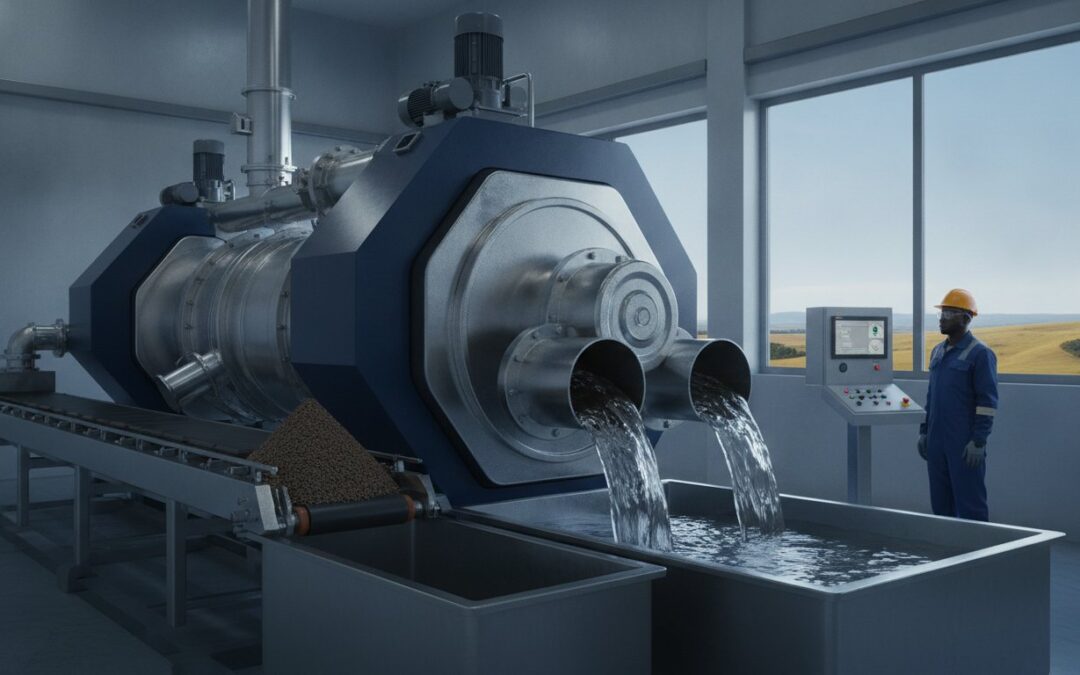
Decanter centrifuges operate on a simple yet powerful principle: the acceleration of sedimentation through high-speed rotation. While a traditional thickener relies on gravity to settle solids, a centrifuge applies forces thousands of times stronger than Earth’s gravity. This intense centrifugal force separates particles from the liquid phase almost instantaneously. By reducing tailings management costs with centrifuges, operators can achieve a level of precision that static systems simply can’t match. The result is a clear centrate ready for immediate reuse and a dense cake that’s often dry enough for conveyor transport.
Achieving optimal solids dryness is a primary goal for any modern mine. When tailings reach a stackable state, the need for high-risk slurry dams vanishes. This mechanical dewatering process is highly controllable. You can adjust the bowl speed and scroll differential to meet specific dryness targets, even as the slurry consistency changes. This level of control also extends to chemical usage. Precise centrifugal separation often requires fewer polymers than traditional belt or filter presses, as the mechanical force does the heavy lifting. It’s a cleaner, more predictable way to manage waste streams.
Recovering Value from Mineral Slurries
Tailings shouldn’t always be viewed as final waste. In many instances, these streams contain residual minerals that were previously too difficult or expensive to recover. Implementing centrifugal dewatering of mineral slurries allows for the capture of ultra-fine particles that might otherwise escape the circuit. For instance, using a decanter centrifuge for coal tailings can turn a waste stream into a secondary product stream by recovering fine coal that adds directly to the bottom line. It’s a method of reducing tailings management costs with centrifuges whilst simultaneously boosting total plant yield.
Scalability of Separation Technology
Mining throughput is rarely constant. A robust tailings system must handle fluctuations in ore grade and volume without compromising performance. Decanter centrifuges offer a modular advantage that traditional TSFs lack. You can scale capacity by adding units in parallel, allowing for a flexible response to mine life changes. These systems integrate seamlessly with existing thickeners, acting as a final polishing stage to maximise water recovery. If you’re looking to enhance your current infrastructure, exploring customised separation solutions can provide the technical bridge needed for long-term efficiency.
Comparing Centrifugation with Conventional Dewatering Methods
Selecting the appropriate dewatering technology involves a careful balance of initial capital expenditure, ongoing operational costs, and long-term reliability. Traditional methods like filter presses, belt presses, and gravity thickeners have served the industry for years, but they often struggle to meet the modern demands of high-throughput mining operations. Reducing tailings management costs with centrifuges becomes a clear strategic advantage when you examine the total cost of ownership (TCO) over a ten-year period. While some conventional systems appear cheaper upfront, their hidden costs in labour, maintenance, and water loss quickly erode those initial savings.
Filter presses, for example, are batch-operated systems that require significant manual intervention or complex plate-shifting mechanisms. In contrast, decanter centrifuges provide a continuous, fully automated process that handles fluctuating feed densities without stopping. Belt presses often suffer from high maintenance requirements due to the constant need for belt washing and replacement, especially when dealing with abrasive mineral slurries. Centrifuges, being enclosed and robustly engineered, offer a far more resilient solution for the harsh environments typical of mining sites.
Footprint and Infrastructure Requirements
One of the most immediate benefits of centrifugal technology is its compact physical footprint. A single decanter centrifuge can process the same volume of slurry as a filter press installation several times its size. This reduction in scale translates directly into lower civil engineering costs. You don’t need massive concrete foundations or expansive buildings to house the equipment. This portability is particularly valuable for multi-site operations or projects where land availability is restricted. By choosing a smaller, more efficient footprint, you’re effectively reducing tailings management costs with centrifuges before the first litre of slurry is even processed.
Maintenance and Operational Continuity
Operational downtime is a silent profit killer in tailings management. Conventional filtration systems often require frequent stops for cleaning, cloth changes, or mechanical adjustments. Modern centrifuges are designed for continuous 24/7 operation with minimal human oversight. They feature sophisticated automated cleaning and monitoring systems that detect imbalances or wear before they lead to failure. This high level of operational continuity ensures that the processing plant never has to slow down due to a bottleneck in the tailings circuit. When you factor in the reduced need for specialised maintenance crews and the longer intervals between major services, the financial case for centrifugation becomes even more compelling.
For those looking to extend the life of their existing assets without the full cost of new machinery, considering centrifuge refurbishment services can be a highly effective way to maintain these performance advantages whilst managing CAPEX budgets.
A Strategic Framework for Implementing Centrifugal Cost Reduction
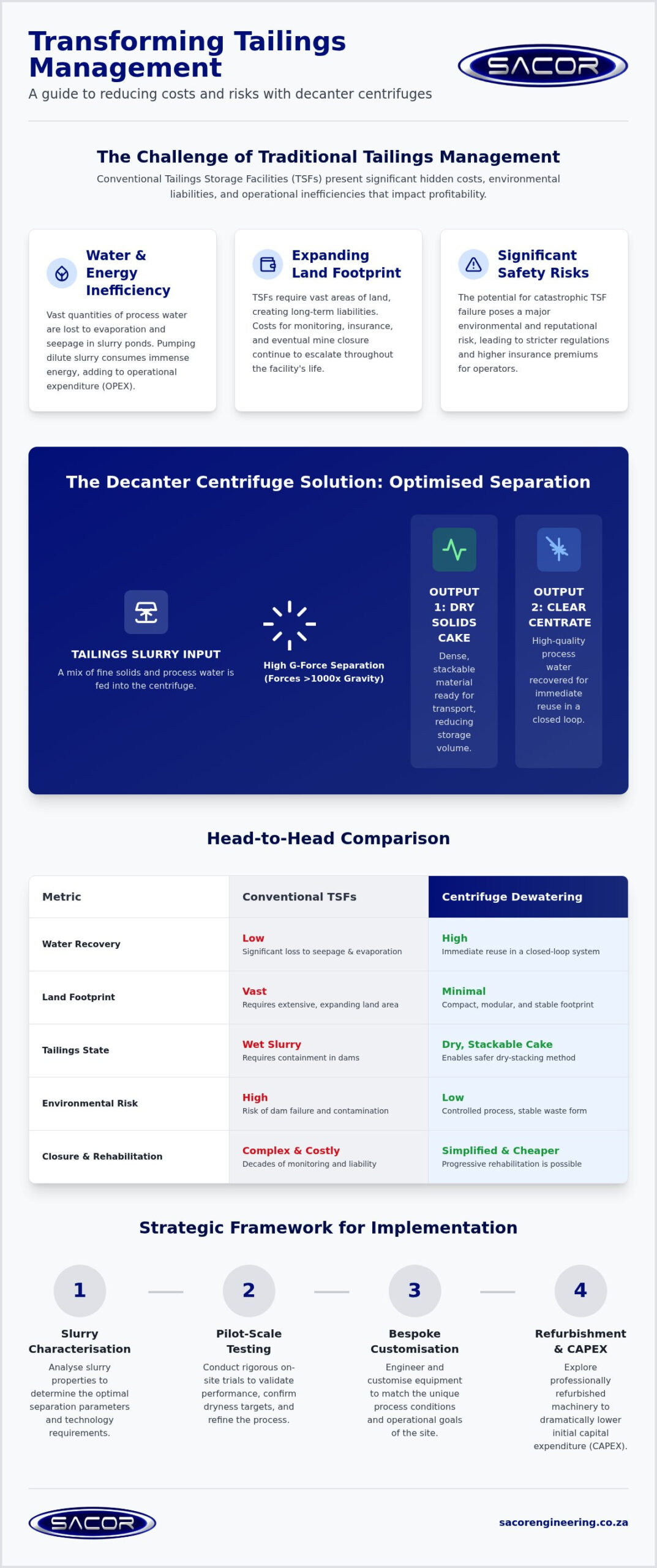
Successful integration of centrifugal technology requires a methodical approach that aligns mechanical capability with the specific mineralogy of your site. Reducing tailings management costs with centrifuges isn’t achieved through a one size fits all installation. Instead, it involves five critical stages of engineering integration designed to maximise water recovery and minimise waste volume. This structured framework ensures that the equipment performs reliably under varying feed conditions whilst maintaining the lowest possible operational expense.
The implementation process follows a logical sequence to mitigate risk and guarantee performance:
- Step 1: Characterising the tailings slurry to understand particle size distribution and specific gravity.
- Step 2: Conducting pilot-scale testing to determine the optimal G-force required for clear centrate.
- Step 3: Integrating the centrifuge into the process water circuit to enable immediate reuse.
- Step 4: Deploying automated control systems to monitor torque and solids dryness in real time.
- Step 5: Establishing a proactive maintenance and refurbishment schedule to protect the asset’s lifespan.
Slurry Characterisation and Bench Testing
The chemical and physical composition of your slurry directly dictates the efficiency of the separation process. Factors such as pH levels and mineral clay content can influence how particles behave under high rotational speeds. Through rigorous bench testing, engineers can determine the precise flocculant dosage needed to aggregate fines without overspending on chemicals. In this context, G-force represents the multiple of Earth’s gravity applied within the centrifuge bowl to force solid particles out of suspension at an accelerated rate. Getting this calculation right is the foundation of reducing tailings management costs with centrifuges, as it prevents energy waste and ensures maximum solids recovery.
Optimising the Dewatering Circuit
Once the baseline parameters are established, focus shifts to balancing feed rates. If the feed is too fast, the clarity of the recovered water may suffer; if too slow, the plant’s throughput is throttled. For a deeper look at modern standards, refer to the Mining Waste Dewatering: 2026 Operational Efficiency Guide. Managing the liquid phase, or centrate, is just as vital as handling the solids. By returning high-quality water directly to the plant, you reduce the energy required for long-distance pumping from a TSF. To ensure your circuit is engineered for these specific targets, consider investing in bespoke decanter centrifuges tailored to your unique mineral slurry profile.
Maximising Long-Term Value with Sacor Engineering Solutions
Achieving long-term efficiency requires more than just high-quality hardware; it demands a partnership with experts who understand the nuances of mineral slurry behaviour. Sacor Engineering provides this expertise through bespoke decanter centrifuge customisation, ensuring that every unit is precision-engineered for the specific rigours of the mining environment. By focusing on the entire lifecycle of the machinery, we help operators move beyond the initial purchase toward a model of sustained performance and reliability. This approach is central to reducing tailings management costs with centrifuges over the long term, as it ensures the technology evolves alongside your operational needs.
Our commitment to precision engineering means that every separation solution is tailored to the specific density and particle size of your waste stream. This level of customisation prevents the common pitfalls of underperforming, off-the-shelf equipment. Instead, you receive a robust system designed to maximise water recovery whilst minimising the energy required for dewatering. It’s a partnership aimed at achieving long-term operational goals, projecting a persona of dependable excellence in every mechanical detail.
The Economics of Centrifuge Refurbishment
Many operators believe that declining efficiency necessitates a total replacement of their dewatering assets. However, professional centrifuge refurbishment services offer a cost-effective alternative that restores machinery to OEM standards for a fraction of the cost of new hardware. This process involves stripping the unit down, performing precision balancing on high-speed components, and upgrading internal wear protection to handle abrasive slurries. It’s a strategic way of reducing tailings management costs with centrifuges by significantly lowering CAPEX requirements whilst extending the operational lifespan of existing hardware. Furthermore, refurbishment supports sustainability and circular economy goals by reducing the environmental impact associated with manufacturing new industrial equipment.
Partnering for Operational Excellence
Navigating the technical complexities of separation requires a consultative partner rather than a simple vendor. Sacor Engineering offers tailored separation technology designed specifically for the unique challenges of the South African industrial landscape. Our team provides comprehensive technical support for high-speed industrial separation machinery, ensuring that your circuit remains optimised as ore bodies and processing conditions change. Whether you’re looking for a new installation or need to revitalise your current fleet, our expertise in tailings dewatering equipment ensures you make data-driven decisions that benefit your bottom line.
Contact Sacor Engineering today to optimise your tailings management process and discover how our bespoke solutions can transform your waste streams into operational assets.
Transforming Mining Waste into Operational Capital
Transitioning from traditional tailings storage to a modern, dewatered approach isn’t just an environmental preference; it’s a financial necessity. We’ve explored how high-speed decanter centrifuges provide the precision needed to reclaim process water and shrink the physical footprint of waste facilities. By adopting a strategic framework that includes rigorous slurry characterisation and proactive maintenance, you can enhance your plant’s total yield whilst mitigating long-term liabilities. It’s a shift that turns a costly disposal problem into a streamlined recovery process.
Reducing tailings management costs with centrifuges involves more than simple equipment selection. It requires a commitment to engineering excellence and lifecycle management. Sacor Engineering is a trusted expert guide in this field. We offer bespoke engineering for South African mining conditions and expert centrifuge refurbishment that extends the life of your assets. If you’re ready to evolve your waste strategy, request a technical consultation for your tailings dewatering strategy. As specialists in industrial centrifugal separation solutions, we’re dedicated to helping you achieve a more sustainable and profitable future.
Frequently Asked Questions
How much can decanter centrifuges actually reduce tailings management costs?
Decanter centrifuges reduce costs by significantly minimising the physical volume of waste and maximising the recovery of process water. While specific savings depend on the mineralogy and scale of the operation, reducing tailings management costs with centrifuges often results in lower pumping expenses and reduced land-use fees. By creating stackable solids, mines can also bypass the massive capital expenditure required for expanding traditional slurry dams.
Is centrifugal dewatering suitable for all types of mineral tailings?
Centrifugal dewatering is highly effective across a broad spectrum of mineral slurries, including coal, gold, and base metals. The technology is particularly suited for ultra-fine particles that traditional gravity thickeners struggle to capture. Through bespoke engineering, the equipment’s G-force and scroll speed are adjusted to match the specific gravity and particle size of the tailings, ensuring efficient separation regardless of the mineral type.
What is the typical lifespan of an industrial centrifuge in a mining environment?
An industrial decanter centrifuge typically has an operational lifespan of 10 to 20 years when properly maintained. The harsh nature of mining environments means that internal components are subject to significant wear from abrasive slurries. Regular servicing and precision refurbishment can restore a unit to its original performance standards, effectively extending its life and ensuring a high return on investment over the long term.
How does water recovery from tailings impact the overall mining budget?
Water recovery directly lowers operational expenditure by reducing the need to purchase and transport fresh water. In water-scarce regions, this closed-loop approach mitigates the risk of production stops and avoids financial penalties for excessive consumption. Additionally, returning centrate directly to the process plant reduces the energy costs associated with long-distance pumping from a tailings storage facility.
Can existing dewatering equipment be refurbished to improve efficiency?
Existing separation machinery can be refurbished to meet or exceed original performance specifications. This process involves upgrading wear protection, replacing bearings, and performing precision high-speed balancing. Refurbishment is a strategic choice for reducing tailings management costs with centrifuges, as it provides the benefits of modern efficiency at a significantly lower capital cost than purchasing entirely new hardware.
What are the main maintenance requirements for decanter centrifuges in mining?
Maintenance focuses on managing the effects of abrasion and vibration. Key requirements include the regular inspection of tiles or hard-facing on the scroll, monitoring bearing health, and ensuring the bowl remains balanced. Modern units often feature automated monitoring systems that alert operators to imbalances before they cause damage, allowing for a proactive approach that prevents unscheduled downtime.
How do centrifuges compare to tailings dams in terms of environmental risk?
Centrifuges offer a significantly lower environmental risk profile compared to traditional wet tailings dams. By producing a dry, stackable cake, the risk of catastrophic dam failure or seepage into groundwater is virtually eliminated. This shift toward dry-stacking simplifies the regulatory compliance process and reduces the long-term financial bonding required for mine closure and land rehabilitation.
Can centrifuges be integrated into an existing mining process without major downtime?
Integration is typically seamless because decanter centrifuges have a compact footprint and modular design. They can be installed in parallel with existing thickeners or as a final dewatering stage without requiring a total plant shutdown. By utilising a phased implementation approach and pre-fabricated mounting skids, engineers can commission the equipment with minimal disruption to the primary production circuit.