
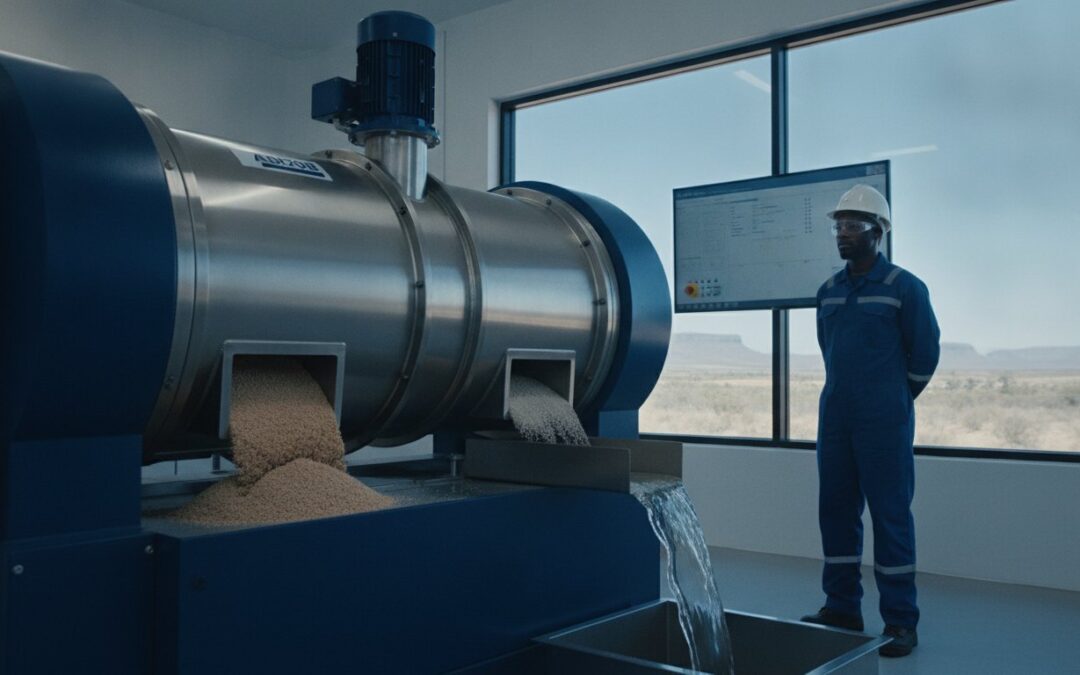
Did you know that 85% of process water in a mining circuit can be recovered for immediate reuse through precision engineering? In the arid landscapes of South Africa, where water scarcity is a constant operational threat and GISTM compliance is now a non-negotiable standard, the efficiency of your tailings management determines your bottom line. You’re likely already feeling the pressure of rising costs per ton and the inherent risks associated with unstable, high-moisture tailings dams. Transitioning to centrifugal dewatering of mineral slurries isn’t just an equipment upgrade; it’s a strategic move towards a closed-loop system that can reduce waste volume by up to 90%.
This guide provides the technical roadmap you need to master these complex processes and achieve maximum solid-liquid separation. You’ll learn how to align operational parameters to ensure peak cake dryness whilst significantly lowering your operational costs. We’ll explore the transition from traditional belt presses to advanced decanter centrifuges, covering everything from initial implementation steps to the bespoke refurbishment strategies that extend the lifespan of your critical machinery.
Key Takeaways
- Understand the mechanical principles of G-force and how high-speed rotation overcomes the surface tension of fine particles to achieve superior solid-liquid separation.
- Learn how to select the optimal centrifuge configuration by assessing particle size distribution and the necessity of tungsten carbide tiles for abrasive mineral environments.
- Master the implementation of centrifugal dewatering of mineral slurries through precise pilot-scale testing, feed system design, and flocculant dosing optimisation.
- Discover technical methods to maximise water recovery and centrate clarity by fine-tuning pond depth and managing torque-to-solids ratios for consistent cake dryness.
- Evaluate the strategic advantages of centrifuge refurbishment as a cost-effective, sustainable alternative to new equipment procurement for South African mining operations.
Understanding the Principles of Centrifugal Dewatering for Mineral Slurries
The centrifugal dewatering of mineral slurries is a mechanical process that uses high-speed rotation to accelerate the separation of solids from liquids. In a mining context, this isn’t just about spinning a mixture; it’s about applying massive G-force to overcome the surface tension of fine particles that would otherwise remain suspended. For a deeper look at the mechanical theory, Understanding the Principles of Centrifugal Dewatering provides a foundational overview of how these units function across various industries. In South African mining operations, where water recovery is vital for environmental compliance and operational continuity, three key metrics define success: cake dryness, centrate clarity, and the solids recovery rate. High cake dryness reduces the volume of waste transported to tailings facilities, whilst high centrate clarity ensures the recovered water is clean enough for immediate reuse in the processing plant.
The Mechanics of Decanter Centrifuges in Mining
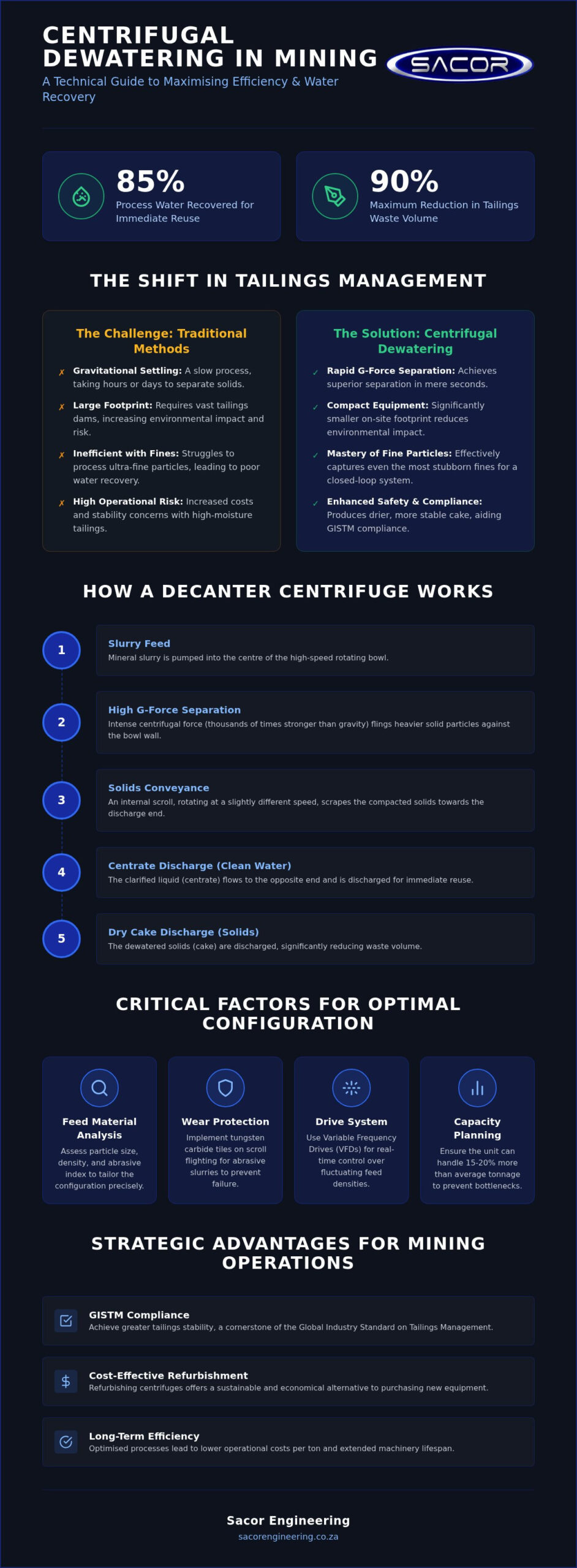
A decanter centrifuge consists of a solid-wall bowl that rotates at high speeds, surrounding an internal scroll conveyor. As the mineral slurry enters the bowl, the centrifugal force flings the heavier solid particles against the bowl wall. The internal scroll, which rotates at a slightly different speed than the bowl, continuously scrapes these compacted solids towards the conical end of the machine. This differential speed is critical; if it’s too high, the solids don’t compact sufficiently; if it’s too low, the machine can plug. Because mineral slurries are often highly abrasive, precision in the scroll’s design and its wear-resistant coatings is non-negotiable. The clarified liquid, or centrate, flows in the opposite direction and is discharged through adjustable weir plates at the large end of the bowl.
Centrifugal Force vs. Gravitational Settling
Traditional thickeners rely on gravity to settle particles, a process that can take hours or even days depending on the particle size and density. In contrast, the centrifugal dewatering of mineral slurries achieves similar or superior results in mere seconds. This speed allows for a significantly smaller equipment footprint on-site, which is a major advantage for mines with limited space or those looking to reduce the environmental impact of large tailings dams. Centrifuges also excel at handling high-density slurries and ultra-fine particles that traditional belt presses or vacuum filters often struggle to process. By applying forces thousands of times stronger than gravity, these systems ensure that even the most stubborn fines are captured, resulting in a closed-loop water system that is both efficient and sustainable.
Selecting the Correct Centrifuge Configuration for Mining Applications
Selecting the correct configuration for the centrifugal dewatering of mineral slurries requires a forensic analysis of your feed material. You simply cannot treat coal fines with the same parameters used for iron ore tailings. The abrasive index of the slurry dictates the necessary level of wear protection. High-silica ores, for example, will erode standard stainless steel components within weeks. This is why material selection remains the cornerstone of any configuration. Integrating tungsten carbide tiles on the scroll’s flighting is essential for maintaining mechanical precision and preventing premature failure.
Drive systems and capacity planning are equally vital. Whilst fixed-speed drives offer lower initial capital expenditure, they lack the flexibility to handle the fluctuating feed densities common in South African mining circuits. Variable Frequency Drives (VFD) allow for real-time adjustments to bowl and differential speeds. This level of control is fundamental to optimising separation performance when plant throughput surges or the ore body characteristics change. Scaling the equipment requires a buffer; always ensure your centrifuge can handle 15% to 20% more than your average hourly tonnage to prevent bottlenecks.
Solid Bowl Decanter Centrifuges
These units are the workhorses of the mining sector. They are specifically engineered to handle high-solids mining slurries where the primary objective is maximum water recovery. Balancing the bowl length and diameter is a delicate engineering task; a longer bowl provides the necessary residence time for ultra-fine particles to settle under high G-force. For a deeper look at these systems, consult The Comprehensive Guide to Tailings Dewatering Equipment in 2026. If you are dealing with particularly complex rheologies, investing in customised separation solutions ensures the hardware matches your specific metallurgical requirements.
Three-Phase Separation Options
Sometimes, you need to separate more than just solids and liquids. Three-phase decanters are utilised in circuits where mineral oils or solvents are present alongside the solid phase. These machines use two different discharge points for liquids of varying densities. It’s a specialised configuration often found in solvent extraction or leaching processes where recovering expensive organic phases is just as important as dewatering the solids. Precision in weir plate adjustment is critical here to prevent cross-contamination between the two liquid phases whilst maintaining cake dryness.
A Step-by-Step Guide to Implementing Centrifugal Slurry Processing
Successful implementation of the centrifugal dewatering of mineral slurries begins long before the machine arrives on-site. It starts with a comprehensive slurry analysis to determine the exact rheology of the material. Pilot-scale testing is non-negotiable. It allows us to simulate real-world conditions and establish a baseline for performance. Without this data, you risk undersizing the feed system or failing to meet moisture targets. Once the baseline is set, the focus shifts to designing a feed system that maintains consistent pressure whilst delivering the precise volume of material required for stable operation.
Phase 1: Pre-Treatment and Flocculation
Chemical conditioning is a vital component in capturing ultra-fine solids that would otherwise escape in the centrate. By using specific polymers, we can aggregate these fines into larger flocs that are more easily separated by centrifugal force. Organising the dosing point correctly is essential for polymer efficiency; the polymer needs enough contact time to react but not so much that the flocs break down before entering the bowl. Monitoring feed consistency prevents “slugging,” which can lead to torque spikes and machine trips. Effective flocculation is a major driver of high Water Recovery Rates, ensuring the plant remains compliant with environmental standards like the GISTM.
Phase 2: Mechanical Installation and Alignment
High-speed machinery requires a foundation that can handle both static and dynamic loads. We ensure all installations use vibration-dampened foundations to protect the structural integrity of the plant. Precision alignment of motors and gearboxes is equally critical; even a minor offset can cause premature bearing failure or excessive wear on the drive belts. For specific applications like the Decanter Centrifuge for Coal Tailings, the installation must also account for the high-volume throughput typical of South African coal wash plants.
The final step involves integrating the unit into the existing plant control centre. This allows operators to monitor performance metrics such as bowl speed, torque, and vibration levels in real-time. It’s a critical safety measure. During commissioning, we perform parametric fine-tuning, adjusting the differential speed and pond depth to find the “sweet spot” for your specific ore. This methodical approach ensures the system reaches its maximum recovery potential from day one.
Optimising Separation Performance and Water Recovery Rates
Achieving peak performance in the centrifugal dewatering of mineral slurries requires a precise balance of mechanical variables. Adjusting the pond depth via weir plates is your primary lever for controlling centrate clarity. A deeper pond increases the residence time for the liquid phase, allowing finer particles more time to settle, which results in a cleaner centrate. Conversely, a shallower pond increases the “beach” length, providing more space for solids to drain, which enhances cake dryness. Finding the “sweet spot” between these two outcomes is essential for meeting specific metallurgical targets.
Managing the torque-to-solids ratio is equally critical for consistent operation. As the solids concentration in the feed increases, the scroll conveyor faces higher resistance, which elevates torque levels. Modern systems use sensors to monitor these fluctuations in real-time, automatically adjusting the differential speed to maintain dryness without risking a mechanical trip. In many South African processing plants, seasonal temperature shifts can also alter slurry viscosity. Warmer slurries generally have lower viscosity, which accelerates separation speed and improves overall throughput. Monitoring these environmental factors ensures your system remains optimized year-round.
Maximising Water Recovery for Closed-Loop Systems
Effective dewatering can reduce sludge volume by 80% to 90%, which significantly lowers the logistical burden of tailings management. Centrifugal systems are capable of recovering up to 85% of process water for immediate reuse, a vital capability for mines operating under strict GISTM guidelines. By achieving a “crystal clear” centrate, you can eliminate the need for massive tailings dams and transition towards a more sustainable, closed-loop water system. This not only reduces environmental risk but also lowers the cost per ton of processed ore by minimising freshwater procurement requirements. For a comprehensive overview of how centrifuge technology for mine water management is reshaping operational efficiency in 2026, the latest industry guidance provides essential context for South African operations. Mines seeking to go further in cutting operational expenditure should also explore how reducing tailings management costs with centrifuges can transform waste handling from a financial liability into a strategic advantage.
Wear Protection and Maintenance Strategy
Proactive maintenance is the only way to ensure long-term reliability in abrasive mining environments. You must identify high-wear zones early, specifically the feed zone where the slurry enters the bowl and the solids discharge ports where the compacted cake exits. Implementing a structured inspection schedule for scroll tips allows you to catch wear before it impacts separation efficiency. Abrasive wear in mineral centrifuges is the progressive loss of surface material caused by the high-velocity impact of sharp particles, a challenge best mitigated through the strategic application of tungsten carbide tiles. To ensure your equipment maintains this level of precision, you can explore customised separation solutions tailored to your specific mineral rheology.
The Role of Customisation and Refurbishment in Long-Term Efficiency
In the demanding environment of South African mining, the centrifugal dewatering of mineral slurries subjects equipment to relentless mechanical stress. Over time, the abrasive nature of ore fines and the chemical composition of process water degrade even the most robust components. Whilst the instinct might be to invest in entirely new hardware, professional refurbishment is often a far more strategic and cost-effective alternative. Restoring existing assets doesn’t just save on capital expenditure; it allows for the integration of modern metallurgical enhancements that wasn’t available when the machine was first commissioned.
Sacor Engineering treats refurbishment as an opportunity for transformation. Our process centres on precision bowl balancing, a non-negotiable requirement for high-speed machinery. Without perfect balance, the resulting vibrations can lead to catastrophic failure, causing expensive downtime and safety risks. We also focus on customising scroll geometry. By adjusting the pitch and flighting of the scroll to match your current mineral behaviour, we can often improve solids transport and cake dryness beyond the original manufacturer’s specifications.
Professional Refurbishment Techniques
A comprehensive overhaul involves more than just a fresh coat of paint. It requires deep technical intervention in high-wear zones to ensure the machine can handle the rigours of the plant. Our refurbishment protocol includes:
- Scroll Hard-facing and Re-tipping: We utilise specialised welding techniques and tungsten carbide tiles to restore the scroll’s edge, ensuring it can withstand the most abrasive slurries for an extended operational life.
- Gearbox Overhauls: The gearbox is the heart of the differential speed system. We perform full teardowns, replacing worn bearings and seals to ensure long-term mechanical reliability.
- Testing and Quality Assurance: Every refurbished unit undergoes rigorous vibration analysis and load testing to ensure it delivers “as-new” performance before returning to the site.
Partnering for Operational Success
Mines today need more than just equipment suppliers; they require technical partners who understand the unique challenges of the local landscape. We support national mining operations by providing tailored solutions that bridge the gap between mechanical engineering and metallurgical necessity. This consultative approach ensures your dewatering circuit remains a high-performing asset rather than a maintenance bottleneck. If you’re looking to optimise your current fleet or explore new high-performance options, you can Contact Sacor Engineering for professional centrifuge refurbishment and sales to discuss a bespoke solution for your site.
Future-Proofing Your Mineral Processing Circuit
Success in modern tailings management requires more than just high-speed rotation; it demands a deep alignment between mechanical precision and metallurgical reality. We’ve explored how mastering the centrifugal dewatering of mineral slurries can transform your processing plant from a high-waste environment into a high-efficiency water recovery system. By focusing on bespoke configurations and proactive maintenance, you can achieve the “crystal clear” centrate and dry cake necessary for GISTM compliance and operational sustainability.
Sacor Engineering stands as a trusted expert guide in this technical landscape. As specialists in high-performance centrifuge refurbishment and tailored separation technology for the mining and food sectors, we provide the national support South African industrial operations need to thrive. Whether you’re looking to restore existing machinery to “as-new” condition or implement a completely new customised separation solution, the path to long-term efficiency is through technical partnership.
Optimise your mining separation with Sacor Engineering’s bespoke solutions and ensure your plant remains at the forefront of industrial innovation. Your journey toward a more sustainable, closed-loop system starts with a single technical intervention.
Frequently Asked Questions
What is the primary advantage of centrifugal dewatering over filter presses?
The primary advantage is the ability to operate continuously without the downtime associated with batch processing in filter presses. Centrifuges offer a much smaller physical footprint and lower labour requirements since they don’t require manual plate cleaning. This makes them ideal for high-volume South African mining circuits that need to maintain steady throughput whilst reducing the overall environmental impact of the processing site.
Can decanter centrifuges handle highly abrasive mineral slurries?
Decanter centrifuges can certainly handle highly abrasive mineral slurries provided they are equipped with specialised wear protection. We use tungsten carbide tiles on the scroll flights and ceramic liners in the feed and discharge zones to mitigate the impact of sharp ore particles. These customisations are essential for ensuring the centrifugal dewatering of mineral slurries remains efficient in harsh environments like iron ore or platinum processing.
How much water can be recovered using centrifugal separation in mining?
Centrifugal separation can recover up to 85% of process water for immediate reuse within the mining circuit. This high rate of recovery is vital for operations in arid regions of South Africa where water scarcity is a significant operational risk. By returning clarified centrate back to the plant, mines can drastically reduce their reliance on external freshwater sources and lower their overall cost per ton.
What maintenance is required for a decanter centrifuge in a mining environment?
Maintenance typically involves regular lubrication of bearings, monitoring vibration levels, and inspecting wear components like scroll tips and discharge ports. Proactive bowl balancing is also critical to prevent mechanical fatigue caused by high-speed rotation. Following a structured maintenance schedule ensures that the equipment maintains its precision and avoids the catastrophic failures that lead to expensive unscheduled downtime during the processing cycle.
Is it possible to refurbish an old centrifuge rather than buying a new one?
It’s entirely possible and often strategically advantageous to refurbish an old centrifuge rather than purchasing new hardware. Professional refurbishment can restore a machine to “as-new” performance whilst allowing for modern upgrades to the scroll geometry or drive systems. This approach supports the circular economy and provides a high return on investment for South African mines looking to extend the lifespan of their existing assets.
How does flocculant dosing affect the centrifugal dewatering process?
Flocculant dosing significantly enhances the centrifugal dewatering of mineral slurries by aggregating fine particles into larger, heavier flocs. This chemical conditioning allows the centrifuge to capture ultra-fine solids that would otherwise remain in the centrate, resulting in superior liquid clarity and faster separation speeds. Correct dosing is essential for achieving the torque-to-solids ratio required for consistent cake dryness and efficient operation.
What is the typical lifespan of a decanter centrifuge in the mining sector?
With a rigorous maintenance and refurbishment strategy, a high-quality decanter centrifuge can have an operational lifespan of 15 to 20 years or more. While the internal wear parts require periodic replacement, the structural components like the stainless steel bowl and frame are designed for long-term industrial use. Regular technical audits and timely component upgrades are the keys to ensuring this longevity in demanding mining conditions.
Can centrifugal dewatering help in eliminating the need for tailings dams?
Centrifugal dewatering is a cornerstone technology for mines aiming to eliminate traditional wet tailings dams in favour of dry stacking. By reducing the moisture content of the tailings to a stable, stackable cake, mines can significantly lower the risk of dam failures and comply with GISTM standards. This shift not only improves environmental safety but also allows for easier site rehabilitation once mining activities finally conclude.