
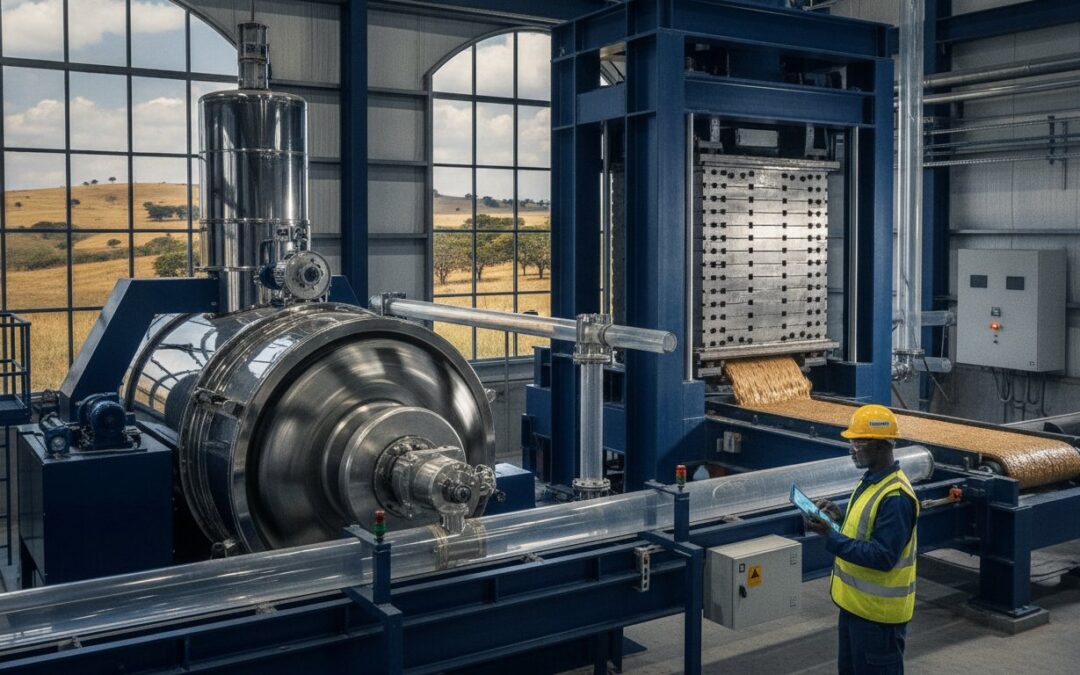
Selecting the driest possible cake discharge isn’t always the most cost-effective decision for a South African mineral processing plant. It’s a common frustration to see thousands of Rand literally wash away through inefficient tailings management or to watch your operational budget disappear into excessive chemical flocculant costs. Deciding between a decanter centrifuge vs filter press for slurry dewatering requires a deep understanding of your material’s unique characteristics and your plant’s need for continuity.
This 2026 guide provides the technical clarity needed to evaluate which technology aligns with your specific slurry rheology. You’ll learn how to achieve superior process water recovery and produce a cake that’s easy to transport without the burden of constant equipment failure. We’ll break down the operational mechanics of both systems, from continuous high-volume throughput to the precision of batch processing. By the end of this analysis, you’ll be equipped to choose a dewatering strategy that keeps your long-term maintenance costs low and your production volumes high, ensuring your operation remains both sustainable and profitable.
Key Takeaways
- Understand the fundamental mechanical differences between continuous centrifugal sedimentation and batch-based high-pressure filtration for industrial slurries.
- Identify the critical slurry characteristics, such as particle size and pH, that dictate whether a decanter centrifuge vs filter press for slurry dewatering is the most efficient choice for your plant.
- Discover why filter presses often achieve higher cake dryness whilst decanter centrifuges offer superior throughput and a smaller footprint for continuous operations.
- Follow a structured two-step selection process to define your required filtrate quality and cake dryness for maximum process water recovery.
- Maximise your return on investment by considering refurbishment services that restore decanter performance to original specifications at a fraction of the replacement cost.
Understanding Slurry Dewatering and Process Water Recovery Systems
Slurry dewatering is the mechanical process of separating suspended solids from a liquid medium to significantly reduce waste volume and reclaim liquid for reuse. In the context of South African industrial operations, this isn’t just about waste management; it’s about resource security. Traditionally, many mines relied on massive settling lagoons or tailings dams. However, the industry is rapidly shifting toward mechanical dewatering to mitigate the risks associated with large-scale liquid storage and to address the country’s chronic water scarcity. High-performance separation technology allows plants to operate in a closed-loop system, where clear filtrate is immediately returned to the process line.
The strategic choice between a decanter centrifuge vs filter press for slurry dewatering determines how effectively a plant can recover this process water. Recovering water at the source reduces the need for expensive freshwater intake, which can save an operation millions of Rand annually. It also produces a more manageable solid waste, lowering the logistical costs of transport and disposal.
The Environmental Imperative for Water Recovery
Stricter environmental regulations and the rising cost of water have made efficient recovery a non-negotiable standard. By implementing advanced mechanical separation, facilities can drastically reduce the footprint of their Tailings Storage Facilities (TSFs), which minimises the risk of environmental contamination and structural failure. A process water recovery system is a critical infrastructure component for resource efficiency. It allows mines and factories to meet discharge standards whilst ensuring that every drop of water is utilised to its maximum potential before being considered waste.
Key Slurry Characteristics That Dictate Technology Choice
Selecting the appropriate machinery begins with a granular analysis of the slurry itself. Solids concentration and particle size distribution are the primary factors that influence whether a centrifuge or a press will perform optimally. For instance, very fine particles might require higher G-forces or specific chemical flocculants to settle effectively. The presence of abrasive materials is another vital consideration for South African coal and mineral sectors. Abrasive slurries can cause rapid wear on internal components, making the choice of wear-resistant materials and the ease of refurbishment essential factors. Understanding how a slurry behaves under mechanical stress, its shear sensitivity and its flow behaviour, ensures the selected system can handle the specific demands of the process without frequent downtime.
Mechanical Mechanics: Decanter Centrifuges vs Filter Presses
The operational principles behind a decanter centrifuge vs filter press for slurry dewatering represent two distinct engineering philosophies. One relies on the power of acceleration and centrifugal force, whilst the other utilises mechanical pressure and physical barriers. Understanding these mechanics is vital for plant managers who need to balance throughput with efficiency. For a broader perspective on how these technologies fit into the modern industrial landscape, you can explore The Professional Guide to Industrial Separation Solutions in 2026.
Decanter centrifuges are often favoured for their compact footprint. They act as a high-intensity centre for processing, requiring significantly less floor space than a filter press of comparable capacity. This makes them ideal for South African mines where site space is at a premium or for factories looking to integrate dewatering into existing production lines without major structural changes.
How a Decanter Centrifuge Organises Separation
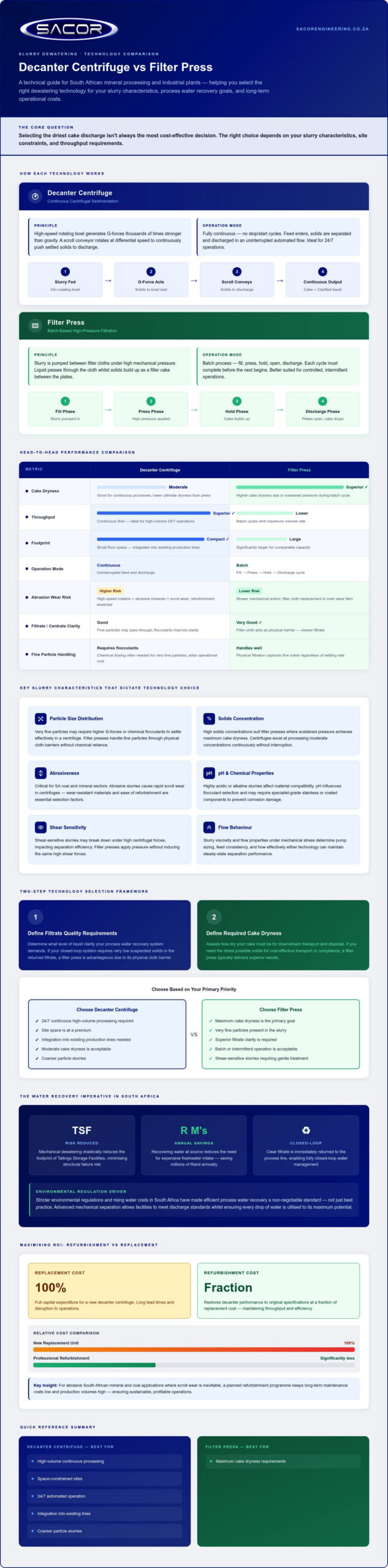
A decanter centrifuge operates through continuous sedimentation. The machine consists of a horizontal cylindrical bowl that rotates at high speeds, creating a “G-force” that is thousands of times stronger than gravity. Inside this bowl, a screw conveyor, known as a scroll, rotates at a slightly different speed. This differential speed is the key to the machine’s efficiency. As the G-force drives solids to the bowl wall, the scroll continuously pushes them toward the discharge end. This automated, uninterrupted flow is why decanters are the preferred choice for 24/7 industrial operations that cannot afford the downtime associated with batch processing.
The Batch Processing Nature of Filter Presses
Filter presses operate on a batch cycle, using high-pressure membrane or plate-and-frame systems to separate liquids from solids. The process involves pumping slurry into the press until the chambers are full. Once the chambers are packed, the hydraulic system applies immense pressure to squeeze the remaining liquid through filter cloths. After the cycle is complete, the press must be opened to discharge the solid cakes. This method is highly effective for achieving extreme cake dryness, but it requires regular maintenance of the filter cloths and hydraulic components. If your operation prioritises maximum dryness over continuous flow, our experts can help you design customised separation solutions that meet your specific moisture targets.
Performance Metrics: Cake Dryness, Filtrate Clarity, and Throughput
Evaluating a decanter centrifuge vs filter press for slurry dewatering involves a strategic trade-off between processing speed and the final moisture content of the solids. Performance isn’t measured by a single variable but by how well the technology meets your specific plant requirements. Filter presses are generally the gold standard for cake dryness. They utilise high-pressure membranes to squeeze out every possible drop of liquid, which is a significant advantage if you’re looking to minimise transport costs for the final “cake”.
However, decanter centrifuges offer a distinct edge in throughput capacity. They excel at handling massive volumes of dilute slurry in a continuous stream, whereas a filter press operates in discrete batches. This batch nature necessitates downtime for filling, pressing, and cake discharge. Regarding filtrate clarity, decanters typically require the addition of polymers or flocculants to match the crystal-clear results produced by the physical cloth barrier of a filter press. Energy consumption also differs; a centrifuge requires constant power to maintain high-speed rotation, whilst a press uses hydraulic power intermittently during its cycle.
Analysing Total Cost of Ownership (TCO)
Understanding the balance between initial capital expenditure (CAPEX) and long-term operational expenditure (OPEX) is vital for a healthy bottom line. Decanters often carry a higher CAPEX but provide significant savings in labour costs through full automation. They don’t require the constant manual oversight that many filter presses need for cake removal or cloth cleaning. You must also weigh the cost of consumables. Whilst filter presses require regular cloth replacements, decanters use wear-resistant tiles or coatings that, although durable, eventually require professional refurbishment to maintain peak efficiency. For a comprehensive overview of how modern centrifugal solids recovery systems are transforming industrial efficiency and reducing waste disposal costs, the latest innovations in decanter technology offer compelling insights into long-term TCO reduction.
Reliability in Heavy Industry and Mining
In the demanding South African mining sector, equipment must handle harsh conditions without frequent failure. Decanters have become the industry standard for coal tailings recovery because they’re exceptionally resilient to process fluctuations. If your feed concentration varies unexpectedly, a centrifuge can adjust its differential speed to compensate, whereas a filter press might suffer from “blinding” of the filter cloths. This adaptability ensures a steady flow of recovered water and consistent waste output. For more detailed insights into the machinery used in these environments, consult The Comprehensive Guide to Tailings Dewatering Equipment in 2026. Choosing a system that handles varying solids loads without manual intervention is often the key to maintaining long-term operational stability.
How to Select the Right Dewatering Technology for Your Slurry
Choosing between a decanter centrifuge vs filter press for slurry dewatering is a methodical engineering process that extends beyond simple price comparisons. To ensure your plant achieves its 2026 operational goals, you must align the mechanical capabilities of the equipment with the physical rheology of your waste stream. This selection process is best approached through five structured steps.
- Step 1: Conduct a comprehensive slurry analysis. You must determine the particle size distribution, pH levels, and temperature of the feed. These factors dictate chemical compatibility and the potential for equipment wear.
- Step 2: Define your desired end-state. Establish clear targets for cake dryness percentage and filtrate clarity. If you require a stackable cake for immediate transport, your moisture thresholds will be more stringent.
- Step 3: Calculate required throughput and available floor space. Measure the total volume of slurry processed daily. High-volume operations with limited square meterage often find vertical or compact horizontal separation more viable.
- Step 4: Evaluate the necessity for continuous vs batch processing. Determine if your upstream process can accommodate the intermittent discharge of a filter press or if it requires the constant flow of a centrifuge.
- Step 5: Assess long-term maintenance and refurbishment support. In the South African market, the availability of local technical expertise and refurbishment services is critical for minimising downtime.
By following this framework, you can avoid the common pitfall of over-specifying equipment that is too complex for your local operational requirements. For expert assistance in navigating these technical specifications, you can consult with our team to develop customised separation solutions tailored to your specific site conditions.
When to Choose a Decanter Centrifuge
A decanter centrifuge is the ideal choice for slurries with a solids concentration between 5% and 50%. These machines are particularly effective for high-volume, continuous water recovery where floor space is limited. If your primary goal is to minimise labour intervention, the fully automated nature of a centrifuge allows for 24/7 operation with only periodic monitoring. They are the preferred standard for coal tailings and mineral processing where consistency and throughput are the dominant priorities.
When to Choose a Filter Press
A filter press is the superior option when your process requires a final cake with over 75% dry solids content. This technology is best suited for small-scale batch runs or for slurries containing very fine, difficult-to-settle particles that a centrifuge might struggle to capture without excessive chemical aid. If your operational budget requires that chemical flocculant usage be kept to an absolute minimum, the mechanical pressure of a filter press provides a cost-effective alternative to achieve high filtrate clarity.
Optimising Operational Life and Efficiency with Sacor Engineering
Sacor Engineering understands that the decision between a decanter centrifuge vs filter press for slurry dewatering is only the beginning of a long-term operational commitment. In the South African mining and food processing sectors, equipment reliability is the foundation of profitability. We don’t just provide machinery; we engineer customised separation solutions that address specific local challenges, such as abrasive coal tailings or high-volume food waste. Having access to national technical support and a reliable supply of spare parts is non-negotiable for maintaining continuous dewatering circuits and avoiding costly plant stoppages.
Refurbishment vs Replacement: A Strategic Decision
Deciding whether to invest in new CAPEX or restore existing assets is a strategic pivot point for many plant managers. Our refurbishment services offer a high-performance alternative to the significant costs associated with new procurement. We specialise in restoring decanter bowls and scrolls to original manufacturer specifications, ensuring that your separation efficiency remains at peak levels. For a deeper look at this process, see our Industrial Centrifuge Life Extension: A Strategic Guide to Refurbishment. By implementing advanced balancing and precision wear protection, we can extend the operational life of process water recovery systems by 10 to 15 years. Precision dynamic balancing and the application of advanced wear protection revolutionise older machinery by restoring mechanical integrity and separation efficiency.
Partnering for Long-Term Separation Success
Sacor Engineering positions itself as a trusted expert guide, moving beyond the role of a traditional equipment vendor. We believe in a partnership that focuses on long-term operational goals rather than short-term sales. This includes providing on-site technical support to troubleshoot complex separation issues and performance optimisation for tailings management. Our goal is to ensure your plant achieves its desired outcome of maximised water recovery and dry, manageable cake discharge. Contact Sacor Engineering today to optimise your dewatering circuit.
Advancing Your Dewatering Strategy for 2026
Selecting the ideal technology is a strategic decision that aligns your plant’s operational goals with the physical realities of your waste stream. You’ve seen that while filter presses offer unparalleled cake dryness, decanter centrifuges provide the continuous, high-volume throughput essential for large-scale South African mining operations. Success depends on a rigorous analysis of your slurry’s particle size and solids concentration to ensure long-term resource efficiency.
As you evaluate the decanter centrifuge vs filter press for slurry dewatering, remember that sustained performance is built on reliable technical support and proactive maintenance. Whether you’re reclaiming process water in a coal tailings circuit or refining a food processing line, the right partnership ensures your machinery operates at peak performance for decades. Sacor Engineering is a specialist in South African tailings dewatering and expert centrifuge refurbishment, helping you reduce CAPEX while maintaining mechanical excellence.
Consult with Sacor Engineering for Your Custom Separation Solution to transform your dewatering circuit today. We’re ready to help you build a more sustainable and profitable operation.
Frequently Asked Questions
Which is better for mining tailings, a decanter centrifuge or a filter press?
Decanter centrifuges are generally superior for high-volume mining tailings because they offer continuous processing and handle varying feed concentrations effectively. In South African coal and mineral sectors, the ability to process thousands of litres per hour without stopping for batch discharge is a massive operational advantage. Filter presses are better suited for smaller tailings volumes where achieving the highest possible cake dryness is the primary priority for the operation.
Can a decanter centrifuge achieve the same dryness as a filter press?
Usually, a decanter centrifuge cannot match the absolute dryness of a filter press. While decanters produce a stackable cake suitable for most transport requirements, the mechanical pressure of a filter press typically reaches higher solids percentages. However, the choice of decanter centrifuge vs filter press for slurry dewatering often depends on whether your process requires that extra dryness or the efficiency of a continuous, automated flow.
How does a process water recovery system reduce operational costs?
These systems reduce costs by reclaiming clear filtrate for immediate reuse, which slashes the expense of purchasing freshwater. In water-scarce South African regions, this can save an operation millions of Rand over the equipment’s lifespan. Additionally, recovering water at the source minimises the logistical costs of hauling wet waste and reduces the physical footprint required for tailings storage facilities, lowering long-term environmental liability and waste management fees.
What are the main maintenance differences between centrifuges and filter presses?
Centrifuges require specialised mechanical maintenance, such as precision dynamic balancing and the refurbishment of wear-resistant tiles. Filter presses demand frequent manual intervention to clean or replace filter cloths and maintain hydraulic seals. While a centrifuge has higher technical maintenance needs, it often requires less daily labour than a manual or semi-automated press. This results in significantly lower long-term personnel costs and higher plant availability for the operator.
Is a decanter centrifuge suitable for food-grade slurry dewatering?
Yes, high-performance decanter centrifuges are widely used in the South African food and beverage sector for applications like juice clarification and yeast separation. They’re designed with stainless steel components and Clean-In-Place systems to meet stringent hygiene standards. Their continuous nature prevents product degradation that can occur during the longer dwell times associated with batch-based filtration systems, ensuring a higher quality final product and more efficient production lines. The same precision mechanical separation principles that apply to industrial slurries are also leveraged in beverage production, as explored in our guide to centrifuges for wine clarification.
What happens if the slurry concentration changes unexpectedly during processing?
A decanter centrifuge handles unexpected concentration fluctuations by automatically adjusting its differential speed. This ensures consistent discharge quality even when the feed becomes thinner or thicker. A filter press is less adaptable to these changes; a sudden drop in solids can lead to blinding of the filter cloths. This halts the cycle and requires manual cleaning before processing can resume, leading to unpredictable downtime and reduced plant efficiency.
How long does it take to refurbish an industrial decanter centrifuge?
A comprehensive refurbishment typically takes several weeks, depending on the extent of wear on the bowl and scroll. Sacor Engineering provides a structured process that includes decontamination, precision balancing, and the application of new wear protection. This timeline is significantly shorter than the current lead times for new machinery. It allows you to restore peak performance to your circuit without the extended downtime and capital expenditure of a full replacement.
Does Sacor Engineering provide support for both decanters and filter presses?
Sacor Engineering specialises specifically in high-performance decanter centrifuges, centrifugal separators, and disk stack separators. We provide customised separation solutions and national refurbishment services for these technologies across South Africa. While we understand the decanter centrifuge vs filter press for slurry dewatering debate, our technical expertise is dedicated to ensuring the longevity of centrifugal equipment. This focus ensures we provide the highest level of specialised support and spare parts availability.