

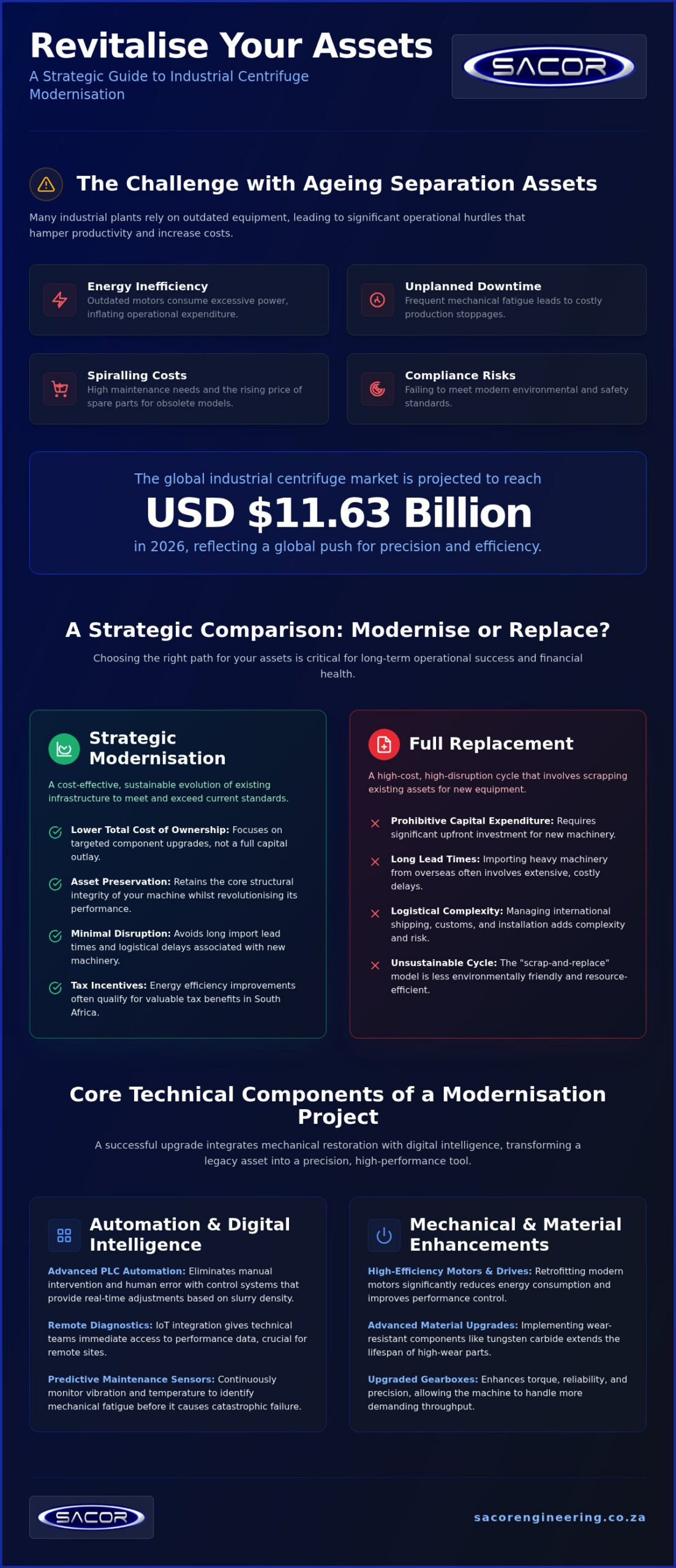
Did you know that the global industrial centrifuge market is projected to reach a value of USD 11.63 billion in 2026? This significant investment reflects a worldwide push for precision, yet many South African mining and food processing plants still rely on ageing separation assets that hamper productivity through energy-inefficient motors and frequent mechanical fatigue. You’re likely all too familiar with the spiralling operational costs and the frustration of sourcing spare parts for obsolete models that lead to costly, unplanned downtime.
Our comprehensive guide explores how industrial centrifuge modernisation services can breathe new life into your existing infrastructure, offering a sustainable and cost-effective alternative to the scrap-and-replace cycle. We’ll show you how to transform legacy systems into high-performance assets that deliver improved separation efficiency and increased throughput. By integrating modern monitoring technology and bespoke engineering upgrades, you can extend your machine’s lifespan whilst achieving the reliability your operations demand. We’ll examine the technical pathways to optimising your workflow, ensuring your refurbished equipment meets the rigorous standards of today’s industrial landscape.
Key Takeaways
- Understand why strategic technical evolution is a more sustainable and cost-effective alternative to full equipment replacement in the current industrial landscape.
- Explore how retrofitting PLC automation and high-efficiency motors can significantly lower energy costs whilst improving separation precision.
- Evaluate the financial advantages of industrial centrifuge modernisation services by comparing long-term operational savings against initial capital expenditure.
- Learn how to conduct a comprehensive technical audit to assess structural integrity and prioritise upgrades based on failure risk.
- Discover how bespoke refurbishment can integrate advanced monitoring systems to transform ageing assets into high-performance separation solutions.
The Strategic Case for an Industrial Centrifuge Upgrade in 2026
Modernising your separation equipment is no longer a simple maintenance task; it’s a comprehensive technical evolution that aligns your plant with 2026 production standards. As the global market for industrial centrifuges expands towards a projected USD 11.63 billion this year, the focus has shifted from mere replacement to the strategic enhancement of existing assets. Our industrial centrifuge modernization services provide a pathway to integrate the latest automation and drive technology into your current framework, bypassing the prohibitive costs of new capital acquisitions.
Economic Drivers for Machine Modernisation
The total cost of ownership (TCO) is the primary metric for any engineering manager. By focusing on targeted component replacement, you can restore a machine to its original specifications or even exceed them without the expense of a new frame. In the South African market, this approach is particularly valuable due to the significant lead times often associated with importing new heavy machinery from overseas. Choosing to upgrade locally ensures that your facility remains operational whilst avoiding the logistical delays of international shipping.
- Component Focus: Swapping outdated mechanical parts for high-precision alternatives reduces long-term maintenance cycles.
- Tax Incentives: South African businesses can often leverage specific tax incentives for industrial energy efficiency improvements, making the ROI on motor upgrades even more attractive.
- Asset Preservation: Modernisation keeps the structural integrity of your centrifuge whilst revolutionising its internal performance.
Environmental and Regulatory Compliance
Stringent environmental regulations are reshaping how mining and food processing sectors manage waste. The 2026 standards for mining waste volume reduction and water recovery necessitate higher separation efficiency. Modernising your decanter centrifuge technology allows for better tailings dewatering, which is crucial for complying with the Global Industry Standard on Tailings Management (GISTM). This focus on water recovery not only meets legal requirements but also supports your facility’s sustainability goals.
Beyond waste management, modernisation addresses workplace health and safety. Modern vibration and noise monitoring systems can be retrofitted to older units, providing real-time data that prevents catastrophic mechanical fatigue. These upgrades ensure your site remains compliant with evolving safety standards whilst protecting your workforce and your equipment from the risks associated with ageing machinery. By opting for professional industrial centrifuge modernization services, you ensure that your facility remains at the forefront of engineering excellence without the need for total asset disposal.
Core Technical Components of a Modernisation Project
Successful industrial centrifuge modernization services rely on the seamless integration of mechanical restoration and digital intelligence. It isn’t enough to simply replace worn parts. You must enhance the machine’s core capabilities to handle 2026’s demanding throughput requirements. This involves a holistic approach that targets the control systems, the drive assembly, and the high-wear internal components. When investing in industrial centrifuge modernization services, the goal is to transform a legacy asset into a precision tool that rivals the performance of a brand-new unit.
Automation and IoT Integration
Installing advanced PLC automation is the most effective way to eliminate manual intervention and human error. Modern control systems allow for real-time adjustments based on fluctuating slurry density, ensuring the machine always operates at its peak efficiency. For operations in remote locations, remote diagnostics are a game-changer. These systems provide technical teams with immediate access to performance data without the need for an on-site visit. By retrofitting predictive maintenance sensors, you can monitor vibration and temperature continuously. This allows you to identify mechanical fatigue before it results in a catastrophic failure. If you’re looking to enhance your facility’s reliability, exploring customized separation solutions can provide the specific automation framework your site requires.
Mechanical and Material Enhancements
The mechanical heart of the centrifuge requires equal attention. Upgrading to high-efficiency motors paired with Variable Frequency Drives (VFDs) can drastically reduce energy consumption whilst providing precise control over bowl and scroll speeds. This precision is vital for managing complex South African mining slurries. We also focus on enhancing wear protection through the application of modern ceramics or tungsten carbide tiles. These materials offer superior resistance to abrasion compared to traditional hard-facing techniques, significantly extending the time between overhauls.
A critical yet often overlooked step is planetary gearbox modernisation. Modern gearboxes offer higher torque capacities, which directly translates to increased solids throughput and better cake dryness. To ensure high-speed stability, the bowl must undergo precision machining and balancing to restore its original centre of gravity. Similarly, scroll refurbishment ensures that the conveyor can handle abrasive loads for extended service intervals. These technical refinements don’t just fix the machine; they revolutionise its operational potential by restoring mechanical integrity and improving overall throughput capacity. To accurately monitor these improvements in output, independentscale.au offers the high-precision weighing solutions necessary for modern industrial facilities.
Deciding whether to decommission an ageing asset or invest in industrial centrifuge modernization services is a pivotal strategic choice for any plant manager. Whilst a new machine offers the appeal of zero-hour components, the capital expenditure (CAPEX) is frequently several times higher than a comprehensive technical upgrade. Beyond the initial purchase price, you must consider the logistical impact. New units often involve lead times of six to twelve months due to global manufacturing queues, whereas a targeted modernisation programme can typically be completed in a fraction of that time, significantly reducing your facility’s exposure to extended downtime.
Structural integrity serves as the primary technical gatekeeper in this decision. If the cast iron or stainless steel frame remains sound without significant stress fractures or deep-seated corrosion, the machine is an ideal candidate for life extension. We’ve found that the primary structural components of decanter centrifuges and disk stack separators are often engineered with such substantial safety margins that they can outlast their internal mechanical systems by decades. Replacing a perfectly viable frame simply because the electronics are obsolete is an inefficient use of capital.
ROI Analysis for Separation Assets
A thorough return on investment (ROI) calculation must look beyond the machine itself. Integrating industrial centrifuge modernization services often yields a payback period of less than 18 months, primarily driven by energy savings from new VFD technology and the elimination of unplanned repairs. You should also factor in the “hidden” costs of total replacement:
- Civil Works: New models rarely match the footprint of legacy machines, often requiring expensive modifications to concrete plinths and structural supports.
- Piping and Infrastructure: Changes in inlet and outlet positions can necessitate a complete redesign of surrounding pipework.
- Operator Training: Modernising existing equipment allows your team to work with a familiar mechanical interface whilst benefiting from updated digital controls, reducing the learning curve.
Sustainability and Circular Engineering
From an environmental perspective, refurbishing an existing unit is the superior choice. Manufacturing a new heavy-duty centrifuge requires immense energy for steel casting and international transport, resulting in a substantial carbon footprint. By retaining the primary steel assets, you directly support your corporate ESG goals and reduce industrial waste. Circular engineering is the practice of retaining high-value materials through multiple lifecycles. This approach ensures that your facility remains at the cutting edge of separation efficiency whilst honouring a commitment to sustainable industrial practices. It’s a partnership between engineering tradition and modern innovation that preserves value where it matters most.
Planning and Implementing Your Centrifuge Modernisation
Executing industrial centrifuge modernization services is a precision-led process that requires a clear engineering roadmap. It isn’t a simple case of “plug and play” components. Instead, it’s a structured transition that begins with a deep understanding of your machine’s current state and ends with a fully optimised, high-throughput system. By following a methodical implementation plan, you can mitigate the risks of technical incompatibility and ensure your upgraded asset delivers immediate value to your production line.
The Technical Audit Process
The foundation of every project is a comprehensive technical audit. We utilise non-destructive testing (NDT), such as ultrasonic and dye-penetrant inspections, to verify the structural integrity of the bowl and frame. This step is non-negotiable; there’s no point in installing advanced electronics on a compromised mechanical foundation. We also conduct a performance baseline analysis, comparing your current separation efficiency against the machine’s original design specifications. This reveals exactly where mechanical wear or outdated geometry is causing bottlenecks in your slurry dewatering machinery setup. By prioritising components based on failure risk and performance impact, we ensure your budget is allocated where it will generate the most significant ROI.
Project Management and Commissioning
Minimising process disruption is a core objective of our industrial centrifuge modernization services. We achieve this through meticulous project management and phased implementation. Instead of a single, lengthy shutdown, we can often modernise specific modules during your existing scheduled maintenance windows. This allows for a steady technical evolution whilst keeping your plant operational. During the commissioning phase, our focus shifts to the seamless integration of legacy mechanical parts with new digital control systems. We don’t consider the project complete until post-upgrade testing validates that the machine meets its new performance targets.
To ensure these gains are permanent, we provide comprehensive staff training on the updated control interfaces and real-time monitoring software. Your team must be fully equipped to interpret the data from new vibration and temperature sensors to maintain the machine’s peak performance. If you’re ready to begin your technical audit, explore our centrifuge refurbishment services to partner with our expert engineering team.
Sacor Engineering: Expert Modernisation and Refurbishment
Sacor Engineering operates as a strategic partner for facilities looking to bridge the gap between ageing mechanical infrastructure and 2026 performance standards. Our approach to industrial centrifuge modernization services is rooted in a deep understanding of both legacy engineering traditions and the latest separation innovations. We don’t believe in one-size-fits-all repairs. Instead, we provide bespoke technical support that transforms decanter centrifuges and disk stack separators into high-performance systems. With a national reach across South Africa, our team provides on-site assessments and comprehensive refurbishment that restores mechanical integrity whilst introducing modern digital precision.
Specialised Solutions for Mining and Food Sectors
The operational challenges in South Africa require engineering solutions that are as resilient as the environments they serve. In the mining sector, we customise separation systems to handle the unique abrasive qualities of local mineral slurries, ensuring that your tailings dewatering equipment can withstand high-wear conditions. For our clients in the food and beverage industry, we adhere to stringent food-grade refurbishment standards. This ensures that your beverage processing equipment maintains the highest levels of hygiene and separation clarity. By focusing on these specific sectoral needs, we provide a clear pathway for industrial centrifuge life extension, allowing you to maximise the utility of your existing assets without compromising on output quality.
The Sacor Engineering Quality Assurance
Precision is the hallmark of our refurbishment process. High-speed separation machinery operates under immense centrifugal forces, meaning even the slightest imbalance can lead to catastrophic failure. Our quality assurance framework includes:
- Rigorous Testing: Every refurbished unit undergoes high-speed balancing and vibration analysis to ensure it meets or exceeds original equipment manufacturer (OEM) specifications.
- Specialist Expertise: Our engineers possess deep technical knowledge of various centrifuge brands, providing you with access to specialist spare parts and bespoke machining capabilities.
- National Technical Support: We offer national maintenance and support, ensuring that your modernisation project is backed by reliable, localised engineering assistance.
Our industrial centrifuge modernization services are designed to give your facility a competitive edge by reducing operational risk and enhancing throughput. We combine decades of mechanical experience with a forward-thinking commitment to sustainability and efficiency. If you’re ready to evaluate the potential of your current separation equipment, contact our team today to organise a technical audit of your separation assets and discover the most effective route to modernisation.
Future-Proofing Your Separation Infrastructure
Transitioning from legacy separation systems to high-performance assets is a strategic necessity in 2026. By choosing industrial centrifuge modernization services, you avoid the prohibitive capital costs and lead times of new equipment whilst significantly lowering your operational expenditure. We’ve explored how technical audits, precision bowl balancing, and the integration of VFD technology can transform your existing machinery into a precision-engineered system. This approach not only supports your sustainability goals through circular engineering but also ensures compliance with evolving environmental and safety regulations.
Sacor Engineering stands as your trusted expert guide in this technical transition. Our specialists in decanter centrifuge refurbishment offer national South African technical support, providing the deep expertise required for complex tailings dewatering and food processing applications. We bridge the gap between mechanical tradition and digital innovation, ensuring your equipment remains at the forefront of separation efficiency. Don’t let mechanical fatigue or obsolete technology hinder your facility’s productivity. Request a Technical Audit for Your Centrifuge Modernisation today to start your journey toward long-term operational excellence. Your path to a more reliable, energy-efficient future is just one engineering assessment away.
Frequently Asked Questions
What are the first signs that my industrial centrifuge needs an upgrade?
Increased vibration, rising energy consumption, and frequent unplanned downtime are the primary indicators that your equipment is failing. You might also notice a drop in separation efficiency, where solids are wetter or liquids are cloudier than usual. If your maintenance team struggles to source spare parts for obsolete components, it’s a clear sign that industrial centrifuge modernization services are required to restore reliability and prevent catastrophic mechanical failure.
How much can a modernisation project improve energy efficiency?
Upgrading to high-efficiency motors paired with Variable Frequency Drives (VFDs) can significantly reduce energy consumption. Modern drives allow for precise torque control and optimised bowl speeds, ensuring the motor only uses the power necessary for the current load. Whilst exact savings depend on your baseline, replacing outdated fixed-speed starters with modern power electronics often results in a measurable reduction in kilowatt-hours per tonne of material processed.
Can any model of decanter centrifuge be upgraded with IoT sensors?
Most industrial decanter frames are suitable for IoT retrofitting regardless of their original age. We install external sensors for vibration and temperature monitoring, alongside internal flow and density meters. These sensors integrate with a central PLC, allowing for real-time data collection and remote diagnostics. To see how these technologies are applied in other high-stakes environments, you can visit Contrinex for their expert guide on specialised sensors. This transformation converts a purely mechanical asset into an intelligent system capable of predictive maintenance and automated performance adjustment based on live data.
A standard control system upgrade generally requires between three to five days of on-site downtime. This includes the physical installation of the new control panel, wiring of sensors, and the critical commissioning phase. We often coordinate these upgrades during scheduled plant maintenance shutdowns to minimise the impact on your production schedule. Our engineering team ensures that all software is pre-configured before arrival to speed up the transition.
Is it possible to upgrade a two-phase decanter to a three-phase system?
Yes, many two-phase decanters can be converted to three-phase operation through a comprehensive mechanical refurbishment. This process involves modifying the bowl and scroll geometry and installing a liquid-liquid separation zone with adjustable weirs. It’s a complex engineering task that allows your facility to separate solids, oil, and water simultaneously. This provides a cost-effective alternative to purchasing a completely new three-phase centrifugal separator for your processing line.
How does centrifuge refurbishment affect the machine’s warranty or certification?
Professional refurbishment typically includes a new warranty on all replaced components and the overall mechanical integrity of the machine. Sacor Engineering ensures that every modernisation project complies with current safety and operational standards. By restoring the unit to OEM-level specifications or higher, you maintain the necessary certifications for your specific industry. This is vital whether you’re operating in heavy mining or the strictly regulated food and beverage processing sectors.
What is the expected lifespan extension after a full technical modernisation?
A full technical modernisation can extend a centrifuge’s operational lifespan by an additional 10 to 15 years. By retaining the robust structural frame and replacing only the high-wear internal parts and outdated electronics, we effectively reset the machine’s maintenance clock. This life extension strategy ensures your plant continues to benefit from high-performance separation without the capital burden of repeating the full procurement cycle for a new machine.
Can Sacor Engineering perform upgrades on-site at remote mining locations?
We offer national technical support across South Africa, including on-site assessments and specific component upgrades at remote mining sites. Whilst major bowl balancing and precision machining are performed at our specialised facilities, many automation and drive retrofits can be executed directly at your location. This flexible approach reduces the logistical costs of transporting heavy machinery whilst ensuring your industrial centrifuge modernization services are delivered by expert engineering teams.