

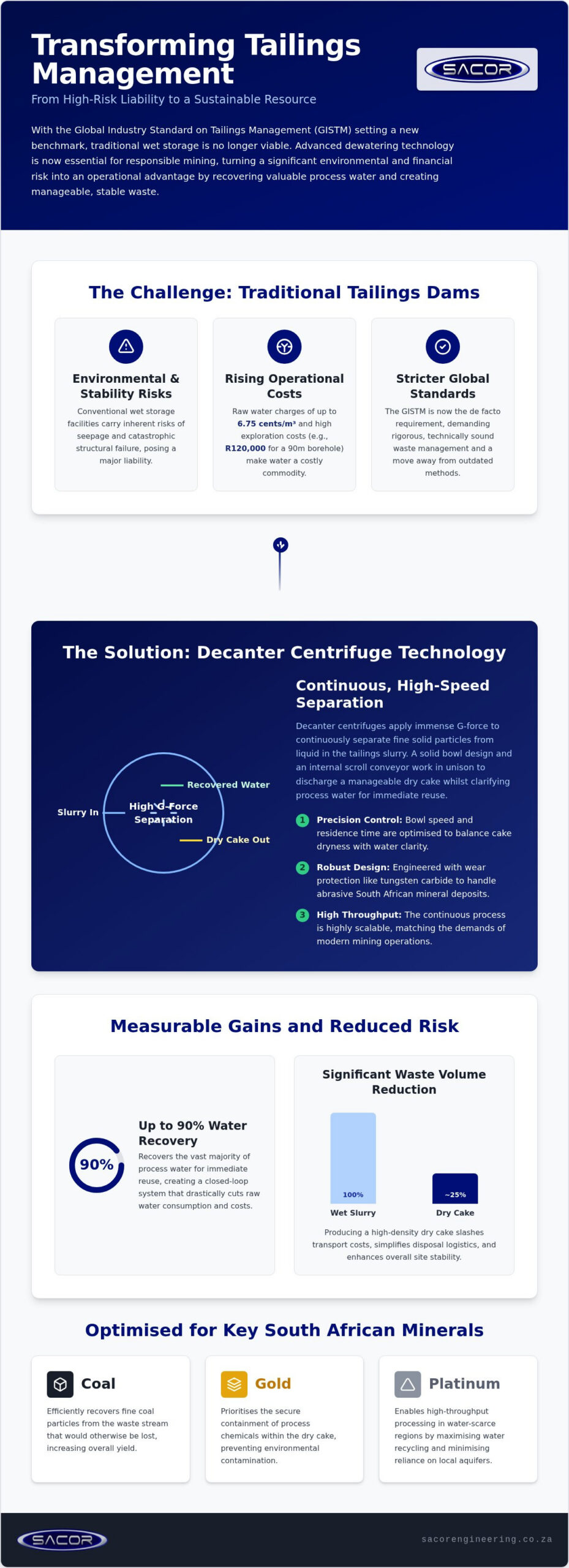
Could your tailings dam be your operation’s greatest financial and environmental liability as we move into 2026? With the Global Industry Standard on Tailings Management (GISTM) now a de facto requirement for responsible mining, the traditional approach to wet waste disposal is no longer sustainable. You’re likely already feeling the strain of rising raw water charges, which reached up to 6.75 cents per cubic metre in recent cycles, alongside the constant pressure to maintain dam stability. It’s a complex challenge that demands more than just incremental changes to your workflow.
We understand that balancing a social licence to operate with operational profitability requires a fundamental shift in how you handle solids. This guide demonstrates how advanced centrifugal dewatering for mine tailings transforms high-volume slurry into a manageable, dry cake whilst recovering up to 90% of process water for immediate reuse. By integrating bespoke decanter centrifuges into your circuit, you can significantly reduce waste volumes and mitigate the catastrophic risks associated with traditional storage. We’ll explore the latest innovations in separation technology and the practical steps to optimise your tailings management for long-term resilience in the South African landscape.
Key Takeaways
- Understand how evolving standards like the GISTM are making mechanical dewatering essential for South African mines seeking to reduce environmental liabilities.
- Discover how centrifugal dewatering for mine tailings enables continuous separation, allowing for up to 90% water recovery and the production of manageable dry cake.
- Compare the efficiency of decanter centrifuges against belt and filter presses to determine which system offers the best throughput for your specific mineral recovery needs.
- Learn why proactive maintenance and professional refurbishment are critical for preventing catastrophic failure and ensuring the longevity of your separation equipment.
- Explore the advantages of bespoke separation technology in creating closed-loop water systems that protect your social licence to operate in water-scarce regions.
The Evolution of Mining Waste Dewatering Systems
The landscape of South African mineral processing has reached a pivotal junction. Historically, mine tailings were managed through vast, wet storage facilities that relied on gravity and time to settle. In 2026, this approach is increasingly obsolete. Modern mining waste dewatering has evolved into a sophisticated mechanical discipline essential for maintaining a social licence to operate. The transition toward centrifugal dewatering for mine tailings reflects a broader industry commitment to the Global Industry Standard on Tailings Management (GISTM), where over 80% of high-risk facilities have already achieved full conformance as of late 2025.
For operations extracting coal, gold, or platinum, the move away from traditional dams isn’t just about compliance; it’s a strategic shift in resource management. Gold mines, for instance, prioritise the containment of process chemicals, whilst coal operations often use separation to recover fine particles that would otherwise be lost. In water-scarce mining regions, platinum producers find that mechanical separation is the only viable path to sustaining high-throughput processing without depleting local aquifers. These minerals represent the backbone of the local industry, and their continued viability depends on precise, high-speed separation technology.
The Environmental Burden of Tailings
Conventional tailings storage facilities (TSFs) carry inherent risks of seepage and catastrophic failure. By implementing mechanical separation, mines can reduce their waste footprint and significantly enhance site stability. This technology is the cornerstone of Zero Liquid Discharge (ZLD) strategies, ensuring that moisture is accounted for and recirculated. It’s a proactive approach that transforms a potential environmental liability into a stable, dry material that is far easier to manage and rehabilitate.
Economic Drivers for Mechanical Separation
Water is no longer a cheap utility. With South African raw water charges reaching up to 6.75 cents per cubic metre in recent financial cycles, the ability to reuse process water directly impacts the bottom line. When you consider that a 90-metre borehole survey in some mining regions can cost up to R120,000, the value of every litre recovered from the waste stream becomes clear. Producing a high-density dry cake also slashes transport costs and simplifies disposal logistics. Tailings dewatering is the mechanical process of removing liquid from mineral waste to achieve maximum volume reduction and solid-liquid separation.
Mechanical Dewatering: Decanter Centrifuge Technology
The decanter centrifuge represents a leap forward in operational efficiency compared to traditional settling ponds. These machines facilitate a continuous separation process, which is vital for maintaining the high throughput required in South African mining. By applying immense G-force, the centrifuge forces fine particles toward the bowl wall, effectively separating them from the process water. This mechanical acceleration is what allows for the precision required to meet the Global Industry Standard on Tailings Management, ensuring that waste is treated with the highest level of technical rigour.
Solid bowl designs are specifically engineered to handle the varying densities of coal, gold, and platinum slurries. The scroll conveyor, or screw, plays a critical role here. It rotates at a slightly different speed than the bowl, continuously scraping the settled solids and pushing them toward the discharge ports. This mechanism ensures that dry cake is removed efficiently without interrupting the flow of treated water, making centrifugal dewatering for mine tailings a far more scalable solution than batch-based alternatives.
Principles of Centrifugal Separation
Centrifugal force acts as a catalyst for separation by magnifying the density difference between solids and liquids. In a tailings circuit, the residence time, the duration the slurry spends inside the bowl, directly dictates the final cake dryness. By optimising bowl speed, engineers can achieve a precise balance between clarity in the recovered water and the moisture content of the solids. It’s a delicate calibration that ensures the system handles high-solids loading without sacrificing the quality of the industrial reuse water.
Design Features for Abrasive Mining Environments
South African mineral deposits are notoriously abrasive. Without robust wear protection, such as tungsten carbide tiles or specialised ceramic coatings, the internal components of a centrifuge would degrade rapidly. High-performance gearboxes are equally essential, providing the necessary torque to manage the heavy solids found in mineral tailings. Selecting the right hardware requires a deep understanding of these mechanical stressors. For a more detailed look at technical specifications, you can consult our Decanter Centrifuge Selection Criteria: 2026 Guide.
Ultimately, the reliability of your dewatering circuit depends on a system tailored to your specific mineral profile. If you’re looking to enhance your current recovery rates, exploring customised separation solutions can provide the technical edge needed to maintain compliance whilst boosting operational efficiency.
Comparing Dewatering Technologies: Finding the Optimal System
Selecting the right mechanical hardware is a decision that dictates the long-term viability of your tailings management systems. Whilst several technologies exist for solid-liquid separation, the choice often comes down to the operational realities of the site. Belt presses, plate-and-frame filter presses, and decanter centrifuges each offer different strengths. However, for high-volume South African operations, the ability to maintain a continuous process is usually the deciding factor. Unlike filter presses that operate in batch cycles, centrifugal systems allow for an uninterrupted flow of material, which prevents bottlenecks in the wider processing plant.
Feed variability is another critical consideration. Mining slurries aren’t uniform; they fluctuate in density and particle size distribution. Centrifugal dewatering for mine tailings is particularly adept at handling these variations. The high-speed rotation and adjustable bowl speeds allow the system to adapt to changes in the feed without requiring the frequent manual recalibration that plagues belt or filter systems. This resilience makes it a preferred choice for sites where the mineralogy of the ore body changes as the pit or shaft progresses.
Centrifuges vs. Filter Presses
From a spatial perspective, decanter centrifuges offer a significantly smaller footprint. A single high-performance unit can process the same volume as a filter press installation that occupies three times the area. This is a vital advantage for site-constrained operations or those looking to integrate dewatering into existing infrastructure. Furthermore, the level of automation in centrifugal systems reduces labour requirements. Whilst a filter press often requires manual intervention for cake release or cloth washing, a centrifuge operates autonomously with minimal oversight. Maintenance cycles are also more predictable. Although centrifuges require specialised refurbishment of high-speed components, they avoid the frequent and costly downtime associated with replacing hundreds of filter cloths.
Performance Metrics for South African Mines
In 2026, the benchmarks for performance are higher than ever. Modern decanter centrifuges can achieve water recovery rates of 80-90%, a critical metric for mines facing rising raw water charges. Energy consumption is also being optimised, with newer units focusing on high torque at lower bowl speeds to reduce the power draw per cubic metre of dewatered slurry. Whilst plate-and-frame filter presses are often cited for achieving superior cake dryness in static environments, decanter centrifuges offer a more robust and continuous alternative for coal tailings recovery, particularly when managing the high-volume throughput typical of South African wash plants. This efficiency ensures that mines can produce a stable, dry cake with 70-80% dry solids, ready for immediate dry stacking or transport.
Optimising Dewatering Performance and Operational Life
Achieving peak performance in a tailings circuit requires more than just high-quality hardware; it demands a rigorous approach to mechanical upkeep. Centrifugal dewatering for mine tailings subjects equipment to extreme centrifugal forces and abrasive slurries, making proactive maintenance the primary defence against catastrophic failure. When a decanter centrifuge operates at several thousand Gs, even minor imbalances or wear patterns can escalate into significant operational risks. Regular monitoring ensures that small issues don’t develop into expensive, unplanned shutdowns.
Feed consistency is a major factor in the longevity of these systems. Fluctuations in solids concentration or particle size distribution force the centrifuge to adjust torque and bowl speed constantly, which increases the thermal and mechanical load on the gearbox and bearings. By stabilising the feed, mines can significantly extend the interval between major service interventions. Identifying wear on the scroll flights and bowl liners early is essential. Once the protective tungsten carbide coating or tiles are breached, the underlying stainless steel erodes rapidly, leading to a sharp drop in separation efficiency.
The Refurbishment Strategy
For many South African mines, the strategic value of professional refurbishment far outweighs the cost of total replacement. A technical Industrial Centrifuge Life Extension: A Strategic Guide to Refurbishment can restore a machine to its original specifications, often at a fraction of the price of new hardware. This process involves more than just replacing worn parts. It includes restoring precision balance to high-speed bowls to eliminate vibration, which is a leading cause of premature bearing failure and structural fatigue.
Troubleshooting Common Dewatering Issues
Operating a dewatering circuit involves managing several variables simultaneously. If you notice poor cake dryness or a sudden spike in polymer consumption, it’s often a sign of internal wear or incorrect bowl speed settings. Torque fluctuations in high-density slurries can also indicate that the scroll is struggling to discharge solids effectively. Regular inspections of the gearbox and bearings are non-negotiable. These components are the heart of the machine, and their failure often leads to extended plant shutdowns that impact the entire mineral recovery circuit.
Maintaining high-performance separation hardware requires a partner who understands the mechanical nuances of the mining sector. If your current system is showing signs of reduced efficiency, it’s time to consider our centrifuge refurbishment services to secure your operational continuity.
Bespoke Dewatering Solutions from Sacor Engineering
Sacor Engineering doesn’t just supply hardware; we provide a consultancy-led partnership designed to solve the specific mechanical challenges of the South African mining sector. By integrating high-performance decanter centrifuges into existing tailings circuits, we help mines transform their waste management from a cost centre into a streamlined, value-recovering operation. Our national presence ensures that technical expertise and support are always accessible, which is vital for maintaining the uptime of critical separation infrastructure across the country’s diverse mining provinces.
Tailored Engineering for Unique Mineral Profiles
Every ore body is different, and a “one size fits all” approach to centrifugal dewatering for mine tailings inevitably leads to operational inefficiencies. Sacor begins every project with a thorough evaluation of slurry characteristics, including particle size distribution, density, and chemical composition. This data-driven approach allows us to design customised separation solutions that are perfectly calibrated for your mineral profile, ensuring maximum throughput and cake dryness. For a broader look at the technology available, see The Comprehensive Guide to Tailings Dewatering Equipment in 2026.
Commitment to Industrial Sustainability
As water scarcity continues to impact social licences to operate across South Africa, the transition to water-efficient processing has become a strategic priority for leadership teams. Sacor supports this evolution by providing systems that maximise water recovery whilst enabling mineral reclamation from waste streams. In coal tailings recovery, for example, our centrifuges can extract high-value fine coal particles that would otherwise be lost to the waste dam, effectively turning a disposal problem into a secondary revenue stream. It’s about more than just compliance; it’s about building a resilient, circular economy within your operation that protects your resources and your bottom line.
Partnering with a specialised expert ensures that your dewatering circuit remains optimised throughout its entire lifecycle. From initial design and installation to long-term refurbishment and technical support, we’re invested in your success. Our engineering team understands the mechanical nuances of heavy industry, providing the precision needed to handle abrasive materials without excessive downtime. If you’re ready to enhance your recovery rates and reduce your environmental footprint, you should Consult with Sacor Engineering for your tailings dewatering needs to find a solution that fits your specific industrial requirements.
Securing Operational Resilience in a Water-Scarce Landscape
The transition toward mechanical separation is no longer optional under modern standards like the GISTM. Implementing high-performance centrifugal dewatering for mine tailings offers a scalable path to achieving up to 90% water recovery while significantly reducing the physical footprint of waste storage. By prioritising bespoke engineering and proactive refurbishment, South African mines can protect their social licence to operate and improve long-term profitability.
Sacor Engineering stands as your trusted expert guide in this transition. We specialise in high-performance decanter centrifuges and provide national technical support across South Africa. Our team brings deep expertise in both new equipment supply and comprehensive refurbishment to ensure your hardware remains efficient in the most abrasive environments. It’s time to transform your waste stream into a sustainable asset.
Optimise your mining waste management with Sacor Engineering and ensure your operation is prepared for the technical demands of 2026 and beyond.
Frequently Asked Questions
What are the primary benefits of using decanter centrifuges for mining waste?
Decanter centrifuges provide continuous solid-liquid separation, which is far more efficient for high-volume mining slurries than batch-based methods. The primary advantages include significant volume reduction of waste and the production of a dry cake that’s easy to handle. By using centrifugal dewatering for mine tailings, operations can also achieve a much smaller mechanical footprint compared to filter presses. This automation reduces manual labour costs whilst ensuring consistent throughput for mineral recovery circuits.
How much water can be recovered using a modern centrifugal dewatering system?
Modern centrifugal dewatering systems are capable of recovering between 80% and 90% of process water for immediate industrial reuse. In the context of 2026 South African water regulations, this high efficiency is vital for maintaining a social licence to operate. Maximising water recovery helps mines mitigate the impact of rising raw water charges, which have fluctuated between 1.98 and 6.75 cents per cubic metre depending on the Water Management Area.
Is mechanical dewatering more cost-effective than a traditional tailings dam?
Mechanical dewatering is often more cost-effective when considering the long-term liabilities and maintenance costs associated with traditional tailings dams. While the initial capital expenditure is higher, the reduction in dam stability risks and the ability to recycle process water provide significant financial offsets. Implementing centrifugal dewatering for mine tailings also slashes transport costs and simplifies disposal logistics. This shift aligns with the Global Industry Standard on Tailings Management, which prioritises safer, dry-stack disposal methods.
What is the difference between thickened tailings and paste dewatering?
The distinction lies in the moisture content and flow characteristics of the final material. Thickened tailings are still pumpable and behave like a heavy liquid, whereas paste dewatering produces a non-segregating material with very little free water. Paste requires higher pressure for transport but offers superior stability for backfilling or surface storage. Decanter centrifuges are highly effective at reaching the precise solid-to-liquid ratios required for both thickened and paste-like consistencies.
Can existing dewatering centrifuges be refurbished to improve performance?
Existing dewatering centrifuges can definitely be refurbished to restore or even enhance their original performance levels. Sacor Engineering specialises in technical refurbishment services that extend the operational life of high-speed separation hardware. This process involves restoring precision balance to the bowl to eliminate vibration and replacing worn internal components with advanced wear-resistant materials. Refurbishment is a strategic, cost-saving alternative to purchasing new equipment whilst maintaining high-performance separation standards.
How does slurry density affect the choice of dewatering equipment?
Slurry density directly dictates the torque requirements and bowl speed settings of your separation hardware. High-density slurries, common in gold and platinum processing, place a greater mechanical load on the centrifuge’s gearbox and scroll conveyor. Choosing a system with a high-torque gearbox and robust wear protection is essential for managing these heavy loads without suffering from premature mechanical fatigue. Precise slurry evaluation ensures the machine is calibrated to your specific mineral profile.
What maintenance is required for high-speed mining centrifuges?
High-speed mining centrifuges require regular gearbox and bearing inspections to prevent unplanned downtime. Maintenance protocols should also include monitoring wear patterns on the scroll flights and bowl liners, particularly when processing abrasive minerals. Precision balancing is another critical requirement; even minor imbalances at high G-forces can lead to catastrophic structural failure. Proactive technical support ensures that internal components like tungsten carbide tiles are replaced before the underlying stainless steel is damaged.
How does dewatering help with environmental compliance in South Africa?
Dewatering is a cornerstone of environmental compliance in South Africa, specifically regarding the Global Industry Standard on Tailings Management (GISTM). By reducing the volume of liquid waste, mines can significantly lower the risk of dam failures and seepage into local groundwater. This technology supports Zero Liquid Discharge goals and helps operations manage the environmental burden of waste sites. It ensures that mineral waste is transformed into a stable material that simplifies long-term site rehabilitation.