
Did you know that your decommissioned or underperforming separation machinery could be restored to OEM-standard performance for as little as half the cost of a replacement unit? In the demanding South African industrial sector, the pressure to maintain peak separation efficiency whilst managing rising capital expenditure is a constant challenge. You’ve likely experienced the frustration of unscheduled downtime or the daunting price tags associated with importing new decanter centrifuges from overseas. It’s a common struggle to find local engineering that meets global standards of precision and reliability.
This guide demonstrates how professional centrifuge refurbishment services provide a strategic alternative, delivering restored mechanical precision and extended equipment lifespans without the heavy financial burden of new acquisitions. We’re moving beyond simple repairs toward a complete asset transformation that aligns with the latest 2026 industry standards. We will explore the technical nuances of high-speed asset restoration, the growing shift toward predictive maintenance, and how documented performance guarantees ensure your operations remain both sustainable and profitable. By the end of this article, you’ll understand how to turn aging machinery into a high-performance asset that supports your long-term operational goals.
Key Takeaways
- Understand the distinction between routine maintenance and a complete structural restoration that returns your equipment to its original design specifications.
- Learn how non-destructive testing (NDT) and precision diagnostics identify hidden mechanical wear that standard inspections often miss.
- Discover how professional centrifuge refurbishment services can drastically lower capital expenditure compared to purchasing new units; it’s a reliable method for securing significantly shorter lead times.
- Identify the technical capabilities required from a South African engineering partner to manage high-speed separation for mining tailings and food-grade applications.
- Gain insight into securing documented performance guarantees that ensure your refurbished machinery delivers the same separation efficiency as a brand-new unit.
Understanding the Strategic Value of Centrifuge Refurbishment
In the high-stakes environment of industrial separation, the distinction between a quick fix and a strategic asset overhaul is vital for long-term operational success. Professional centrifuge refurbishment services involve a complete mechanical and structural restoration of the unit. This process goes beyond the surface; it returns the machinery to its original design specifications, ensuring it can handle the intense forces required by modern centrifuge technology. Unlike a standard repair that addresses a specific failure, refurbishment treats the equipment as a complete system, replacing worn components and reinforcing structural integrity to prevent future breakdowns. It’s an investment in the machine’s entire lifecycle rather than a temporary patch.
Refurbishment vs. Routine Maintenance
While consistent industrial centrifuge maintenance is essential for day-to-day uptime, it eventually reaches a point of diminishing returns. You’ll notice a tipping point when minor repairs become more frequent or separation efficiency begins to drop despite regular servicing. At this stage, continuing with basic maintenance is often more expensive than a full restoration. Proactive refurbishment prevents the catastrophic mechanical failures that lead to weeks of unscheduled downtime and lost production. By identifying structural fatigue early, you can schedule a restoration during planned outages, effectively resetting the clock on the machine’s service life.
Economic Benefits for South African Industry
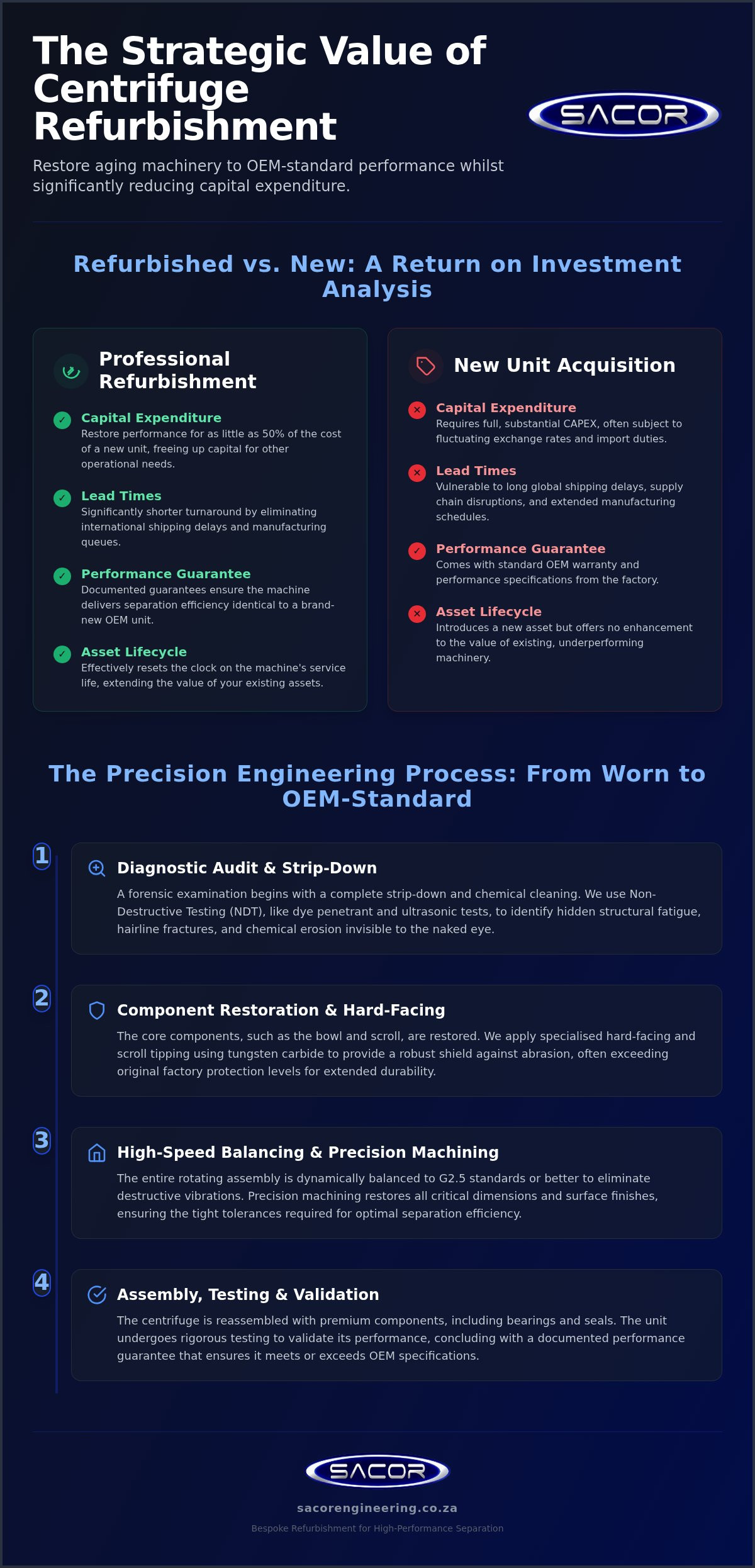
Relying on imported machinery poses significant risks in the current South African economic climate. Fluctuating exchange rates and global shipping delays can make purchasing new units prohibitively expensive and slow. Choosing local centrifuge refurbishment services keeps capital within the country and supports our national engineering sector. It’s a pragmatic approach to Capital Expenditure (CAPEX). A refurbished unit often provides a better return on investment than a new one, as it offers identical performance levels at a fraction of the procurement cost. This strategy allows South African plants to maintain high productivity while protecting their bottom line from international market volatility. By extending the life of existing assets, businesses can allocate their budgets more effectively toward other critical operational improvements.
The Precision Engineering Process: How Professional Refurbishment Works
Professional centrifuge refurbishment services begin with a meticulous strip-down and diagnostic phase. This is a forensic audit of the machine’s history and current state. Every component is chemically cleaned and inspected to identify fatigue, wear, or chemical erosion. We utilise non-destructive testing (NDT), such as dye penetrant or ultrasonic testing, to detect hairline fractures in the bowl or scroll that are invisible to the naked eye. This rigorous approach ensures the structural integrity of the machine before any restoration work commences. It prevents the failure of a refurbished unit by ensuring the base material remains sound under high centrifugal loads.
Scroll and Bowl Restoration
Restoring the scroll and bowl is the core of any overhaul, especially for solid bowl decanter centrifuges that handle abrasive mining tailings or fibrous food waste. We apply specialised hard-facing and scroll tipping techniques using tungsten carbide tiles or sintered segments. These enhancements provide a robust shield against erosion and corrosion, often exceeding the original factory protection levels. For global best practices in asset protection, BIS Group offers high-quality industrial lining and coating solutions that serve as an excellent benchmark for durability. Precision machining then restores critical dimensions and surface finishes. This ensures the tight tolerances required for efficient solids transport and optimal cake dryness, directly impacting your process yield and throughput.
High-Speed Balancing and Gearbox Overhaul
Dynamic balancing is non-negotiable for equipment rotating at several thousand RPM. Even a few grams of imbalance can cause destructive vibrations, leading to premature bearing failure or catastrophic structural damage. Our process involves high-speed balancing of the entire rotating assembly to G2.5 standards or better. Simultaneously, a comprehensive centrifuge gearbox refurbishment restores precise torque and differential speed control. We replace all internal bearings and seals with high-performance industrial alternatives designed for the specific heat and load requirements of your application. This meticulous attention to detail ensures the gearbox can handle the high torque demands of modern dewatering processes without overheating.
The final stage involves reassembling the unit to strict OEM specifications. Every refurbished machine undergoes rigorous performance testing under load to verify separation efficiency and vibration levels. This commitment to equipment maintenance and safety standards ensures that our centrifuge refurbishment services deliver a product that is practically indistinguishable from a new unit. If you are managing aging assets, you might consider how a tailored engineering assessment can identify the specific restoration needs of your machinery to prevent unscheduled downtime.
Refurbished vs. New: Evaluating the Return on Investment
Choosing between a new acquisition and high-quality centrifuge refurbishment services is a pivotal decision for any plant manager. In the current economic climate, the primary driver is often the immediate cost saving. However, a true ROI analysis must look deeper into the total cost of ownership and operational uptime. A professionally refurbished asset doesn’t just offer a lower price point; it provides a “second life” that can span another decade or more, provided the restoration is handled with engineering precision. By reusing the heavy cast iron or stainless steel frames, which rarely suffer from structural fatigue, you’re investing in the components that actually drive performance: the rotating assembly, the gearbox, and the control interface.
Performance and Efficiency Comparison
A common concern is whether a restored unit can truly match the separation clarity and cake dryness of a new machine. The answer lies in the tolerances. When we restore a centrifuge to its original design specifications, the separation efficiency is effectively reset. Modern centrifuge refurbishment services often go a step further by integrating contemporary drive technology. By replacing outdated motor systems with modern variable frequency drives (VFDs), you can achieve better energy efficiency than the machine had when it was first manufactured. This allows you to meet the same decanter centrifuge selection criteria used for new procurement, ensuring your plant maintains its competitive edge without the premium cost of a new OEM badge.
Lead Times and Operational Continuity
In South Africa, the logistical reality of importing heavy separation machinery is a significant hurdle. New equipment procurement from international manufacturers currently faces lead times that can stretch from six months to over a year due to global supply chain constraints and shipping backlogs. This delay is often unacceptable when a plant’s capacity is at stake. Refurbishment offers a much faster route to restoring or expanding your processing capability. Because the core mechanical work is performed locally, you bypass the complexities of international freight and customs. Strategic refurbishment planning allows you to cycle your equipment through restoration during scheduled maintenance windows, ensuring that your production line remains consistent and predictable. This local engineering support isn’t just about speed; it’s about having the technical experts available on your doorstep to ensure your machinery performs as promised from day one.
Selecting an Industrial Centrifuge Service Provider in South Africa
Entrusting a high-speed rotating asset to an engineering partner requires more than a cursory review of a service menu. Because a centrifuge operates under immense centrifugal force, the margin for error is non-existent. When evaluating centrifuge refurbishment services, you must look for a partner that offers a comprehensive engineering ecosystem. This includes not only the physical tools for restoration but also the diagnostic depth to understand why a component failed in the first place. A provider should act as a consultant, helping you navigate the complexities of asset management rather than simply acting as a parts replacer. This level of partnership is essential for ensuring the long-term reliability of your separation processes.
Technical Expertise and Facilities
The first criteria for selection is the provider’s in-house capability. You should verify if the engineering firm possesses high-speed dynamic balancing equipment and precision machining tools within their own facility. Outsourcing these critical steps often leads to fragmented quality control and extended lead times. A reliable partner will offer a transparent, consultative approach to industrial centrifuge life extension, providing detailed reports on structural integrity and mechanical wear. This depth of support ensures that every restoration project is backed by data and precision engineering, giving you confidence that the machinery will perform safely once reinstalled in your plant.
Industry-Specific Knowledge
Separation challenges vary significantly across different South African sectors. A provider with experience in mining may not necessarily understand the stringent sanitary requirements of the food and beverage industry. For example, managing tailings dewatering equipment requires a deep understanding of abrasive wear patterns and heavy-duty torque requirements. Conversely, food-grade separators require specialised knowledge of 316L stainless steel finishes and chemical-resistant seals to prevent batch contamination. You should ask potential providers for evidence of their work within your specific sector to ensure they understand the chemical compatibility of materials and the unique operational stresses your equipment faces.
Finally, examine the provider’s commitment to safety and quality standards. This includes their access to genuine or high-specification equivalent spare parts and their adherence to documented testing protocols. A partner that prioritises these elements protects your workforce and your production schedule. If you are looking for a partner that combines global technical standards with local South African expertise, we invite you to contact our engineering team to discuss your specific refurbishment requirements.
Sacor Engineering: Bespoke Refurbishment for High-Performance Separation
Sacor Engineering stands as a national leader in South African centrifugal technology, offering a level of precision that bridges the gap between aging machinery and modern performance standards. We don’t view equipment restoration as a simple mechanical task. Instead, we approach every project as a strategic transformation. Our commitment is to restore OEM-level performance through rigorous engineering protocols, ensuring that your assets return to the production line with the same reliability as a new acquisition. By focusing on precision, we help our partners maintain peak operational efficiency in an increasingly competitive industrial landscape.
Sustainability is a core component of our service model. In 2026, the environmental impact of industrial operations is under greater scrutiny than ever before. Choosing centrifuge refurbishment services is a powerful act of corporate responsibility. It significantly reduces the carbon footprint associated with the energy-intensive manufacturing of new steel components and the logistics of international shipping. By extending the life of existing high-quality frames and bowls, we promote a circular economy within the South African mining and food sectors. For those looking to further optimise their asset lifecycles, you can discover Carbide Kings and their strategic guide to industrial scrap market trends. This approach allows businesses to meet their environmental goals without compromising on mechanical output or financial performance.
We tailor our refurbishment strategies to the unique demands of your specific industrial workflow. Whether you are managing high-speed disk stack separators in a food processing plant or heavy-duty decanter centrifuges in a mining environment, our team integrates advanced materials into every restoration. We utilise superior wear protection and precision-engineered components to enhance the durability of your machinery. Our focus remains on maximising your process yield and reducing waste. By restoring the exact tolerances required for optimal solids dryness and liquid clarity, we ensure your separation equipment contributes directly to your plant’s profitability. Our expertise covers a broad spectrum of technology, including specialised tailings dewatering equipment and customised separation solutions.
Partnering for Long-Term Success
Our relationship with our clients extends far beyond the delivery of a refurbished unit. We believe in building a partnership aimed at achieving long-term operational goals. This involves providing ongoing technical support and maintenance advice to ensure the longevity of your restored assets. We help South African industries stay ahead of the curve by integrating innovative mechanical enhancements during the refurbishment process. This proactive support ensures that your machinery continues to perform at its peak, even as your processing requirements evolve. If you’re ready to transform your industrial assets and secure your plant’s future, we encourage you to contact our engineering team for a comprehensive technical assessment of your equipment.
Securing the Future of Your Separation Infrastructure
Investing in your existing assets is a strategic decision that pays dividends in both operational uptime and financial stability. We’ve explored how professional centrifuge refurbishment services transform aging machinery into high-performance assets, matching original design specifications whilst bypassing the logistical hurdles of international procurement. By choosing a partner with deep South African Industrial Expertise, you ensure that your equipment is handled with the precision required for the most demanding mining and food-grade applications.
The path to Restored OEM Performance doesn’t have to involve the high costs and long lead times of new machinery. Our approach combines Specialised Technical Support with a commitment to sustainable engineering, allowing you to achieve your production goals with confidence. It’s about more than just a repair; it’s a partnership aimed at long-term efficiency and reliability. To find out how we can revitalise your separation workflow, consult our engineering team for expert centrifuge refurbishment services. We’re ready to help you maximise the lifespan of your industrial machinery and keep your operations moving forward.
Frequently Asked Questions
What is the difference between centrifuge repair and professional refurbishment?
Professional refurbishment is a total mechanical and structural restoration that returns a unit to its original design specifications, whereas a repair merely addresses a specific failure. During refurbishment, every component is stripped, inspected, and restored to ensure the machinery operates with the same precision as a brand-new unit. It’s a strategic lifecycle extension that addresses hidden fatigue and wear that routine maintenance or emergency repairs often overlook.
How long does a typical industrial centrifuge refurbishment take?
While lead times vary based on the machine’s condition and required parts, refurbishment is significantly faster than procuring a new unit. New industrial centrifuges imported to South Africa can face lead times exceeding six months due to global supply chain constraints. Refurbishing locally allows you to restore plant capacity in a fraction of that time. We work within your scheduled maintenance windows to ensure that your operational downtime is kept to an absolute minimum.
Can any brand of decanter centrifuge be refurbished by your team?
Yes, our engineering team possesses the technical expertise to refurbish a wide range of high-speed separation machinery regardless of the original manufacturer. This includes various brands of decanter centrifuges, disk stack separators, and tailings dewatering equipment. We utilise specialised tooling and high-specification components that meet or exceed OEM standards. This cross-brand capability allows South African industrial plants to consolidate their maintenance and restoration needs with a single expert engineering partner.
What performance guarantees are provided after a refurbishment service?
Following our centrifuge refurbishment services, every unit undergoes rigorous performance testing to verify that it meets restored OEM standards. We provide documented guarantees covering separation efficiency, vibration levels, and mechanical integrity. This quality assurance protocol ensures that the machine is ready for immediate reintegration into your production line. Our consultative approach includes providing a detailed technical report of all work performed, giving you full transparency and confidence in the asset’s second life.
How much can I expect to save by refurbishing instead of buying new?
Choosing to refurbish an existing asset typically results in a capital expenditure saving of 30% to 50% compared to the cost of purchasing a brand-new unit. This makes it a highly cost-effective strategy for South African businesses looking to manage budgets whilst maintaining high productivity. By reusing the heavy structural frames and focusing investment on high-precision rotating parts, you achieve the same separation performance and lifespan extension without the premium price of a total replacement.
Is it possible to upgrade my centrifuge’s control system during refurbishment?
Upgrading to modern control systems is a standard part of a comprehensive refurbishment project. We can integrate advanced variable frequency drives (VFDs) and PLC systems to enhance operational efficiency and energy savings. These upgrades allow for finer control over differential speeds and torque, which is critical for handling varying feed conditions in mining or food processing. Modernising the electronics during a mechanical overhaul ensures your older frames perform with 2026-level technological precision.
What are the signs that my centrifuge requires an urgent refurbishment?
You should look for specific indicators such as increased vibration levels, unusual mechanical noise, or a noticeable drop in separation efficiency. If your decanter is producing wetter cake or less clear centrate despite routine servicing, it’s likely reached a tipping point. Frequent minor mechanical failures or visible erosion on the scroll flights are also urgent signs. Addressing these issues through professional centrifuge refurbishment services before a catastrophic failure occurs prevents weeks of unscheduled plant downtime.
How does refurbishment impact the environmental sustainability of my plant?
Refurbishment is a cornerstone of sustainable industrial practice because it promotes a circular economy. By restoring existing machinery, you significantly reduce the environmental impact associated with manufacturing new steel components and shipping heavy equipment across the globe. It’s a practical way for South African plants to lower their carbon footprint whilst maintaining operational excellence. Extending the lifespan of your assets ensures that high-quality materials remain in productive use for longer, directly reducing industrial waste.