
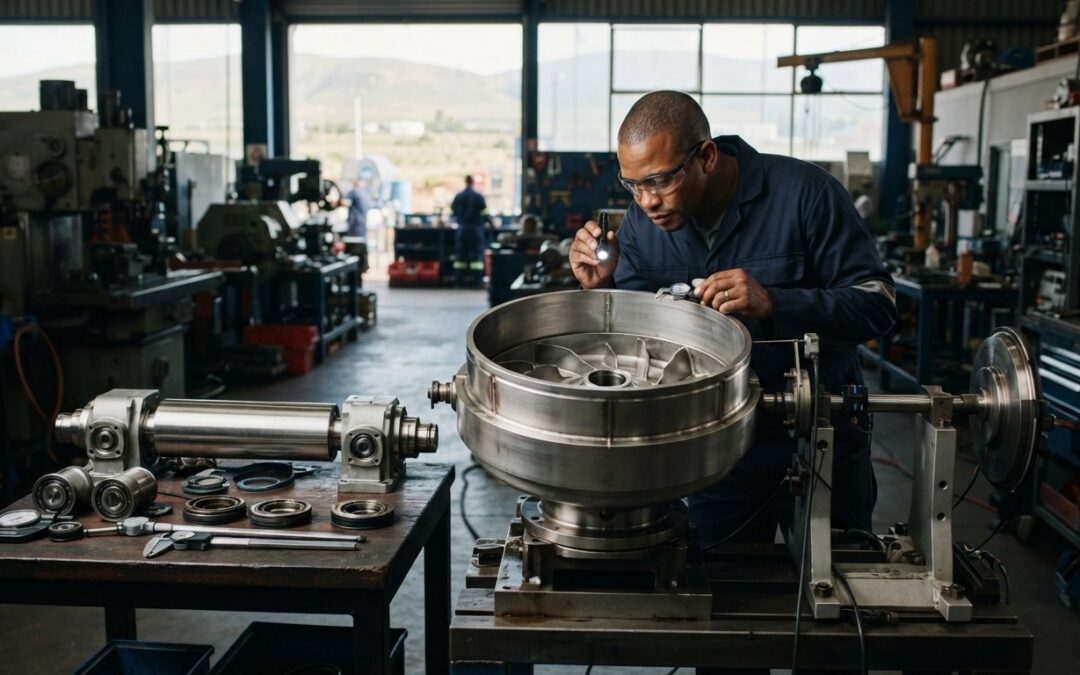
Replacing a worn centrifuge bowl is often an unnecessary drain on capital that ignores the potential for superior re-engineering. You’ve likely noticed the subtle warning signs: a slight increase in vibration, a decrease in cake dryness, or liquid clarity that no longer meets your rigorous standards. These aren’t merely operational inconveniences; they’re indicators of wear that could lead to unplanned downtime or catastrophic mechanical failure. We understand that maintaining peak performance whilst managing equipment lifecycles is a constant balancing act for plant managers.
This technical guide demonstrates how a precision centrifuge bowl refurbishment restores your machinery to its original G-force performance, often exceeding the durability of the initial install. By following a structured restoration path, you can extend the lifespan of expensive capital equipment and ensure total operational safety. We will explore the essential engineering stages, including non-destructive testing and precision balancing, to show you how to transform degraded components into reliable, high-efficiency assets for 2026 and the years ahead.
Key Takeaways
- Learn why professional centrifuge bowl refurbishment is critical for restoring structural integrity and managing the intense stresses of high G-force operations.
- Discover the essential role of Non-Destructive Testing (NDT) in identifying sub-surface defects that compromise safety and separation efficiency.
- Understand how precision dynamic balancing reduces energy consumption and extends the operational life of bearings by eliminating parasitic vibration.
- Evaluate the financial advantages of refurbishment over new procurement, including significantly reduced lead times and lower capital expenditure.
- Identify how bespoke restoration plans can enhance wear resistance beyond original OEM specifications to realise long-term reliability.
The Engineering Criticality of Centrifuge Bowl Integrity
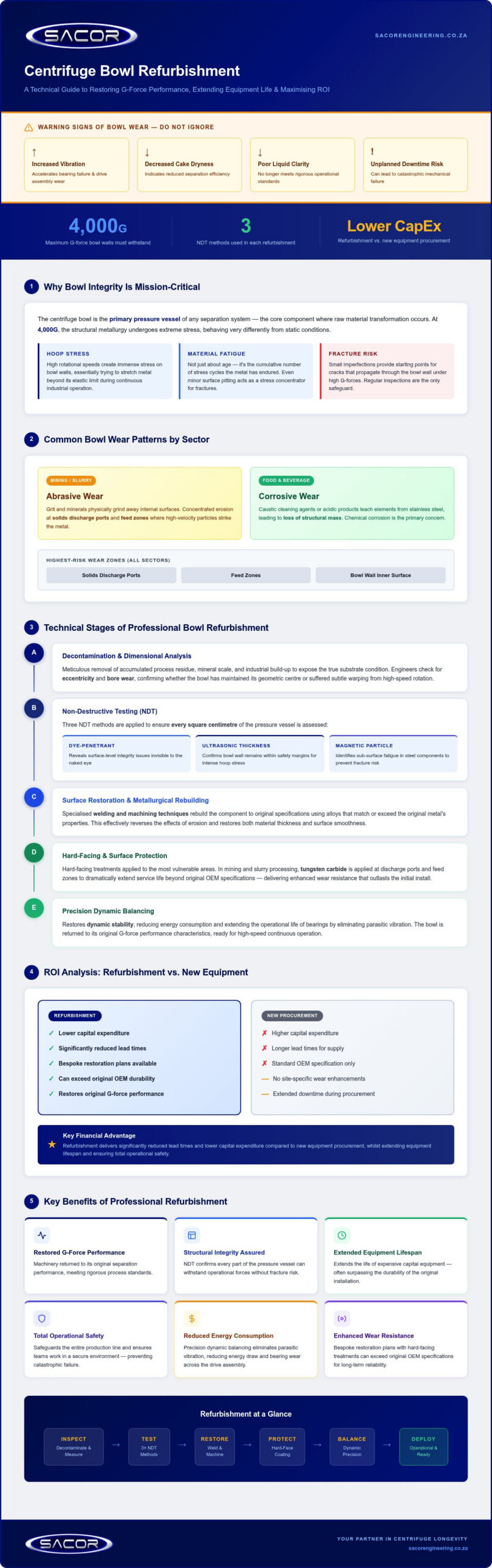
The centrifuge bowl acts as the primary pressure vessel of any separation system. It’s the core component where the actual transformation of raw material occurs. To fully grasp the mechanical demands involved, one must consider the centrifuge separation principles that dictate how these machines function. When a bowl rotates at speeds capable of generating 4000G, the structural metallurgy undergoes extreme stress. At this level of force, the material behaves differently than it would under static conditions, making the integrity of the alloy paramount to operational safety and process efficiency.
Common wear factors such as abrasion from heavy solids, chemical corrosion from process fluids, and general erosion can silently degrade this integrity. If you ignore these signs, the consequences are severe. Unchecked wear leads to increased vibration, which rapidly accelerates bearing failure and compromises the drive assembly. A professional centrifuge bowl refurbishment isn’t just about fixing a part; it’s about safeguarding your entire production line from catastrophic failure and ensuring your team works in a secure environment.
Centrifugal Force and Structural Stress
High rotational speeds create immense hoop stress on bowl walls, essentially trying to stretch the metal beyond its elastic limit. In industrial settings where machines run continuously, material fatigue becomes a significant factor. This isn’t just about age; it’s about the number of stress cycles the metal has endured. Even minor surface pitting can be deceptive. These small imperfections act as stress concentrators, providing a starting point for fractures that can propagate through the bowl wall under the influence of high G-forces. Regular inspections are the only way to catch these issues before they turn into structural breaks.
Identifying Common Bowl Wear Patterns
Wear patterns vary significantly across different sectors. In mining tailings and slurry processing, abrasive wear is the most frequent challenge, as grit and minerals physically grind away the internal surfaces. Conversely, in food and beverage applications, corrosion is often the primary concern. Caustic cleaning agents or acidic products can leach elements from the stainless steel, leading to a loss of structural mass. You’ll often find concentrated erosion at the solids discharge ports and feed zones, where high-velocity particles strike the metal. A thorough centrifuge bowl refurbishment addresses these specific wear zones by restoring material thickness and surface smoothness to original specifications.
The Technical Stages of a Professional Bowl Refurbishment
A successful restoration begins with a meticulous decontamination process. Removing decades of accumulated process residue, mineral scale, and industrial build-up is essential to expose the true condition of the substrate. Mechanical cleaning isn’t merely for aesthetics; it’s a functional requirement that allows engineers to perform an accurate dimensional analysis. During this phase, we check for eccentricity and bore wear, identifying if the bowl has maintained its geometric centre or if years of high-speed rotation have caused subtle warping that could lead to catastrophic failure.
Once the assembly is clean and measured, the focus shifts to metallurgical integrity. Surface restoration involves specialised welding and machining techniques designed to rebuild the component to its original specifications. By using alloys that match or exceed the original metal’s properties, we can effectively reverse the effects of erosion. If your equipment is showing signs of performance decay, our centrifuge refurbishment services provide a structured, consultative approach to these complex mechanical challenges.
Precision Non-Destructive Testing (NDT)
Identifying sub-surface cracks is a non-negotiable stage of a professional centrifuge bowl refurbishment. We employ dye-penetrant testing to reveal surface-level integrity issues that are invisible to the naked eye. For a deeper assessment, ultrasonic thickness testing confirms that the bowl wall remains within the safety margins required to handle intense hoop stress. Magnetic particle inspection further identifies fatigue in steel components, ensuring that every square centimetre of the pressure vessel is capable of withstanding operational forces without risk of fracture.
Hard-Facing and Surface Protection
To enhance the durability of the refurbished bowl, we apply hard-facing treatments to the most vulnerable areas. In mining and slurry processing, the application of tungsten carbide or specialised wear-resistant alloys creates a sacrificial layer that significantly extends the interval between service cycles. Following the application of these materials, precision machining restores the original geometric tolerances. For clients in the food and beverage sector, we ensure all surfaces receive food-grade finishes. These high-polish treatments eliminate microscopic pits where bacteria could harbour, ensuring your equipment meets the most stringent hygiene standards whilst maintaining peak separation efficiency.
Precision Balancing: Restoring Dynamic Stability
Dynamic stability is the final, critical hurdle in the engineering workflow. Once the metallurgical repairs and surface treatments are complete, the assembly must be calibrated to handle high-speed rotation without generating destructive parasitic forces. Dynamic balancing is non-negotiable for decanter centrifuge bowls because even the slightest deviation from the rotational centre leads to excessive vibration. This vibration doesn’t just shake the machine; it creates heat, accelerates bearing wear, and significantly increases energy consumption. By eliminating these rotational harmonics through multi-plane balancing, we ensure the equipment operates at its peak efficiency whilst protecting the integrity of the drive system.
The Physics of Rotational Imbalance
At operational speeds, the laws of physics amplify minor imperfections with alarming efficiency. A mere few grams of imbalance at the bowl’s periphery can exert hundreds of kilograms of centrifugal force when the machine is running at full capacity. These forces don’t remain localised; they’re transmitted directly into the centrifuge gearbox and the main frame. This constant pounding causes metal fatigue and premature component failure, often leading to the very cracks identified during the NDT stage. Identifying the “sweet spot” for operational stability requires more than just standard calibration. It demands an understanding of how the machine behaves under load, ensuring that the centre of mass aligns perfectly with the geometric axis of rotation.
Sacor Engineering’s Approach to Precision
Our methodology relies on advanced sensors capable of detecting micro-vibrations that traditional methods might overlook. We don’t just balance the bowl in isolation, as this only solves half the problem. It’s vital to balance the bowl and scroll as a matched set. Their interaction during operation can introduce new imbalances if they aren’t synchronised, particularly when processing variable-density slurries in mining or food production. Every centrifuge bowl refurbishment we undertake concludes with rigorous testing protocols to ensure your machinery returns to service in peak condition.
- Multi-plane calibration: We address imbalance across the entire length of the bowl, not just at the ends, to neutralise complex harmonics.
- ISO 1940/1 Compliance: We ensure all assemblies meet or exceed stringent international balancing grades for high-speed rotors.
- Matched Set Synchronisation: The bowl and scroll are tested together to eliminate any potential for harmonic interference during operation.
- Comprehensive Documentation: We provide detailed balance reports for your compliance and safety records, verifying the restored stability.
This thorough approach ensures that when your equipment returns to the plant, it doesn’t just run; it performs with the quiet precision of a new machine. Documenting these results provides you with a comprehensive safety record and proof of compliance that guarantees your equipment is ready for the demands of 2026 and beyond. This commitment to precision is what transforms a simple repair into a long-term operational advantage for your facility.
ROI Analysis: Refurbishment vs. New Equipment Procurement
Deciding between capital expenditure for new machinery and the restoration of existing assets requires a clear understanding of long-term value. For many plant managers in the mining and food sectors, the primary driver is the significant difference in cost. A professional centrifuge bowl refurbishment typically represents only 40% to 60% of the cost of a new replacement unit. This allows for a more efficient allocation of maintenance budgets without compromising on the machinery’s operational output or safety standards. It’s a pragmatic way to maintain high-performance separation whilst deferring the heavy CAPEX associated with new procurement.
Lead times provide another compelling argument for restoration. In the current industrial climate of 2026, procuring a new high-specification bowl can take several months due to global manufacturing queues. In contrast, a comprehensive refurbishment is usually completed in a matter of weeks. This reduction in downtime directly translates to maintained production targets and improved revenue stability. It’s often the difference between a minor scheduled pause and a prolonged shutdown that affects the entire plant’s output. Beyond the schedule, choosing to refurbish supports a circular engineering model, reducing the environmental impact associated with manufacturing new heavy-duty steel components.
The Economic Case for Refurbishment
Investing in industrial centrifuge life extension isn’t just about saving money today; it’s about reducing the total cost of ownership (TCO) over the machine’s entire lifespan. By choosing a precision restoration, you’re essentially resetting the clock on your most expensive capital equipment. This strategic approach allows facilities to maintain high-performance separation whilst managing tighter operational budgets. It’s a solution that balances fiscal responsibility with mechanical reliability, ensuring that your equipment remains an asset rather than a liability.
Assessing Equipment Lifespan
Not every bowl is a candidate for restoration, and safety remains the absolute priority. If historical maintenance data or NDT results show extreme wall thinning beyond safe engineering limits, replacement becomes the only viable path. However, most units with surface-level erosion or minor fatigue are ideal candidates for a second or even third life. Consulting with expert industrial centrifuge service providers ensures you receive an honest, data-driven audit of your equipment’s condition. If you’re ready to evaluate your machinery’s potential, contact our engineering team for a technical assessment to determine the best path forward for your facility.
Sacor Engineering: Your Partner in Centrifuge Longevity
Sacor Engineering is more than a service provider; we’re a dedicated partner in your operational success. Our commitment to restoring high-performance separation machinery ensures that your facility maintains global efficiency standards whilst managing the realities of industrial wear. We provide a vital bridge between complex engineering requirements and daily operational needs, ensuring that your centrifuge bowl refurbishment isn’t just a technical fix but a strategic improvement. Every project we undertake is grounded in practical experience, focusing on extending the life of your assets and reducing the risk of unplanned downtime.
Our approach is built on a foundation of reliability and consultative support. We don’t just repair equipment; we offer a partnership aimed at achieving your long-term operational goals. By combining a global perspective with accessible, localised support, we create an atmosphere of dependable excellence that South African industries can rely on. This forward-thinking mindset allows us to revolutionise your industrial workflows through precision engineering and mechanical reliability.
Industry-Specific Expertise
We recognise that different sectors face unique challenges that require bespoke solutions. In the mining industry, we provide specialised restoration for tailings dewatering equipment, where abrasive slurries demand high-durability alloys and precision hard-facing. For our food and beverage clients, we implement hygienic refurbishment standards that prioritise surface finish and microbiological safety. Our expertise also extends to energy and oil separation processes, where reliability is essential for maintaining production continuity in demanding environments. This tailored approach ensures that the refurbishment plan matches your specific industrial workflow and regulatory requirements perfectly.
Getting Started with Your Refurbishment
Initiating a refurbishment project begins with a comprehensive technical audit. Our engineering team conducts a thorough on-site or workshop-based inspection to determine the current state of your equipment. We don’t believe in one-size-fits-all solutions. Instead, we offer a consultative process that identifies the most cost-effective and technically sound path forward for your specific machinery. With a nationwide support network, we’re positioned to provide accessible assistance to industrial plants across South Africa, ensuring your maintenance needs are met with speed and precision.
If you’re ready to restore original G-force performance and extend the lifespan of your capital equipment, our team is ready to assist. We invite you to contact our engineering experts for a comprehensive consultation. By partnering with Sacor Engineering, you’re investing in a future of dependable excellence and mechanical reliability that keeps your operations running at peak efficiency for 2026 and beyond.
Optimising Industrial Separation for a Resilient Future
Restoring your separation efficiency requires more than just mechanical repair; it demands a precision-led engineering approach that addresses the structural and dynamic integrity of your equipment. By prioritising specialised NDT and rigorous dynamic balancing, you can transform worn components into high-performance assets that meet original OEM specifications. This proactive strategy not only reduces capital expenditure by up to 60% but also streamlines your maintenance cycles through significantly shorter lead times than new procurement. We’ve seen how these technical interventions prevent catastrophic failure whilst ensuring your plant operates at peak performance.
Our team brings deep expertise in both decanter and disk stack technology, serving the critical needs of the South African mining and food sectors. We’re committed to helping you achieve total operational safety and extended equipment life through a consultative, expert-led process. If you’re ready to enhance your plant’s performance for 2026, consult our engineering team for professional centrifuge bowl refurbishment. Let’s work together to ensure your machinery remains a reliable cornerstone of your production success for years to come.
Frequently Asked Questions
How often should a centrifuge bowl undergo professional inspection?
A centrifuge bowl should undergo professional inspection every 12 to 24 months, depending on the intensity of your operational cycle. In abrasive environments like mining tailings, more frequent audits are necessary to monitor material loss. We recommend a consultative approach where inspection intervals are aligned with your specific vibration data and process conditions. Regular check-ups prevent minor wear from escalating into structural failures that require a full centrifuge bowl refurbishment.
Can a centrifuge bowl be refurbished if it shows signs of cracking?
Yes, many bowls showing surface-level cracking can be safely restored through precision welding and metallurgical re-engineering. However, the viability of the repair depends on the results of Non-Destructive Testing (NDT). If cracks are sub-surface or have compromised the primary pressure vessel’s structural limit, replacement is the safer path. Our engineers evaluate each case individually to ensure the final assembly meets the rigorous safety standards required for high-speed industrial rotation.
What are the main causes of vibration in a decanter centrifuge bowl?
Vibration in a decanter centrifuge bowl typically stems from three primary issues: uneven solids accumulation, mechanical bearing wear, or erosion of the bowl’s internal geometry. When the centre of mass shifts away from the rotational axis, it creates parasitic forces that shake the entire frame. This imbalance often occurs as abrasive materials wear down discharge ports unevenly. Addressing these issues early through dynamic balancing is essential to prevent secondary damage to the gearbox and drive motor.
How long does the typical centrifuge bowl refurbishment process take?
The typical centrifuge bowl refurbishment process usually takes between three and six weeks, depending on the extent of the metallurgical damage. This timeline is significantly shorter than the months-long lead times often associated with procuring new OEM components in 2026. The process includes decontamination, NDT, precision machining, and final balancing. This rapid turnaround ensures your facility returns to full operational capacity whilst minimising the impact of unplanned downtime on your production targets.
Is dynamic balancing included in the refurbishment service?
Dynamic balancing is a standard and non-negotiable component of our refurbishment service. Every bowl and scroll assembly we restore undergoes multi-plane balancing to ensure it meets ISO 1940/1 standards for high-speed rotors. We test these components as a matched set to eliminate rotational harmonics that could cause future mechanical fatigue. You’ll receive a comprehensive balance report that verifies the assembly is ready for safe, vibration-free operation in your specific industrial workflow.
What is the difference between surface repair and structural refurbishment?
Surface repair focuses on restoring wear-resistant layers, such as applying tungsten carbide hard-facing to discharge ports. Structural refurbishment is a more intensive process that involves identifying and fixing sub-surface fatigue, restoring material thickness, and ensuring the bowl’s geometric eccentricity is corrected. While surface repairs address immediate erosion, structural work ensures the long-term integrity of the centrifuge bowl refurbishment by treating the assembly as a high-pressure vessel rather than just a mechanical part.
Can refurbishment improve the wear resistance of the original bowl?
Refurbishment often improves upon the original bowl’s durability by utilising advanced alloys and superior hard-facing techniques that weren’t available during the initial manufacture. We can customise the wear protection to suit your specific process, whether you’re dealing with acidic food products or abrasive mining slurry. This bespoke approach allows us to enhance the equipment’s lifespan beyond its original design, offering a more resilient solution that better withstands your plant’s unique operational stresses.
Are refurbished centrifuge bowls as safe as new ones?
Refurbished bowls are entirely safe for industrial use, provided they pass rigorous Non-Destructive Testing and meet all dimensional tolerances. We don’t restore units where wall thinning has progressed beyond safe engineering limits. Every unit that leaves our workshop is certified to handle the intense G-forces required for efficient separation. Our commitment to precision engineering ensures that a refurbished bowl provides the same level of operational security and performance as a brand-new unit.