

Thermal systems may prepare the batch, but continuous mechanical separation ultimately dictates plant profitability and recovery margins. In high-volume manufacturing, deploying the right food and beverage processing equipment is the defining factor between exceptional clarity and costly product loss down the drain. You already recognise that high-speed rotating components bear the brunt of daily operation; dealing with abrasive wear, Clean-in-Place bottlenecks, and crippling lead times for imported spares can quickly compromise an entire production schedule.
You shouldn’t have to sacrifice flavour, colour, or sanitary compliance just to satisfy demanding throughput targets. In this engineering guide, you will discover how to evaluate, select, and maintain industrial separation machinery to maximise recovery yields whilst meeting rigorous international hygiene standards. We examine continuous separation principles, review critical sanitary design updates, and outline how dependable national engineering support extends equipment service life without unnecessary downtime.
Key Takeaways
- Understand how transitioning to continuous food and beverage processing equipment eliminates batch bottlenecks whilst safeguarding product colour, flavour, and yield.
- Learn the mechanical criteria for evaluating decanter centrifuges and disk stack separators based on fluid rheology, density differentials, and target solids clarity.
- Discover how recent updates to EHEDG guidelines and 3-A Sanitary Standards dictate food-contact metallurgy, surface finish thresholds, and clean-in-place protocols.
- Master predictive maintenance practices, including dynamic bowl balancing and scroll refurbishment, to prevent catastrophic mechanical failure during intensive harvesting cycles.
- Explore the strategic advantages of partnering with national engineering specialists to eliminate extended overseas lead times and secure bespoke separation solutions.
What Is Modern Food and Beverage Processing Equipment?
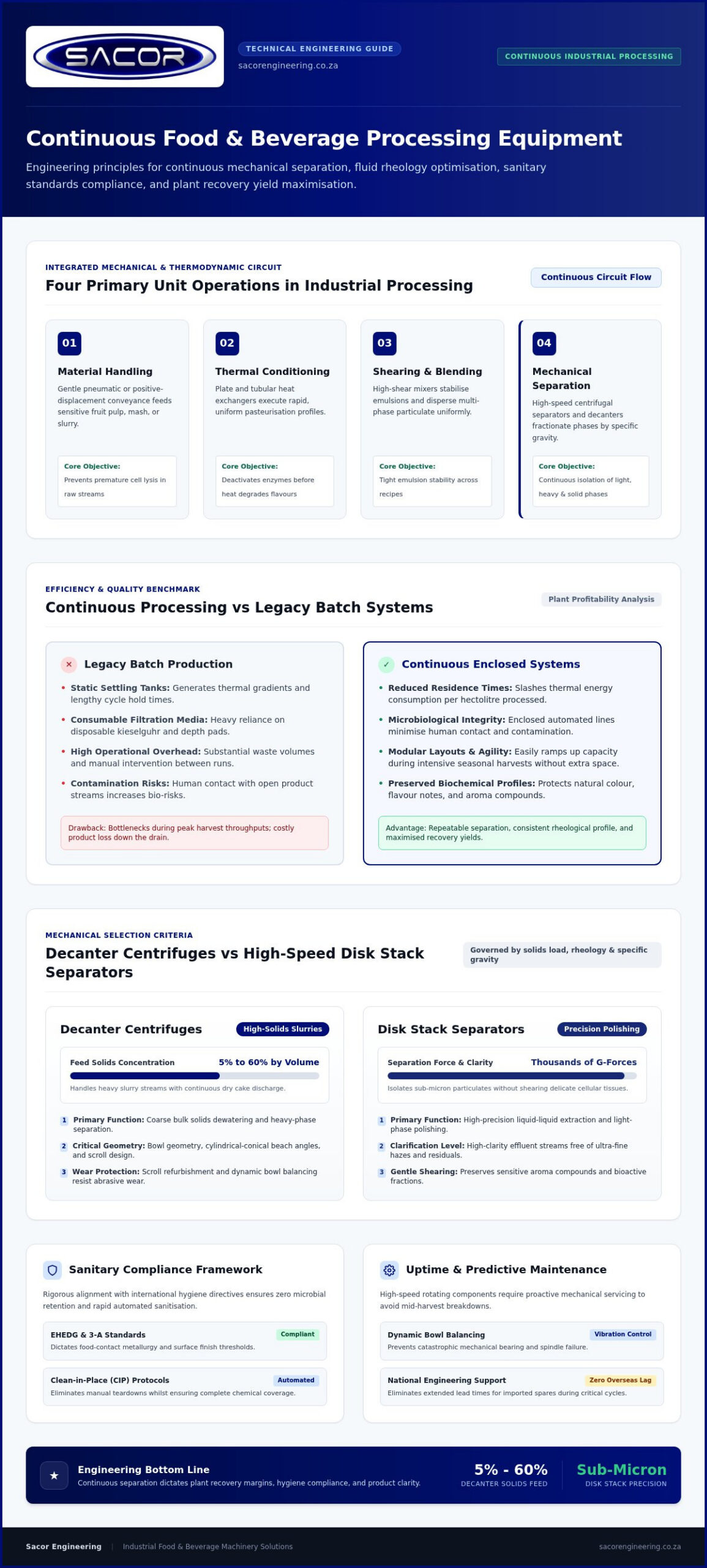
Modern industrial processing converts raw, perishable agricultural harvests into uniform, shelf-stable goods. At its core, food processing relies on highly coordinated mechanical and thermal unit operations that alter physical structures, eliminate microbial loads, and isolate valuable constituents. Rather than treating processing as disparate mixing or packaging stations, sophisticated facilities treat food and beverage processing equipment as an integrated thermodynamic and mechanical circuit. Every valve, bowl, and heat transfer surface must protect delicate biochemical properties, aroma compounds, and natural pigments whilst running at high throughputs.
Primary Unit Operations in Industrial Food Processing
Raw agricultural streams arrive with natural inconsistencies in moisture, fibre, and viscosity. Engineering a resilient line requires balancing distinct unit operations:
- Material Handling: Gentle pneumatic or positive-displacement conveyance feeds sensitive fruit pulp, mash, or slurry without causing premature cell lysis.
- Thermal Conditioning: Plate and tubular heat exchangers execute rapid pasteurisation, deactivating spoilage enzymes before heat degrades delicate flavour notes.
- Mechanical Shearing and Blending: High-shear mixers achieve tight emulsion stability and uniform particle dispersion across complex multi-phase recipes.
- Mechanical Separation: High-speed centrifugal separators and decanters continuously fractionate light liquids, heavy liquids, and insolubles based on specific gravity differentials.
Continuous Processing Versus Batch Production Systems
Legacy facilities frequently struggle with the limits of batch production. Holding batches in static tanks creates thermal gradients, extends cycle durations, and demands intensive manual intervention between runs. Continuous food and beverage processing equipment eliminates these inefficiencies. By feeding raw streams through continuous extraction, clarification, and thermal circuits, plants substantially decrease residence times and slash thermal energy consumption per hectolitre processed.
Microbiological integrity improves simultaneously. Enclosed, automated continuous lines minimise human contact with open product streams, vastly reducing contamination risks. Modular equipment layouts also provide exceptional operational agility. Processors can ramp up throughput during seasonal agricultural harvests, such as intensive citrus or grape seasons, without altering floor space. This engineering approach delivers consistent rheological profiles batch after batch, protecting product quality while driving maximum operational profitability.
How to Evaluate Critical Food Processing Machinery
Evaluating food and beverage processing equipment requires assessing how thermal kinetics, fluid shear, and mechanical separation interact across continuous product streams. Plant engineers often default to static settling vessels or consumable filtration media like kieselguhr and depth pads. However, these legacy methods create massive waste volumes, high consumable overheads, and sanitation risks that run counter to modern Good Manufacturing Practices (GMPs). Replacing disposable filter aids with continuous centrifugal extraction ensures repeatable separation without compromising biochemical profiles.
Centrifugal Separation: Decanters and Disk Stack Separators
Mechanical separation performance hinges on three primary variables: feed solids concentration, particle size distribution, and density differentials between phases. Decanter centrifuges handle high-solids slurries (typically 5% to 60% solids by volume), discharging dry cake whilst recovering clear liquid phases continuously. Process teams can consult our decanter centrifuge selection criteria to evaluate bowl geometry, beach angles, and scroll wear protection. For light-phase polishing and liquid-liquid extraction, high speed disk stack separators generate thousands of g-forces to isolate sub-micron particulates without shearing delicate cellular tissues.
Thermal and Mixing Equipment Across Production Lines
Upstream conditioning directly dictates downstream separation efficiency. Scraped-surface and tubular heat exchangers provide rapid, uniform thermal control to stabilise viscosities and deactivate spoilage enzymes without scorching heat-sensitive fluids. High-shear inline homogenisers fracture fat globules to ensure tight emulsion stability, whilst continuous vacuum deaeration units strip entrained atmospheric oxygen before packaging to prevent oxidative browning.
Beverage Clarification and Brewery Separation Equipment
Beverage clarification exposes the true mechanical limits of food and beverage processing equipment. In commercial breweries, fruit juice processing, and wineries, rapid clarification prevents spent yeast and grape solids from creating off-flavours. Consulting our guide to centrifuges for wine clarification illustrates how hydro-hermetic seals prevent dissolved oxygen pickup, safeguarding esters and delicate fruit bouquets. If you are re-engineering an existing clarification or extraction train, collaborating with the technical specialists at Sacor Engineering ensures your machinery parameters match exact process fluid rheology.
Hygienic Design and Material Standards for Food Machinery
Inadequate component design and material selection account for roughly 15-20% of food processing recalls according to industry analyses by FM Machine. Meeting contemporary food hygiene criteria means engineering food and beverage processing equipment that actively resists bacterial harborage and biofilm development. Machinery builders and processing plants look to foundational frameworks such as the European Hygienic Engineering & Design Group (EHEDG) guidelines and 3-A Sanitary Standards to establish baseline cleanability. Engineering teams must eliminate stagnant dead legs, crevice corrosion zones, and horizontal ledges where process fluids might pool.
Metallurgy and Surface Finish Specifications
Selecting the correct metallurgy protects product integrity against chemical degradation and mechanical stress:
- AISI 316L Stainless Steel: Low carbon content and added molybdenum provide essential resistance against aggressive chlorides, hot sanitising washes, and acidic beverages like citrus or tomato juices.
- Surface Roughness (Ra): Food-contact surfaces must achieve an electropolished finish with an Ra value below 0.8 micrometres. This microscopic smoothness eliminates the micro-pits where bacteria adhere.
- Duplex Stainless Steels: For high-speed rotating equipment like decanters and disk stack separators, duplex grades deliver superior tensile strength and stress-corrosion resistance under immense centrifugal loads.
Clean-in-Place Engineering and Self-Cleaning Features
Effective sanitation depends on seamless Clean-in-Place (CIP) and Sterilise-in-Place (SIP) execution without manual dismantling. Automated spray devices and internal distribution conduits must establish turbulent wall-scouring velocities, typically exceeding 1.5 metres per second, across every internal face. For rotating machinery, automated hydraulic bowl systems trigger intermittent partial or full desludging cycles. These controlled ejections purge separated solids mid-run, preserving processing performance without interrupting line continuity.
Sanitary engineering also requires complete internal drainability. All internal surfaces and housing basins must incorporate a minimum three-degree slope toward central drainage points, ensuring wash solutions purge entirely before product re-entry. Dynamic mechanical seals, food-grade lubricants, and elastomer gaskets (such as EPDM or FFKM) must endure repeated thermal cycling and aggressive chemical regimes, including 85°C caustic flushes and nitric acid descaling, without embrittlement or fluid migration.
Maintaining Process Uptime: Refurbishment and Servicing
Intensive seasonal processing campaigns push food and beverage processing equipment to extreme mechanical limits. Running continuous 24-hour cycles under heavy particulate loads induces severe mechanical fatigue on high-speed rotating assemblies. Without structured preventative maintenance, minor unbalance conditions quickly escalate into catastrophic bearing seizures or bowl contact, halting entire processing operations when throughput matters most.
Proactive Maintenance Framework for Processing Machinery
Condition-based monitoring prevents sudden mechanical breakdowns during peak harvest windows:
- Ultrasonic Vibration Analysis: Tracking peak vibration velocity across bearing housings identifies race spalling, misalignment, and cage fatigue weeks before mechanical failure occurs.
- Mechanical Seal Surveillance: Regular seal integrity checks prevent acidic fruit liquors, wash chemicals, and process liquids from penetrating bearing pedestals.
- Food-Grade Lubrication Regimes: Executing scheduled relubrication cycles with certified synthetic H1 greases prevents thermal breakdown under elevated processing temperatures.
- Operating Parameter Logging: Documenting motor amperage draws and differential drive temperatures provides early warning of internal solids compaction or mechanical binding.
Strategic Refurbishment and Dynamic Balancing
When high-speed equipment approaches operational wear thresholds, complete machinery replacement isn’t the only viable route forward. Comprehensive mechanical overhauls restore original operating tolerances while avoiding the protracted lead times and capital expenditure associated with new imported machinery. Process engineers can study our technical guide to industrial centrifuge life extension to evaluate how planned mechanical rebuilds return machines to factory-original performance.
Abrasive feed slurries gradually erode scroll flights and bowl shells. Re-tipping decanter conveyor flights with tungsten carbide hardfacing shields critical components from abrasive erosion, restoring proper cake conveyance and torque efficiency. High-speed bowls must then undergo precision dynamic balancing in specialised balancing facilities to eliminate residual radial stress and dangerous harmonic vibrations. Overhauling planetary and cycloidal gearboxes simultaneously restores precise differential speed control between bowl and scroll. If your plant requires certified rebuilds ahead of upcoming production campaigns, contact Sacor Engineering for specialised centrifuge refurbishment services backed by comprehensive national support.
Sourcing Tailored Processing Solutions for National Industry
National food processors face operating conditions that rarely match generic overseas design assumptions. Variances in seasonal crop maturity, ambient facility temperatures, and fluctuating feed solid profiles demand adaptable food and beverage processing equipment. Relying entirely on standardised foreign machinery often leaves local plants stranded when unexpected feed variability leads to high solids loss, poor clarity, or sudden mechanical unbalance.
Securing domestic engineering support also protects operating margins against global supply chain volatility. Importing replacement rotating assemblies or shipping heavy machinery abroad for routine overhaul exposes manufacturers to harsh foreign exchange shifts and months of lost production. Direct access to national engineering specialists provides the mechanical agility required to keep critical production runs on schedule.
Custom Engineering for Complex Food Applications
Matching mechanical architecture to specific process fluid rheology significantly enhances extraction yields across dairy fractionation, brewery clarification, starch dewatering, and edible oil refining. Customised separation packages integrate specialised features to protect sensitive products:
- Dynamic Feed Geometry: Bespoke gentle-acceleration feed zones minimise shear forces on fragile emulsions, preventing cellular breakage in fresh juices and dairy proteins.
- Atmospheric Blanketing: Integrated nitrogen purging circuits eliminate oxygen ingress during high-speed centrifugal separation, safeguarding delicate lipid structures and aroma profiles in cold-pressed edible oils.
- Variable-Frequency Drives (VFDs): Automated dual-drive electrical configurations automatically synchronise differential speeds between bowl and scroll, adapting to shifting solid loadings in real time.
Partnering with Sacor Engineering for Process Success
Sacor Engineering bridges the gap between global industrial design and responsive national execution. As a dedicated technical partner serving the food and beverage industry nationally, the company supplies robust decanter centrifuges, high-speed disk stack separators, and bespoke separation systems configured around your exact plant throughput requirements. Every unit is engineered to extract maximum yield whilst adhering to strict food safety protocols.
Reliability extends beyond initial equipment installation. Sacor Engineering supports national operations through specialised domestic engineering workshops equipped for precision dynamic bowl balancing, scroll re-profiling, and certified gearbox rebuilds. Rather than waiting on international logistics chains, processing plants gain direct access to experienced mechanical engineers and rapid parts turnaround. To evaluate tailored machinery options or discuss an upcoming separation overhaul, contact Sacor Engineering today.
Securing the Future of Your Processing Operations
Continuous mechanical separation remains the technical foundation of modern processing profitability. Integrating high-performance food and beverage processing equipment engineered around exact fluid properties safeguards product clarity, aromatic volatiles, and recovery yields. When aligned with modern EHEDG and 3-A sanitary guidelines, continuous separation eliminates the production bottlenecks and contamination vulnerabilities that compromise batch-dependent plants.
Protecting long-term operating margins also requires keeping rotating machinery mechanically sound. Relying on specialised national engineering facilities for dynamic bowl balancing and scroll refurbishment gives processing facilities total operational confidence throughout intensive seasonal runs. Sacor Engineering pairs decades of engineering expertise in high-performance centrifugal separation machinery with tailored separation equipment built to stringent hygienic and mechanical standards. You don’t have to navigate equipment wear, unexpected downtime, or protracted overseas supply lines alone. Optimise your production line with Sacor Engineering separation systems and establish dependable, high-yield processing performance across every campaign.
Frequently Asked Questions
What is the difference between a decanter centrifuge and a disk stack separator in food processing?
Decanters handle high-solids feeds containing up to 60% solids by volume, utilising a horizontal rotating bowl and internal scroll conveyor to discharge dry cake continuously. Disk stack separators operate vertically at significantly higher gravitational forces, using conical disk stacks to clarify low-solids liquids or separate immiscible liquid phases like oil and water. Plants often deploy decanters upstream for initial separation, followed by disk stack units for polishing.
Which grades of stainless steel are mandatory for commercial food and beverage processing equipment?
AISI 304 stainless steel serves structural and non-wetted framework duties, but AISI 316L is the industry benchmark for product-contact surfaces. Its molybdenum content provides vital resistance against pitting from fruit acids, chlorides, and aggressive caustic washes. For high-speed rotating bowls subjected to immense centrifugal stress, duplex stainless steels provide the superior yield strength and stress-corrosion resistance necessary to prevent catastrophic mechanical fatigue.
How often does high-speed centrifugal separation equipment require dynamic bowl balancing?
Dynamic balancing is required during scheduled mechanical overhauls, typically every 8,000 to 12,000 operating hours, or immediately following scroll re-tipping and component repairs. However, if routine vibration monitoring detects harmonic peaks exceeding established baseline thresholds, balancing must take place immediately. Operating an unbalanced rotating bowl accelerates bearing degradation, damages drive splines, and creates serious operational hazards during intensive processing runs.
Can refurbished food processing equipment meet modern sanitary and safety standards?
Yes, professional refurbishment restores high-performance machinery to factory-original mechanical tolerances and sanitary specifications. Specialised engineers re-machine critical mating fits, replace dynamic seals with food-safe elastomers, electropolish wetted faces, and rebuild drive assemblies. When executed to rigorous EHEDG and 3-A hygienic design standards, refurbished food and beverage processing equipment delivers reliable, compliant operation at a fraction of the cost of new imported hardware. Similarly, across commercial food preparation environments, sourcing professionally reconditioned appliances from established specialists such as Island Catering Equipment Co. provides a dependable, cost-effective way to maintain high hygiene and operational standards.
What causes premature bearing failure in continuous beverage processing machinery?
Premature bearing failure usually stems from dynamic unbalance, washdown chemical ingress, or lubrication breakdown. High-pressure washdown cycles can force caustic solutions past degraded seals, washing out grease and pitting bearing raceways. Similarly, running with worn scroll flights creates uneven solids distribution, generating severe radial loads that overheat bearing assemblies and cause accelerated race fatigue during continuous high-speed production campaigns.
How do Clean-in-Place systems clean industrial separation equipment without disassembly?
Clean-in-Place systems pump hot caustic wash solutions, water flushes, and acid descalers through internal process pathways at scouring velocities exceeding 1.5 metres per second. Centrifugal separators utilise automated hydraulic operating water systems to trigger partial or full solids ejections mid-cycle. This scouring action dislodges stubborn protein films and yeast deposits without manual intervention, maintaining validated sanitary conditions across continuous runs.
Why is local engineering support vital when investing in food and beverage processing equipment?
Relying on overseas original equipment manufacturers introduces lengthy shipping lead times, unpredictable currency fluctuations, and delayed technical interventions during seasonal processing windows. Dedicated national partners like Sacor Engineering provide rapid access to certified workshops for dynamic bowl balancing, scroll re-profiling, and precision mechanical servicing. This domestic capability ensures industrial food and beverage processing equipment maintains continuous uptime throughout demanding production schedules.