
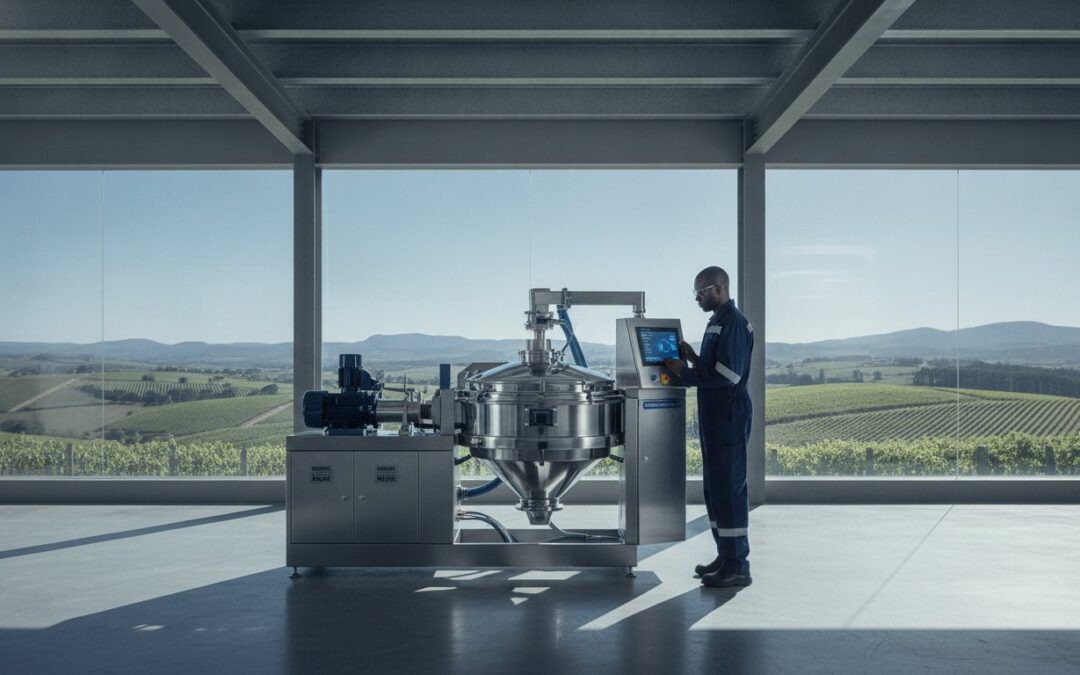
Could your winery be losing as much as 10 per cent of its total volume to the bottom of a settling tank? It’s a frustrating reality for many producers who rely on traditional sedimentation, only to face heavy product loss in the lees and production bottlenecks. You likely want a process that respects the integrity of the grape whilst ensuring every drop of value is captured; this is why choosing the right centrifuge for wine clarification has become a strategic priority for modern cellars.
Integrating advanced separation technology transforms these operational hurdles into a distinct competitive advantage. This approach allows you to recover more juice and wine, significantly reducing the turnaround time between fermentation and bottling. In this guide, we’ll examine the latest 2026 innovations, such as the new FW400 decanter’s deep pond design and disc stack separators capable of exerting over 7,000 Gs of force. We’ll show you how to optimise your workflow, maintain consistent clarity regardless of harvest conditions, and protect the sophisticated flavour profiles your customers expect.
Key Takeaways
- Learn how to increase total product volume by up to 10 per cent by recovering high-quality juice and wine from heavy lees and must.
- Understand the specific operational roles of decanter centrifuges versus disk stack separators to select the most effective centrifuge for wine clarification based on your solids load.
- Discover how precision mechanical control and “soft-inlet” designs protect delicate flavour profiles by minimising shear stress and oxygen pickup.
- Optimise your production timeline by replacing time-consuming natural sedimentation with rapid, automated separation for faster bottling cycles.
- Explore how custom separation solutions and equipment refurbishment can enhance long-term operational efficiency whilst reducing initial capital expenditure.
Principles of Wine Clarification and Centrifugal Technology
Wine centrifugation is the strategic application of G-force to accelerate the natural sedimentation process. Whilst traditional settling relies on the slow pull of gravity, a centrifuge for wine clarification uses rapid rotation to isolate yeast, tartrates, and grape residue in a fraction of the time. This technology is no longer a luxury reserved for massive industrial plants; it’s a vital tool for any quality-focused winery aiming to maintain precision and throughput. Modern food processing separators manage high solids concentrations without needing chemical additives or fining agents, ensuring the wine’s chemical profile remains unadulterated.
The Science of Accelerated Sedimentation
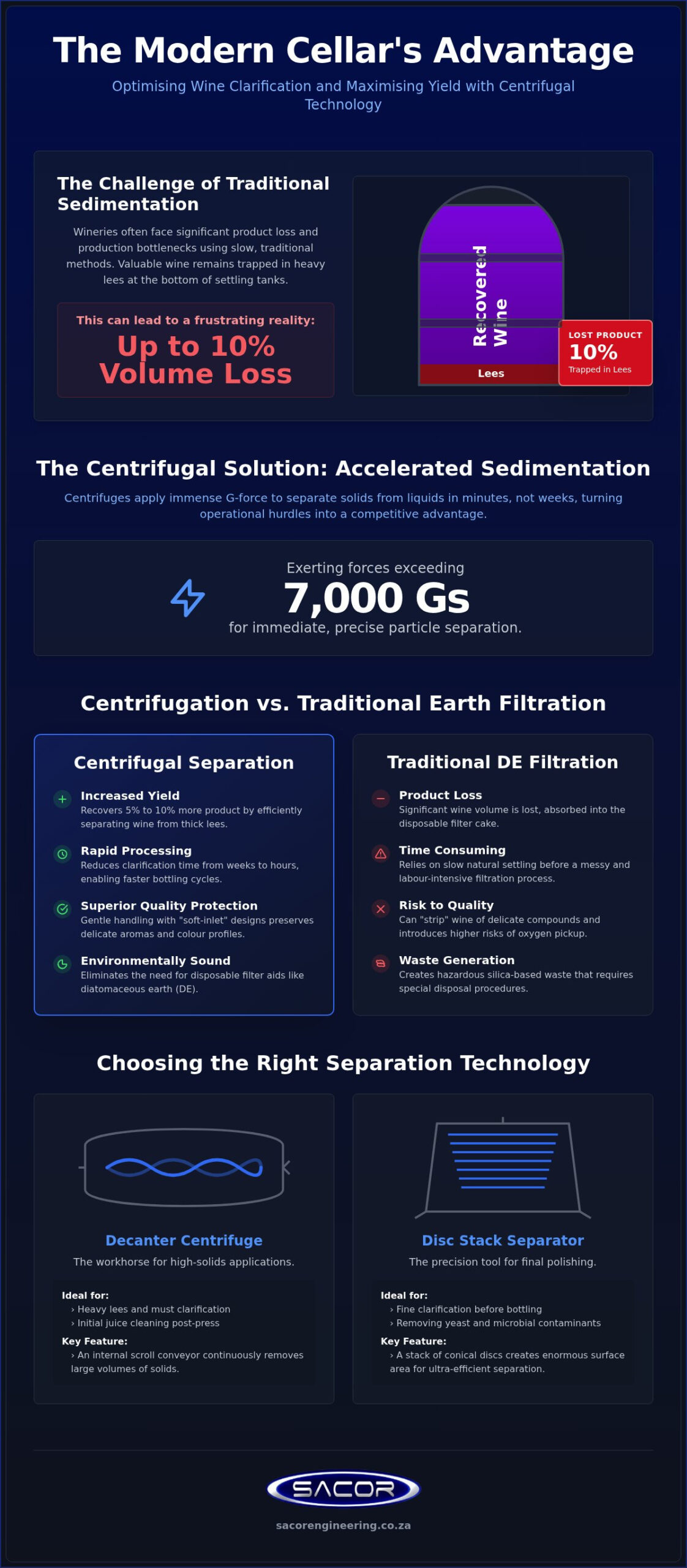
The efficiency of this process is governed by Stokes’ Law, which describes how particles settle in a liquid based on their size and density. In a standard tank, fine particles take weeks to reach the bottom. Centrifugal technology bypasses this timeline by creating an environment where the effective gravitational force is multiplied thousands of times. In winemaking, G-force is the mechanical amplification of gravity, often reaching speeds exceeding 7,000 Gs in disc-stack separators to drive immediate particle separation. This force ensures that even the smallest yeast cells and microbial contaminants are removed with surgical precision. The density of the particles dictates the speed of separation; heavier grape skins and seeds drop out instantly, whilst lighter solids are captured through carefully calibrated bowl speeds.
Centrifugation vs. Traditional Earth Filtration
Choosing a centrifuge for wine clarification over traditional diatomaceous earth (DE) filtration offers significant operational advantages. Traditional filtration often results in high product loss as wine becomes trapped in the filter cake. Research indicates that switching to centrifugal separation can increase yield by 5 to 10 per cent, as the machine recovers liquid that would otherwise be discarded as thick lees. Beyond the volume gains, there’s a strong environmental case for this transition. Moving away from DE reduces the logistical burden of purchasing and disposing of hazardous silica-based materials. The clarification and stabilisation of wine becomes a streamlined, continuous process. You can move a batch from fermentation to a clarified state in just a few hours, rather than waiting weeks for natural settling or dealing with the messy, time-consuming setup of earth filters. This speed allows for faster cellar turnover and more responsive production schedules.
Mechanical Separation: How Food Processing Separators Protect Wine Quality
A common misconception in traditional winemaking is that mechanical separation “bruises” the wine, stripping away the very characteristics that define its terroir. In reality, a modern centrifuge for wine clarification is engineered to be exceptionally gentle on sensory compounds. The perceived aggression of high-speed rotation is mitigated by sophisticated fluid dynamics that ensure the product is never subjected to unnecessary turbulence. By replacing the erratic nature of manual filtration with precise mechanical control, you can achieve a level of clarity that actually enhances the wine’s purity without compromising its structure.
Gentle Handling and Shear Stress Prevention
The secret to protecting delicate wine components lies in the “soft-inlet” design. Older systems often caused high shear stress, which could rupture yeast cells and release unwanted proteins into the liquid. Modern food processing separators use a hydro-hermetic feed system that accelerates the wine gradually as it enters the bowl. This smooth transition prevents the mechanical breakdown of grape skins and seeds, which would otherwise release bitter phenolic compounds and astringent tannins. Adjustable scroll speeds allow for the fine-tuning of solids discharge, ensuring that even the most sensitive must is handled with care. If you’re looking for specific technical parameters to match your production scale, reviewing Decanter Centrifuge Selection Criteria can help clarify which design features best suit your varietals.
Preserving Aroma and Colour Profiles
Temperature management is another critical factor where mechanical separators excel. Friction heat can be the enemy of volatile aromatic compounds, potentially “cooking” the delicate nose of a Sauvignon Blanc or Chenin Blanc. High-performance units are designed with cooling jackets and optimised bowl geometries to minimise heat transfer during the separation process. Beyond temperature control, rapid clarification reduces the time the wine spends in contact with gross lees. Whilst some lees contact is beneficial, prolonged exposure to dying yeast cells in a settling tank can lead to reductive off-flavours and hydrogen sulphide issues. By using a centrifuge for wine clarification, you can selectively remove solids at precisely the right moment, locking in the vibrant colour and fresh fruit profile of the vintage. Achieving this balance requires a partner who understands these nuances, which is why many producers rely on customised separation solutions to meet their specific oenological goals.
Decanter Centrifuges vs. Disk Stack Separators in Winemaking
Choosing the right centrifuge for wine clarification requires an understanding of how mechanical orientation affects separation. While both machines utilise centrifugal force, they serve distinct roles in the cellar. Decanters are horizontal workhorses built for volume, whereas disk stack separators are vertical precision instruments designed for final clarity. Selecting the wrong unit for a specific stage can lead to inefficiencies, so it’s vital to match the machine’s capabilities to your solids load. When evaluating your options, consulting a comprehensive resource on decanter centrifuge suppliers South Africa can help you identify the right engineering partner for your specific production requirements.
The Decanter: Handling the Heavy Lifting
The decanter centrifuge is your primary tool for managing high-solids streams. Its horizontal, solid-bowl design allows it to process must directly from the press or handle thick tank bottoms that would otherwise clog traditional filters. By using a high-torque internal screw conveyor, it continuously discharges dry solids whilst recovering clear juice. This robust engineering shares many principles with Tailings Dewatering Equipment, where the goal is to extract maximum liquid from heavy sludge. For a winery, this means turning what was once “waste lees” into profitable product, significantly improving your bottom line during the busy harvest season. It’s the most effective way to manage the “rough” first stage of clarification.
The Disk Stack: Precision Polishing
Once the heavy solids are removed, the disk stack separator takes over for fine clarification. This vertical machine features a series of conical disks that dramatically increase the available settling area within a compact footprint. Rotating at higher speeds than decanters, these units can generate over 7,000 Gs of force, which is necessary for removing microscopic yeast and bacteria. It’s the final polishing step that makes your wine bottling-ready in a single pass. Modern disk stacks include auto-ejection mechanisms that discharge accumulated solids without stopping the machine. This allows for continuous operation, ensuring your production flow remains steady even during high-demand periods without the need for manual cleaning cycles. For a deeper technical understanding of how these machines achieve sub-micron precision, the professional guide to high speed disk stack separators covers the intricate mechanics, configurations, and maintenance strategies in detail.
For large-scale producers, an integrated approach is often the most efficient strategy. Using a decanter to “pre-clarify” the must reduces the load on the disk stack, allowing the latter to run at higher flow rates with fewer discharge cycles. Implementing a dual-stage centrifuge for wine clarification allows you to scale production without sacrificing the delicate sensory qualities of the wine. This combination maximises yield and ensures the highest possible clarity, providing a reliable solution that adapts to the specific needs of each vintage regardless of how challenging the harvest conditions might be. To see how South African producers are applying this dual-stage approach in practice, the centrifugal separators for wine clarification case study in yield optimisation provides a detailed look at real-world results and NTU targets achieved.
Maximising Winery Yield: Practical Implementation Strategies
Integrating a centrifuge for wine clarification into your existing cellar workflow requires more than just floor space; it demands a shift in how you manage timing and tank rotation. Unlike traditional settling, which dictates your schedule based on gravity, centrifugal technology allows the winemaker to take control of the production timeline. Successfully implementing this technology involves balancing feed rates with desired clarity and ensuring that hygiene standards are met through rigorous Cleaning-in-Place (CIP) protocols. When these variables are optimised, the centrifuge becomes the heart of a high-efficiency production line.
Oxygen Management and Hermetic Sealing
One of the primary concerns when processing wine at high speeds is the potential for dissolved oxygen (DO) pickup. Exposure to air during separation can lead to premature oxidation, stripping the wine of its vibrant fruit notes and reducing its shelf life. Modern centrifugal separators solve this through hydraulic or hermetic sealing. These systems create a physical barrier that prevents air from entering the bowl, often supplemented by inert gas blanketing with nitrogen or carbon dioxide. Hermetic sealing is essential for maintaining the longevity and aromatic freshness of white wines by preventing any contact with ambient air during the high-speed clarification process. By controlling the environment within the machine, you ensure that the “nose” of the wine remains as intended from the tank to the bottle.
Lees Recovery: Turning Waste into Revenue
The financial justification for investing in a centrifuge for wine clarification often rests on its ability to recover value from what was previously considered waste. Traditional methods leave behind a significant volume of thick lees at the bottom of the tank, which is frequently discarded or sold for a fraction of its potential value. Centrifuges, particularly decanter models, are designed to handle these high-solids streams with ease.
The return on investment becomes clear when you look at the volume gains. Industry data suggests that the use of a centrifuge can result in 5 to 10 per cent more beverage from the same amount of raw ingredients. For a medium-to-large winery, this increase in yield per hectare can pay for the equipment within a few vintages. To ensure your cellar achieves these results, it’s vital to partner with experts who provide customised separation solutions tailored to your specific grape varieties and production volumes. This precision-led approach transforms a technical necessity into a powerful driver of winery profitability.
Operational success also depends on maintaining the machine’s performance over time. Feed rates must be carefully calibrated; pushing the machine too fast may compromise clarity, whilst running it too slowly reduces the throughput benefits. Automated CIP systems help maintain these standards by ensuring that every internal surface is thoroughly sanitised between batches, preventing cross-contamination and protecting the integrity of different varietals.
Selecting and Maintaining Your Centrifuge for Wine Clarification
Selecting the ideal centrifuge for wine clarification requires a detailed analysis of your winery’s specific operational parameters. You must evaluate the required throughput during peak harvest, the typical solids percentage in your must, and the physical footprint available in your cellar. A machine that is undersized will create bottlenecks, whilst an oversized unit may lead to unnecessary energy consumption. It’s about finding a balance that supports your long-term production goals without overextending your capital budget. Precision in selection ensures that the technology integrates seamlessly into your existing workflow.
New vs. Refurbished: Making the Strategic Choice
Deciding between a brand-new unit and a restored machine is a significant strategic choice. While new models offer the latest modular designs, the capital costs can be substantial for many producers. Centrifuge refurbishment services provide an excellent alternative, allowing you to acquire high-performance machinery at a significantly lower entry point. For a detailed breakdown of the restoration process, consult our Industrial Centrifuge Life Extension Guide. It’s vital that any refurbished unit is restored to meet modern food-grade standards, ensuring that all contact parts are high-quality stainless steel and that the mechanical seals are capable of hermetic operation to protect against oxygen pickup.
Critical Maintenance for Longevity
High-speed separation machinery operates under immense physical stress, often generating thousands of Gs of force. To prevent catastrophic failure and ensure consistent performance, a strict preventative maintenance schedule is non-negotiable. This proactive approach protects your equipment and prevents costly downtime during the harvest season. Key areas of focus include:
- Bowl Balancing: Regular vibration monitoring identifies minor imbalances before they lead to structural damage.
- Scroll Wear Protection: For high-abrasion must containing seeds and stems, scrolls should be protected with hard-facing or ceramic tiles to maintain conveying efficiency.
- Genuine Spare Parts: Sourcing original components ensures that the machine remains within its original engineering tolerances, protecting the integrity of the high-speed rotating assembly.
The value of a partnership with a local specialist cannot be overstated. National technical support across South Africa ensures that if a technical issue arises during the critical harvest window, help is readily accessible. This localised expertise provides the reassurance needed to run a high-performance cellar with confidence. You aren’t just buying a piece of hardware; you’re investing in a long-term operational partnership designed to achieve dependable excellence in every vintage. By combining the right hardware with expert maintenance, your winery can secure a competitive edge through superior yield and quality control. Beverage producers across the industry are recognising this principle, and the same discipline that governs cellar maintenance applies equally to brewery centrifuge maintenance services, where preventing unplanned downtime is equally critical to protecting product quality and yield.
Future-Proofing Your Cellar with Precision Separation
Modern winemaking in 2026 demands a balance between industrial efficiency and artisanal integrity. Implementing a high-performance centrifuge for wine clarification isn’t just about speeding up production; it’s a strategic move to protect the delicate sensory profiles that define your brand. We’ve seen how these systems can increase total volume by capturing product from heavy lees whilst ensuring hermetic seals prevent oxygen pickup. Whether you’re investing in new hardware or choosing a sustainable path through expert centrifuge refurbishment services, the right technology ensures your winery remains resilient against harvest variability.
Sacor Engineering provides the specialised food and beverage engineering and national technical support across South Africa needed to maintain this competitive edge. We’re committed to being more than just a supplier; we’re a partner in your long-term operational success. Our team focuses on delivering reliable, bespoke solutions that respect both engineering traditions and modern oenological requirements. Optimise your winery yield with Sacor Engineering’s bespoke separation solutions. Securing the future of your cellar starts with a commitment to mechanical excellence and precision control.
Frequently Asked Questions
Does using a centrifuge for wine clarification affect the flavour or aroma?
No, modern centrifuges do not negatively impact flavour or aroma when operated correctly. High-quality systems use hermetic seals to prevent oxygen pickup and “soft-inlet” designs to minimise shear stress. These mechanical features ensure that delicate volatile compounds remain intact. By rapidly removing solids, you actually reduce the risk of reductive off-flavours associated with prolonged lees contact in traditional settling tanks, resulting in a cleaner, more vibrant wine profile.
What is the difference between a decanter and a separator in winemaking?
The primary difference lies in their orientation and the volume of solids they can handle. Decanters are horizontal machines designed for “rough” clarification of must or heavy lees with high solids content. Conversely, disk stack separators are vertical units used for fine polishing and removing microscopic particles before bottling. Using a centrifuge for wine clarification often involves a combination of both to achieve maximum efficiency throughout the production cycle.
Can a centrifuge replace the need for cross-flow filtration?
A centrifuge significantly reduces the load on cross-flow filters but doesn’t usually replace them for final sterile filtration. Centrifugation is a clarification step that removes the bulk of yeast and solids. By pre-clarifying the wine, you prevent filter clogging and production bottlenecks. This allows cross-flow systems to operate more efficiently, extending the life of expensive membranes and speeding up the final transition from tank to bottle.
How much wine yield can I expect to recover using a centrifuge?
Wineries typically recover between 5 and 10 per cent more product when using a centrifuge for wine clarification compared to traditional sedimentation. This increase comes from the machine’s ability to extract high-quality wine from heavy tank bottoms and lees that would otherwise be discarded. Over several vintages, this additional volume can significantly improve the return on investment, effectively paying for the equipment through increased sales of recovered wine. For a detailed real-world example of these yield gains, see how South African cellars have applied centrifugal separators for wine clarification to achieve measurable yield optimisation.
Is a centrifuge suitable for small-scale boutique wineries?
While centrifuges were once reserved for large facilities, modern compact models make them viable for boutique wineries. The decision depends on your throughput requirements and the value of your product. If high product loss in the lees is a major pain point, a smaller high speed disk stack separator can provide a faster turnaround and more consistent clarity. Refurbished units are also an excellent entry point for smaller operations looking for industrial-grade performance.
What are the power and utility requirements for a wine centrifuge?
Industrial wine centrifuges require a stable three-phase power supply and access to potable water for Cleaning-in-Place (CIP) cycles. The specific power draw depends on the bowl speed and motor size, often ranging from 15kW to 55kW for mid-sized units. You also need a compressed air supply for pneumatic valves and adequate drainage to manage the discharged solids and cleaning fluids during automated discharge cycles.
How often does a wine processing centrifuge require professional maintenance?
Professional maintenance should be performed at least once a year, ideally just before the harvest season begins. High-speed machinery requires regular checks on bowl balance, vibration levels, and seal integrity to prevent catastrophic failure. Between these major services, your cellar team should perform routine inspections of wear parts and monitor the lubrication system. Consistent preventative care ensures the machine remains reliable during the high-pressure weeks of vintage.
Can a refurbished centrifuge perform as well as a brand-new model?
A professionally refurbished centrifuge can match the performance of a new model at a lower capital cost. At Sacor Engineering, our refurbishment process involves stripping the machine to its frame, replacing all bearings and seals, and re-balancing the rotating assembly. When updated with modern control systems and food-grade stainless steel components, these units provide the same precision and reliability as new hardware, backed by our national technical support.