
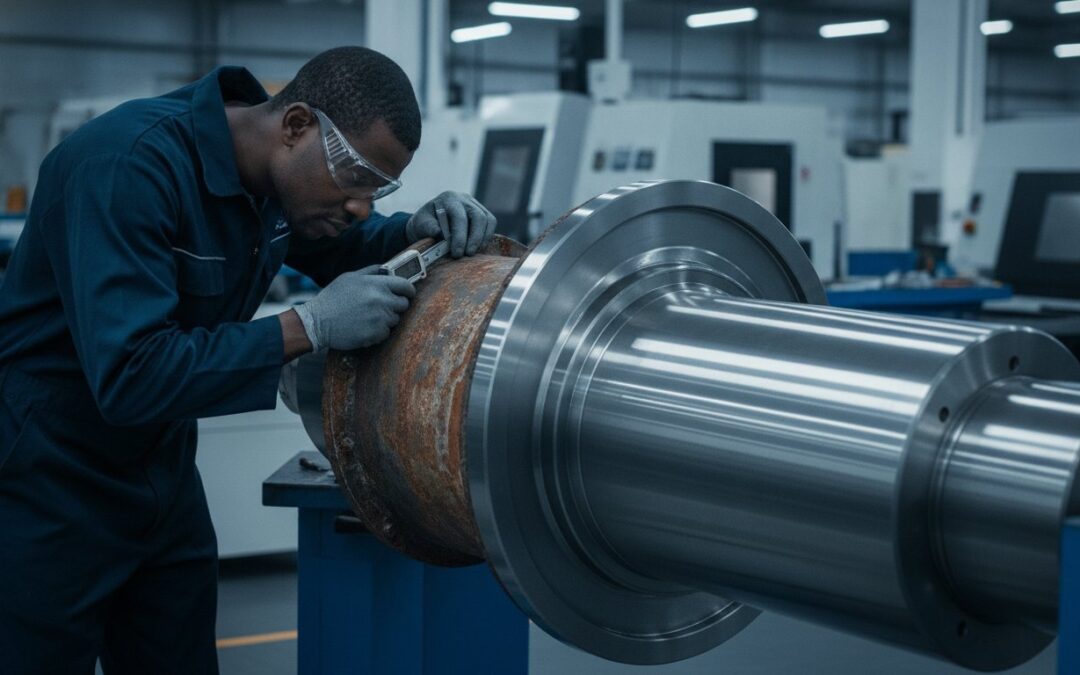
A worn centrifuge scroll is often viewed as a terminal mechanical failure, yet it’s actually a prime opportunity for metallurgical transformation. You’re likely all too familiar with the spiralling costs of OEM replacements and the frustration of unplanned downtime caused by scroll erosion. It’s a common challenge where uneven wear leads to debilitating vibration issues that threaten your entire process. Choosing professional centrifuge scroll refurbishment isn’t just a repair; it’s a strategic investment in your plant’s longevity.
We understand that maintaining high-performance separation is critical to your operational success. This technical guide explores the precision engineering methods used to restore your equipment, promising to extend its operational life whilst significantly enhancing separation efficiency. By focusing on advanced wear protection and exact tolerances, you can achieve a lower total cost of ownership and a much-improved mean time between failures (MTBF). We’ll examine the specific stages of the restoration process, from initial assessment and specialised hardfacing to the final dynamic balancing that ensures smooth, reliable performance.
Key Takeaways
- Identify the underlying causes of scroll degradation, including abrasion and erosion, to prevent premature mechanical failure and loss of throughput.
- Understand the rigorous protocols involved in centrifuge scroll refurbishment, ensuring every rotating assembly is restored to its original engineering tolerances.
- Compare advanced hardfacing and wear protection methods to select the most effective sacrificial barrier for your specific industrial application.
- Optimise your maintenance budget by analysing the Total Cost of Ownership (TCO) when choosing between refurbishment and costly OEM replacements.
- Discover how precision engineering extends the mean time between failures (MTBF) and restores peak separation efficiency for decanter centrifuges.
Understanding Centrifuge Scroll Wear and Erosion
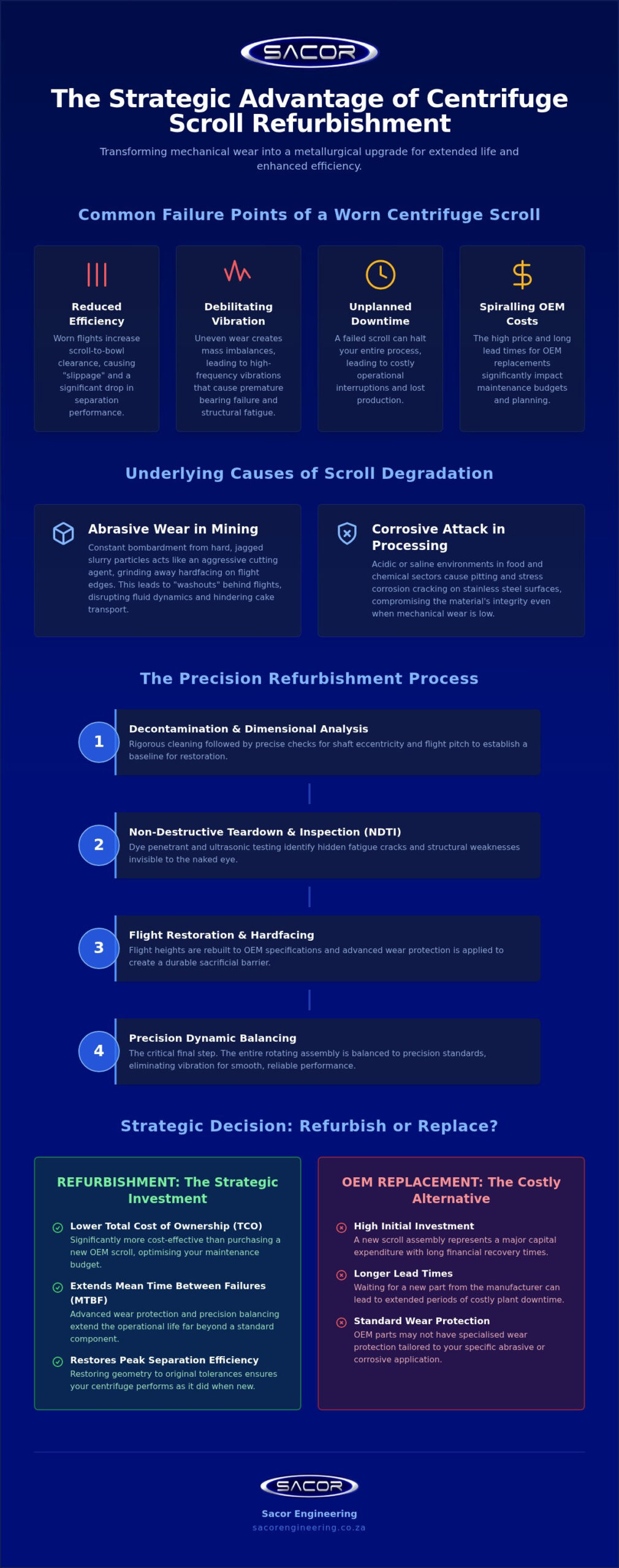
The scroll, or conveyor, is the mechanical engine within an industrial Centrifuge, responsible for the continuous transport of solids through the bowl. Its performance dictates the clarity of the liquid discharge and the dryness of the resulting cake. Over time, the harsh environment inside the machine leads to degradation through abrasion, erosion, and corrosion. When the leading edges of the scroll flights wear down, the gap between the scroll and the bowl wall increases. This causes “Slippage,” where solids are no longer effectively conveyed. This directly results in a significant drop in separation efficiency and increased moisture in the discharged solids.
Beyond performance loss, degradation is rarely uniform. Uneven wear across the length of the scroll creates mass imbalances that manifest as high-frequency vibrations. These vibrations are the primary cause of premature bearing failure and structural fatigue. Professional centrifuge scroll refurbishment addresses these issues by restoring the original geometry of the flights and ensuring the entire rotating assembly is dynamically balanced to precision standards. By catching this wear early, you transform a potential breakdown into a controlled maintenance event.
The Mechanics of Abrasive Wear in Mining
In mining and tailings applications, the scroll faces constant bombardment from hard, jagged slurry particles. These solids act as aggressive cutting agents, grinding away the sacrificial hardfacing on the flight edges. As the wear progresses, “washouts” or hollowed-out sections appear behind the flights, disrupting the fluid dynamics and hindering cake transport. Higher feed concentrations naturally accelerate this process. This makes regular inspections essential to prevent the erosion from reaching the base metal, which would necessitate a much more complex restoration.
Corrosive Attack in Food and Chemical Processing
Food and chemical sectors often deal with acidic or saline environments that challenge the integrity of stainless steel surfaces. Whilst these materials are chosen for their resistance, they remain susceptible to pitting and stress corrosion cracking under high centrifugal forces. During the centrifuge scroll refurbishment process, it’s vital that the chosen repair materials and welding techniques are chemically compatible with the process medium. Failing to match these metallurgical properties can lead to rapid re-failure, even if the mechanical restoration appears perfect. A methodical approach to centrifuge corrosion repair ensures that the refurbishment isn’t just a physical patch, but a chemical-grade restoration of the component’s integrity.
The Precision Refurbishment Process: A Step-by-Step Guide
Effective centrifuge scroll refurbishment begins long before the first weld is struck. The process starts with a rigorous decontamination of the rotating assembly to remove process residues and chemical build-up. This allows for a precise dimensional analysis where we check for shaft eccentricity and flight pitch. If these foundational measurements aren’t accurate, even the most advanced hardfacing won’t restore original performance levels. We treat every scroll as a unique engineering challenge, requiring a bespoke restoration plan based on its specific wear profile.
Non-Destructive Teardown and Inspection (NDTI)
We use NDTI protocols to look beneath the surface of the metal. Dye penetrant and ultrasonic testing identify hidden fatigue cracks or structural weaknesses that the naked eye simply can’t see. By documenting these wear patterns, we provide a detailed condition report that helps you predict future maintenance intervals. If defects are found during NDTI, they’re immediately addressed through structural repairs and weld build-up before the restoration continues. This ensures the structural integrity of the scroll is never compromised during high-speed operation.
Flight Restoration and Pitch Correction
Restoring the flights to original OEM specifications is a delicate engineering task that requires absolute precision. We rebuild flight heights and ensure the scroll-to-bowl clearance is perfectly calibrated to your machine’s requirements. This precision is vital because even a millimetre of deviation in flight pitch can disrupt the consistent discharge of solids. During this stage, referring to a comprehensive review of hardfacing helps in selecting the correct alloys and application techniques for the build-up process, ensuring the new surface is as resilient as the original.
The Critical Final Step: Dynamic Balancing
A common industry oversight is assuming that static balancing is sufficient for industrial equipment. For high-speed machinery, dynamic balancing is non-negotiable. An imbalanced scroll creates harmonic vibrations that damage bearings and seals, leading to the very downtime you’re trying to avoid. There’s an inextricable link between scroll condition and centrifuge bowl balancing services; both must work in tandem to ensure vibration-free operation. We adhere to strict ISO tolerances to guarantee your equipment returns to service in peak condition. If you’re seeing increased vibration levels, consulting with a refurbishment specialist can prevent a minor imbalance from becoming a major mechanical overhaul.
Centrifuge Wear Protection Services and Hardfacing
In the technical execution of centrifuge scroll refurbishment, selecting the appropriate wear protection is a critical metallurgical decision. Hardfacing creates a sacrificial barrier that shields the base metal from the aggressive forces of abrasion and erosion. The science behind this involves depositing a layer of wear-resistant material, typically a cobalt or nickel-based alloy, onto the flight edges. Whilst thickness is important, the bead profile is equally vital. A smooth, controlled profile maintains laminar fluid flow, whereas irregular beads create turbulence that actually accelerates erosion in the surrounding areas.
Refurbishment specialists must choose between thermal spray and welding methods. Welding, such as Plasma Transferred Arc (PTA), provides an exceptional metallurgical bond suitable for high-impact loads. Conversely, thermal spray techniques like High-Velocity Oxy-Fuel (HVOF) offer a denser coating with minimal heat-affected zones. This prevents the distortion of the scroll shaft, which is essential for maintaining the precision pitch required for efficient solids transport. The choice often depends on the required Rockwell C hardness. For most industrial slurries, a range of 58 to 62 HRC provides the ideal balance between extreme hardness and the toughness needed to avoid brittle cracking.
Tungsten Carbide Tiles vs. Hardfacing Weld
For extreme abrasion, particularly in mining tailings, sintered Tungsten Carbide (TC) tiles offer the highest level of protection. These tiles are brazed or bolted onto the flight edges, providing a surface that is significantly harder than standard weld deposits. One major advantage is that tile replacement simplifies future maintenance cycles; individual worn tiles can be swapped out without needing to rebuild the entire flight. However, hardfacing weld beads remain the preferred choice for complex geometries or smaller scrolls where the rigid structure of a tile isn’t practical. The decision rests on the specific abrasive characteristics of your process medium.
Advanced Spray Coatings for Corrosion Resistance
When dealing with the corrosive environments found in food and chemical processing, standard hardfacing may not suffice. We utilise specialised alloys and ceramic coatings to combat chemical attack whilst maintaining surface integrity. These advanced spray coatings are engineered to provide a high-friction barrier that resists pitting and stress corrosion. Ensuring a high bond strength is paramount during application to prevent delamination under the intense centrifugal forces of operation. By matching the coating chemistry to your process, we ensure the refurbished scroll survives even the most aggressive chemical workflows without compromising the base metal’s structural integrity. For equipment where surface pitting or material thinning has already taken hold, a structured centrifuge corrosion repair programme using glass-flake or ceramic-filled coatings can restore OEM specifications and extend service life.
Strategic Decision-Making: Refurbish or Replace?
Choosing between a capital expenditure for new equipment and an operational investment in centrifuge scroll refurbishment requires a nuanced understanding of your plant’s long-term goals. This decision shouldn’t be based on the initial price alone; it requires a deep dive into the Total Cost of Ownership (TCO). Whilst a new OEM scroll offers a “zero-hour” starting point, the associated lead times can often span several months, creating significant operational bottlenecks. In contrast, a professional refurbishment typically follows a much tighter schedule, allowing you to restore peak performance during a standard plant shutdown. This speed of response is often the deciding factor for high-capacity mining and food processing operations.
Beyond the financial balance sheet, environmental considerations are becoming central to industrial procurement. Opting for a rebuild over a replacement is a powerful way to meet ESG (Environmental, Social, and Governance) targets by reducing the carbon footprint associated with manufacturing new heavy-duty components. However, there are technical red flags to watch for. If a scroll exhibits severe shaft distortion or if erosion has compromised the structural base metal beyond safe limits, the unit may be beyond economic repair. In these cases, our consultative approach ensures you receive an honest assessment of the risks versus the rewards, prioritising your long-term mechanical reliability over a short-term fix.
Cost-Benefit Analysis of Refurbishment
A precision rebuild generally costs between 30% and 50% of the price of a new unit, providing a significant capital saving that can be redirected elsewhere in the maintenance budget. This process is a cornerstone of industrial centrifuge life extension, as it addresses the root causes of performance decline before they become catastrophic. Beyond the hardware cost, consider the energy savings. A worn scroll creates “slippage” that increases the torque required to move solids, leading to higher electricity consumption. By restoring the flight geometry, you immediately optimise the machine’s energy profile and restore its original throughput capacity.
Operational Risks of Delayed Maintenance
Delaying a necessary refurbishment often triggers a “cascade effect” of mechanical failure. The vibration caused by an eroded, imbalanced scroll doesn’t stay confined to the conveyor; it travels through the entire assembly, rapidly degrading the main bearings, seals, and the expensive planetary gearbox. Operating an imbalanced rotating assembly at high speeds also presents serious safety implications for on-site personnel. To avoid these risks, we recommend planning your refurbishment cycles to align with scheduled shutdowns, ensuring your equipment is ready for the next production run. Understanding the full spectrum of common decanter centrifuge problems through a systematic maintenance checklist can help you identify warning signs early and prevent minor wear from escalating into costly cascade failures. If you are unsure of your equipment’s current status, you should request a technical evaluation to determine the most viable path forward for your facility.
Sacor Engineering: Specialist Centrifuge Refurbishment
Sacor Engineering approaches centrifuge scroll refurbishment as a strategic partnership aimed at achieving your long-term operational goals. We don’t just provide a repair service; we offer a consultative guide through the technical complexities of industrial separation. Our expertise spans both decanter centrifuges and disk stack separators, ensuring that regardless of your machine’s configuration, the restoration is grounded in engineering traditions and mechanical reliability. We focus on transforming worn components into high-performance assets that restore your plant’s throughput and separation precision.
Our commitment to excellence is reflected in our solution-oriented focus. We understand the high cost of downtime and the technical risks associated with scroll erosion. By positioning refurbishment as a sustainable alternative to replacement, we help you navigate the balance between capital expenditure and operational efficiency. Our engineers bring a global, high-level perspective to every project, whilst maintaining the accessible, localized support that South African industrial operations require to thrive in a competitive landscape.
Engineering Excellence in South Africa
We maintain a national service footprint, providing essential technical support to the South African mining and food sectors. Our engineers adhere to rigorous international standards whilst delivering the responsive, on-the-ground expertise that high-stakes industrial environments demand. We have extensive experience with tailings dewatering equipment, where the aggressive nature of the process requires a deep understanding of metallurgy and fluid dynamics. By choosing a partner with deep roots in local industry, you gain a reliable ally committed to restoring your machinery to peak performance levels.
Request a Technical Assessment
The first step toward optimising your industrial separation is a thorough, professional inspection. We organise comprehensive assessments to identify the precise state of your centrifugal equipment, looking beyond surface-level wear to find the root causes of performance decline. This isn’t a generic check-up; it’s the foundation of a bespoke refurbishment plan tailored to your specific process chemistry and throughput requirements. We provide a clear, instructional roadmap that outlines the necessary mechanical interventions to restore your equipment’s integrity.
Take the first step toward extending your mean time between failures (MTBF) and lowering your total cost of ownership. Our team is ready to provide the specialised technical support needed to ensure your rotating assemblies remain dependable assets. Contact us today to begin the technical evaluation process and discover how our precision engineering can revolutionise your industrial workflow.
Securing Long-Term Operational Reliability
Precision engineering transforms a worn conveyor from a mechanical liability into a high-performance asset. By addressing metallurgical degradation through advanced hardfacing and ensuring exact dynamic balancing, you restore the throughput and separation efficiency originally intended by the manufacturer. This strategic approach to centrifuge scroll refurbishment not only lowers the total cost of ownership but also aligns with modern environmental goals by significantly extending the service life of heavy-duty machinery.
Sacor Engineering provides specialised technical support for high-speed machinery with comprehensive national service coverage in South Africa. Our deep expertise in decanter centrifuge selection criteria and precision maintenance ensures your rotating assemblies remain dependable throughout their lifecycle. Consult our experts for centrifuge scroll refurbishment to begin optimising your plant’s separation performance today. We’re committed to helping you achieve consistent, vibration-free operation for years to come.
Frequently Asked Questions
What are the first signs that a centrifuge scroll needs refurbishment?
The most common indicators include a noticeable increase in operational vibration and a decline in solids dryness. You might also observe reduced liquid clarity in the centrate discharge or a sudden rise in torque demand. Visual inspections often reveal rounded flight edges or “washouts” behind the conveyor flights. Monitoring these performance metrics allows for proactive intervention before the erosion reaches the base metal and causes structural failure.
How long does a typical centrifuge scroll refurbishment take?
A standard centrifuge scroll refurbishment usually requires between two to four weeks to complete. This timeframe encompasses the full technical sequence, including decontamination, non-destructive testing, structural weld build-up, and final dynamic balancing. Whilst this is significantly faster than the months-long lead times often associated with new OEM parts, the exact duration depends on the extent of the wear identified during the initial inspection phase.
Can a refurbished scroll perform as well as a brand-new one?
A professionally restored scroll often matches or exceeds the performance of a new unit. By utilising advanced hardfacing materials and restoring the flights to original pitch specifications, we reset the component’s operational clock. Because the refurbishment process includes precision dynamic balancing to ISO standards, the machine frequently operates with greater stability and efficiency than it did prior to the wear, ensuring a reliable return to service.
Is it possible to refurbish scrolls from any centrifuge brand?
Yes, our technical expertise allows us to refurbish rotating assemblies from all major industrial centrifuge manufacturers. The fundamental principles of solids transport and fluid dynamics are universal, which enables us to apply precision engineering techniques across various decanter and disk stack designs. We customise each restoration plan to respect the original design tolerances whilst often upgrading the wear protection to better suit your specific process chemistry.
What is hardfacing, and why is it necessary for decanter scrolls?
Hardfacing is the process of depositing a layer of wear-resistant alloy onto the flight edges to create a sacrificial barrier. It is a critical component of centrifuge scroll refurbishment because scrolls operate in aggressive environments where abrasive particles act as cutting agents. Without this protective layer, the flights would erode rapidly, leading to “slippage” where solids are no longer conveyed effectively, resulting in poor separation and increased moisture in the cake.
How often should I balance my centrifuge scroll during its operational life?
You should perform a dynamic balance whenever the scroll undergoes significant repair or if vibration levels exceed established ISO 10816 limits. Whilst a full balance is a mandatory part of the refurbishment process, operational imbalances can develop over time due to uneven wear or material accumulation. Regular vibration monitoring is the best way to determine frequency, but balancing is always necessary after any metallurgical work or flight restoration.
What happens if a worn scroll is not repaired promptly?
Neglecting a worn scroll triggers a “cascade effect” that damages other expensive components. The resulting vibration quickly degrades main bearings and seals, eventually putting the planetary gearbox at risk of catastrophic failure. Beyond the mechanical risks, process efficiency drops as energy consumption rises and solids dryness decreases. This leads to significantly higher waste disposal costs and a much larger total cost of ownership compared to a timely repair.
Do you provide on-site inspections for centrifuge refurbishment in South Africa?
We offer comprehensive technical assessments and inspections across South Africa to evaluate the condition of your centrifugal equipment. These evaluations help identify specific wear patterns and structural fatigue before the machinery is moved for repair. By conducting an initial assessment on-site, we can develop a bespoke refurbishment strategy that aligns with your plant’s scheduled shutdowns, ensuring a streamlined process that minimises unplanned downtime and restores peak separation efficiency.