
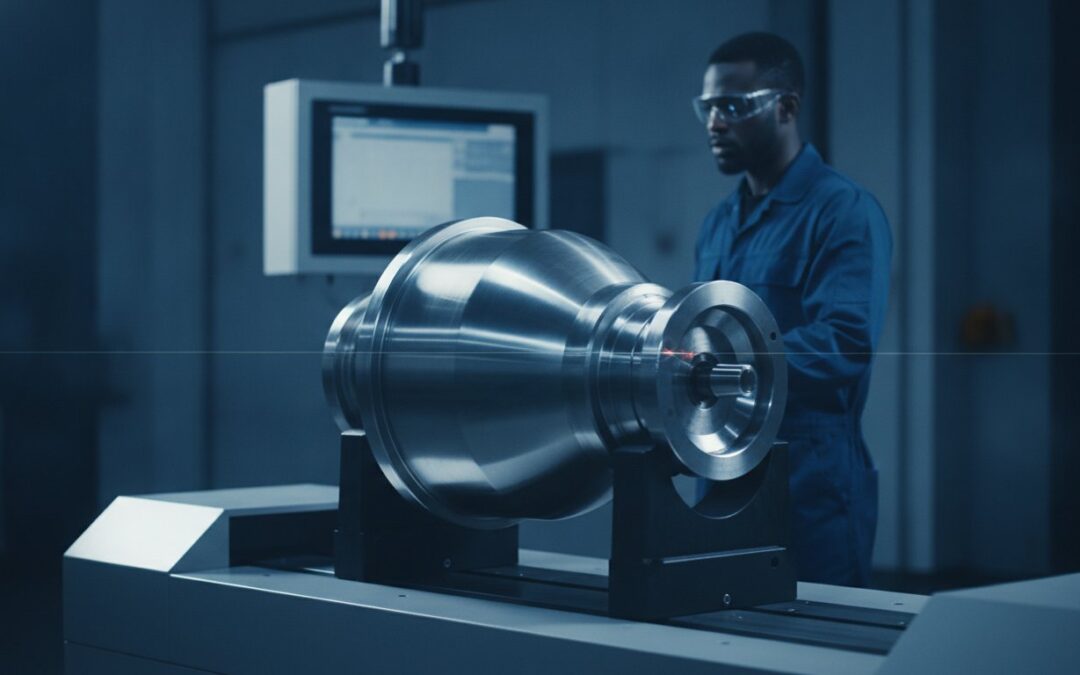
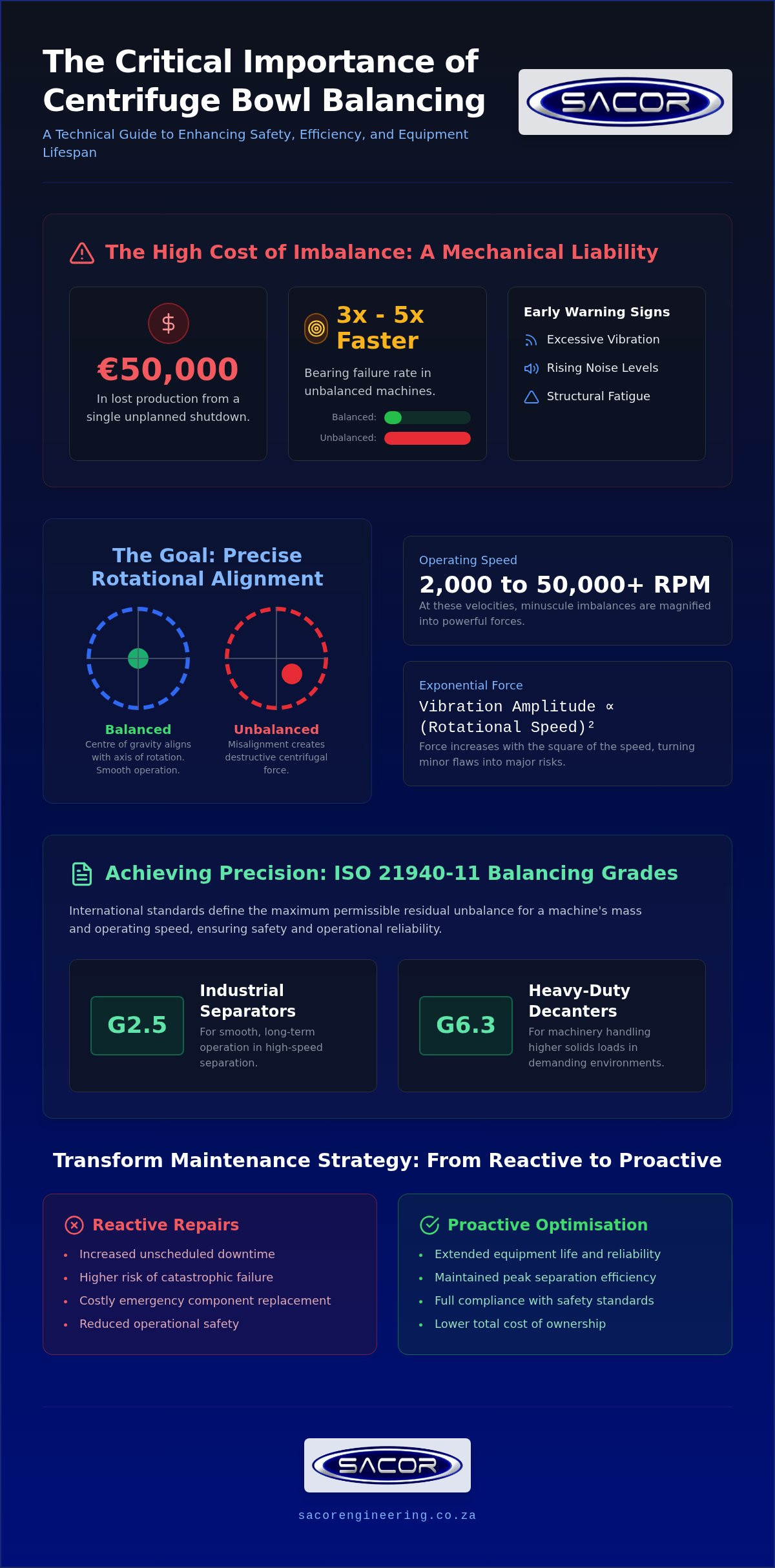
An unbalanced centrifuge isn’t just a noise nuisance; it’s a mechanical liability that can cause critical bearings to fail three to five times faster than a properly calibrated machine. For operators in high-stakes sectors like mining tailings or food and beverage processing, the cost of a single unplanned shutdown can reach €50,000 in lost production. You likely recognise the warning signs: excessive machinery vibration, rising noise levels, and the constant worry of a catastrophic failure during peak operation. Investing in professional centrifuge bowl balancing services is no longer a luxury of maintenance; it’s a fundamental requirement for operational safety and mechanical integrity.
We understand that maintaining a consistent throughput depends on the precision of your high-speed separation equipment. This reference guide provides a technical overview of how dynamic balancing at operating speeds eliminates vibration-induced wear and ensures your machinery complies with modern safety standards like ISO 21940-11. By mastering these technical nuances, you can successfully extend the interval between major refurbishments and transform your maintenance strategy from reactive repairs to proactive optimisation. We’ll explore the essential G-grade requirements and the methodologies that keep your decanters and separators running at peak efficiency.
Key Takeaways
- Understand why aligning the centre of gravity with the axis of rotation is critical for mitigating the destructive forces generated during high-speed separation.
- Learn to identify the early indicators of bowl imbalance, such as subtle vibration shifts, to prevent costly bearing failures and structural fatigue.
- Discover how professional centrifuge bowl balancing services utilise high-precision dynamic machinery to ensure your equipment meets strict ISO safety and performance standards.
- Explore the comprehensive refurbishment process for decanters and disk stack separators that prioritises mechanical integrity and industrial life extension.
- Gain a strategic advantage by mastering the technical precision required to reduce unscheduled downtime and maintain peak separation efficiency in demanding environments.
The Fundamentals of Centrifuge Bowl Balancing
Bowl balancing is an engineering necessity that involves aligning a component’s centre of gravity precisely with its geometric axis of rotation. In the context of The Fundamentals of Centrifuge Bowl Balancing, this process ensures that the mass distribution remains uniform across the entire rotating assembly. Whilst static balancing addresses basic gravitational offsets, high-speed industrial machinery requires dynamic balancing to account for centrifugal couples that only emerge during operation. Achieving this equilibrium is the primary objective of professional centrifuge bowl balancing services, as it prevents the uneven distribution of mass from translating into destructive kinetic energy.
Precision balancing is a non-negotiable component of industrial centrifuge life extension. When a bowl is out of alignment, the resulting centrifugal force doesn’t just impact separation efficiency; it places immense strain on the structural integrity of the entire unit. By correcting these imbalances during a standard refurbishment cycle, operators can transform their maintenance from a reactive struggle against equipment fatigue into a proactive programme of mechanical optimisation.
The Science of Centrifugal Force and Imbalance
Industrial centrifuges operate at exceptional speeds, often ranging from 2,000 to over 50,000 RPM. At these velocities, even a few grams of residual unbalance can exert several tonnes of force on the machine’s internal frame. Vibration amplitude increases with the square of the rotational speed when an unbalance is present. This exponential growth in force means that minor defects at low speeds become catastrophic at operational frequencies. For decanter centrifuges, this stress is particularly concentrated on the internal scroll and main bearings. Research indicates that unbalanced machines can cause bearings to fail three to five times faster than those in balanced systems, significantly increasing the total cost of ownership.
Balancing Grades and ISO 1940 Standards
To maintain consistency across industries, engineers rely on the ISO 1940-1 standard, which is now part of the ISO 21940-11 framework. These “G grades” define the maximum permissible residual unbalance relative to the machine’s mass and operating speed. Most industrial separators require a balance quality grade of G2.5 to ensure smooth, long-term operation. Heavy-duty decanters, which handle higher solids loads, typically operate within the G6.3 range. Utilising professional centrifuge bowl balancing services ensures that your equipment is certified to these specific grades. This certification provides the documented proof of precision required for safety compliance and operational reliability in demanding mining and food-grade environments.
Identifying Common Signs of Bowl Imbalance
Detecting imbalance before it escalates into a mechanical emergency requires a vigilant approach to daily operations. Whilst some vibration is inherent in high-speed rotation, any deviation from established baselines suggests that the centre of gravity has shifted. This progression usually starts with microscopic surface changes, perhaps from erosion or uneven solid buildup, and ends with significant structural damage if left unaddressed. Ignoring these early warnings allows the destructive forces to multiply, eventually exceeding the design limits of the bearings and housing.
Integrating regular vibration monitoring into your maintenance schedule is the most effective way to quantify this risk. Industry standards suggest that corrective action is necessary when vibration levels exceed 2-4 mm/second. Citing the EASA’s perspective on Why Precision Balancing is Essential for Operational Safety, we can see that early intervention is the only way to protect both personnel and the surrounding infrastructure from the catastrophic “missile effect” of a component failure at high RPM.
Acoustic and Visual Warning Signs
Operators should listen for unusual harmonic “whining” or rhythmic thumping, especially during the critical ramp-up and ramp-down phases. These sounds often indicate that the bowl is struggling to find its equilibrium at specific resonant frequencies. An unbalanced centrifuge can generate an additional 10 dB of noise, often pushing workplace levels beyond safe limits. On the physical side, look for uneven wear patterns on the internal scroll or bowl wall. If you find yourself constantly retightening foundation bolts or noticing hairline cracks in the mounting frame, the machine is likely shedding excessive kinetic energy due to mass eccentricity.
Performance Indicators of Imbalance
Imbalance forces the drive motor to consume more electricity as it attempts to overcome mechanical resistance. In a decanter centrifuge, this often manifests as fluctuating torque readings and inconsistent differential speeds between the bowl and the scroll. Beyond the mechanical strain, your process output quality will inevitably suffer. Verified data shows that bowl imbalance can lead to a 20% decrease in separation efficiency, resulting in higher moisture content in the cake discharge and increased solids carryover in the centrate. If your throughput is declining despite stable feed conditions, it’s time to consider professional centrifuge bowl balancing services as part of a wider refurbishment strategy. A systematic review of common decanter centrifuge problems can help you distinguish between imbalance-related performance loss and other mechanical faults that may be affecting your separation quality.
The Technical Process of Dynamic Balancing
Restoring a centrifuge to its optimal state requires more than just a surface-level adjustment. Professional centrifuge bowl balancing services follow a rigorous, multi-stage engineering protocol designed to neutralise the destructive forces of mass eccentricity. The precision of The Technical Process of Dynamic Balancing is what ensures a machine can return to high-speed service without risking the structural fatigue discussed in previous sections. This methodical approach begins with meticulous preparation and concludes only when a certified state of equilibrium is achieved.
Pre-Balancing Inspection and Preparation
A bowl cannot be accurately balanced whilst it carries the remnants of its last operational cycle. All product build-up, scale, and process residues must be removed through thorough cleaning, as even a few grams of unevenly distributed material will skew the sensor data. Once cleaned, the component undergoes a detailed structural inspection. Technicians look for signs of erosion, corrosion, or hairline stress cracks that could compromise safety at high RPM. We also verify the condition of the journals and bearing surfaces; if these interfaces are worn or out of round, the balancing machinery won’t be able to provide a true reading of the bowl’s inherent balance.
Sensor Calibration and Data Analysis
Once mounted on high-precision dynamic balancing machinery, the bowl is accelerated to specific test speeds. Advanced piezoelectric sensors detect microscopic displacements, converting mechanical vibrations into precise electrical signals. Sophisticated software then processes this data to identify the exact angle and magnitude of the unbalance. For industrial centrifuges, technicians must distinguish between single-plane and two-plane (dynamic) balancing. Whilst single-plane balancing might suffice for thin discs, the elongated bowls of decanter centrifuges require two-plane balancing to correct “couple unbalance,” which prevents the machine from oscillating or “wobbling” along its horizontal axis.
The final phase involves an iterative cycle of weight adjustment. Technicians either remove small amounts of material through precision machining or add calibrated weights to specific locations identified by the software. This process repeats until the residual unbalance falls within the strict G-grade tolerances required for your specific application. This level of detail doesn’t just reduce noise; it fundamentally protects your investment by ensuring every rotational cycle remains smooth and controlled. For machines where scroll erosion has contributed to the imbalance, pairing this process with professional centrifuge scroll refurbishment ensures that both the bowl and scroll are restored to their optimal mass distribution simultaneously.
Why Precision Balancing is Essential for Operational Safety
Operational safety in high-speed separation isn’t merely about following a checklist; it’s about managing the immense kinetic energy contained within a rotating bowl. When mass is unevenly distributed, the resulting vibration can lead to catastrophic mechanical failure, often referred to as the “missile effect.” This occurs when internal components, unable to withstand the centrifugal stress, detach and pierce the machine’s outer casing. In industrial environments across South Africa, maintaining compliance with occupational health and safety regulations requires rigorous attention to these risks. Professional centrifuge bowl balancing services act as a critical safeguard, ensuring that equipment operates within safe mechanical limits and protecting both your personnel and your surrounding infrastructure from structural damage.
Reliability is also inextricably linked to the health of your bearings. Whilst we’ve established that imbalance accelerates wear, the safety implication of a seized bearing at high velocity cannot be overstated. A sudden seizure can cause the entire rotating assembly to decelerate violently, transferring massive torque loads to the frame and foundations. By prioritising precision balancing, you ensure that these critical components remain within their design parameters, preventing the thermal runaway and mechanical fatigue that lead to such dangerous events.
Risk Mitigation in High-Speed Applications
The risks are magnified in sectors handling abrasive materials, such as tailings dewatering equipment. In these applications, the constant flow of abrasive slurry can cause rapid, uneven erosion of the bowl wall and scroll flights. This “dynamic” change in mass distribution means that a machine balanced six months ago may now be dangerously out of alignment. Understanding the full scope of centrifuge scroll refurbishment techniques is therefore essential, as restoring worn scroll flights to their original geometry directly addresses one of the primary causes of this progressive mass shift. Post-balancing, we recommend overspeed testing to verify structural integrity under peak load. This rigorous testing phase confirms that the corrections made during the balancing process hold firm even when the machinery is pushed to its maximum operational frequency in harsh mining environments.
Financial ROI of Proactive Balancing
Beyond safety, the financial argument for regular balancing is compelling. Industry data indicates that an unplanned shutdown due to excessive vibration can cost between €15,000 and €50,000 in lost production time, far exceeding the cost of scheduled maintenance. Smoother mechanical operation also translates to reduced energy consumption, as the motor no longer has to fight the parasitic loads created by vibration. By extending the lifespan of expensive spare parts like gearboxes and scrolls, you significantly lower your total cost of ownership. If you’re ready to secure your facility’s safety and efficiency, contact our team to discuss our specialist centrifuge bowl balancing services today.
Sacor Engineering: Specialist Refurbishment and Balancing
Sacor Engineering positions itself as a strategic partner in the maintenance and optimisation of industrial separation machinery. Our centrifuge bowl balancing services are not isolated tasks; they are integrated components of a broader commitment to mechanical reliability and industrial life extension. By combining deep engineering traditions with innovative diagnostic technology, we ensure that every decanter and disk stack separator we service meets the rigorous demands of South Africa’s primary industries. We don’t just fix equipment; we restore operational certainty.
Our technical expertise is specifically tailored to the unique challenges of the local industrial landscape. Whether handling high-volume abrasive tailings or delicate food-grade separations, we understand that downtime is the enemy of profitability. Our team focuses on transforming worn, vibrating machinery into high-precision assets that operate at peak efficiency. This commitment to excellence ensures that your investment in centrifugal technology continues to deliver value long after the initial installation.
Our Approach to Centrifuge Refurbishment
A full technical overhaul at Sacor Engineering goes beyond simple parts replacement. We treat the centrifuge as a single, cohesive system where the balance of the bowl must harmonise with the precision of the scroll and the integrity of the gearbox. Our refurbishment process involves stripping the unit to its core, conducting non-destructive testing on all structural components, and applying specialised hard-facing to scrolls to combat the abrasive wear common in tailings dewatering. For our clients in the food and beverage sector, we prioritise hygiene-critical finishes and seal integrity, ensuring that every refurbished unit complies with both performance and safety standards. This holistic approach addresses the root causes of vibration and wear, providing a bespoke solution that generic repair shops cannot match.
Partnering for Long-Term Efficiency
We believe that mechanical excellence is the foundation of process efficiency. Our team provides consultative support to help you understand how subtle changes in feed characteristics or rotational speeds impact your machinery’s lifespan. With national service coverage across South Africa, Sacor Engineering is equipped to support large-scale mining operations and high-volume food production facilities alike. We focus on achieving long-term operational goals, moving away from the “quick fix” mentality toward sustainable industrial health. If your machinery is exhibiting the warning signs of imbalance or if you’re planning a scheduled maintenance cycle, contact Sacor Engineering for a professional assessment of your centrifugal machinery. Our expertise ensures your high-performance equipment remains a reliable asset for years to come.
Securing the Future of Your High-Speed Assets
Maintaining the mechanical integrity of your separation equipment is a continuous commitment to precision. We’ve explored how identifying early warning signs and adhering to strict ISO balancing grades can prevent catastrophic failure and protect your personnel. Professional centrifuge bowl balancing services are the most effective way to eliminate vibration-induced wear, ensuring your machinery operates within its designed safety parameters. By integrating these services into a comprehensive refurbishment cycle, you transform your maintenance strategy from reactive repairs to proactive industrial life extension.
Sacor Engineering provides the technical expertise required to handle high-performance separation machinery for the mining and food sectors. As specialists in decanter and disk stack separator refurbishment, we offer national technical support to keep your heavy industry operations running smoothly. Our consultative approach ensures your machinery remains a reliable asset for years to come. Request a technical assessment for your centrifuge refurbishment to secure your operational future. We’re ready to help you achieve a new standard of mechanical reliability and process efficiency.
Frequently Asked Questions
How often should a centrifuge bowl be balanced?
A centrifuge bowl should be balanced whenever vibration levels exceed 2-4 mm/second or during a scheduled refurbishment cycle. For machines in high-wear environments like tailings dewatering, we recommend checking the balance every 2,000 to 4,000 operational hours. Regular vibration analysis helps predict when mass distribution has shifted due to erosion or solid buildup. Maintaining a consistent balancing schedule prevents the exponential increase in centrifugal force that leads to premature bearing failure.
Can I balance a centrifuge bowl on-site?
Whilst portable equipment allows for basic vibration analysis on-site, high-precision centrifuge bowl balancing services are best performed in a controlled workshop environment. Shop-based balancing allows for the bowl to be accelerated to its full operating speed in a protected facility, ensuring that G2.5 or G6.3 tolerances are met. This environment also permits a thorough inspection for stress cracks or erosion that might be missed during a field assessment, ensuring a more reliable outcome.
What is the difference between static and dynamic balancing?
Static balancing involves correcting the centre of gravity whilst the bowl is at rest or rotating slowly. Dynamic balancing is far more critical for industrial centrifuges as it addresses couple unbalance that only appears at high rotational speeds. During dynamic balancing, sensors detect microscopic oscillations at two different planes, allowing technicians to neutralise the forces that cause the bowl to wobble. This process is essential for protecting the internal scroll and main bearing assemblies.
Will balancing fix all vibration issues in my centrifuge?
Balancing is a primary solution for mass-related vibration, but it won’t resolve issues caused by mechanical misalignment or structural instability. Excessive vibration can also stem from worn drive belts, damaged bearings, or loose foundation bolts. A comprehensive technical assessment is necessary to distinguish between an imbalanced bowl and other mechanical faults. We always recommend a holistic inspection of the entire rotating assembly to ensure that all sources of harmonic distress are identified and rectified. Consulting a detailed checklist of common decanter centrifuge problems can help your maintenance team systematically rule out each potential cause before committing to a specific repair pathway.
How much does professional centrifuge bowl balancing cost?
The cost of professional centrifuge bowl balancing services is determined by several factors, including the bowl’s size, its current mechanical condition, and the specific ISO balancing grade required. Because every machine has unique wear patterns and technical specifications, we provide pricing on a per-quote basis after an initial assessment. This bespoke approach ensures that you only pay for the precision corrections your equipment actually needs to return to a safe and efficient operational state.
Does a repaired bowl need to be re-balanced?
Every repaired bowl must be re-balanced before it returns to service. Any structural work, such as welding, machining, or the application of hard-facing to the flights, fundamentally alters the mass distribution of the component. Even minor additions of material can exert tonnes of force at high RPM, leading to immediate mechanical failure if not corrected. Re-balancing ensures that the repaired bowl maintains its structural integrity and operates smoothly within its designed speed range during peak operation.
What standards govern industrial centrifuge balancing in South Africa?
Industrial centrifuge balancing in South Africa is governed by the international ISO 21940-11 standard, which replaced the older ISO 1940-1 framework. This standard defines the maximum permissible residual unbalance through G grades, such as G2.5 for high-speed separators. Adhering to these globally recognised benchmarks ensures that your equipment meets the safety and performance requirements expected in the mining and food processing sectors. Certification to these standards provides essential proof of mechanical compliance and operational safety.
Can an imbalanced bowl damage the centrifuge gearbox?
An imbalanced bowl will inevitably damage the centrifuge gearbox over time. The excessive vibration generated by mass eccentricity transfers directly through the drive train, causing premature wear on gear teeth and bearings. This kinetic energy can also lead to seal failures, resulting in oil leaks and internal contamination. By maintaining proper bowl balance, you protect the entire transmission system, extending the lifespan of these expensive components and reducing the frequency of major gearbox overhauls in heavy industrial applications.