
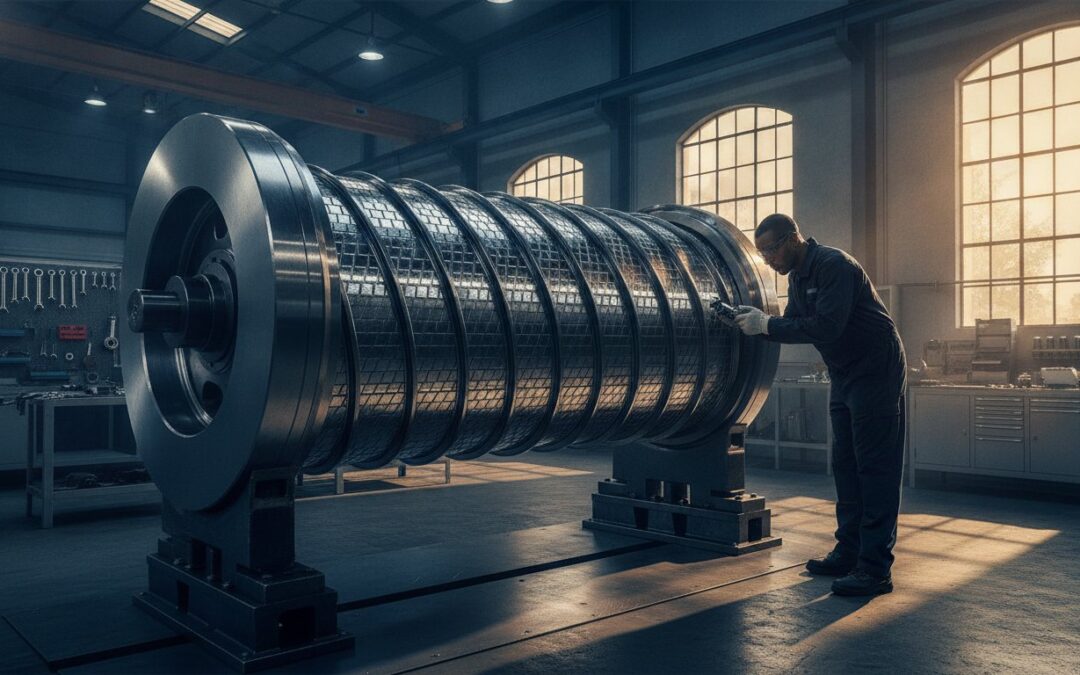
Did you know that unscheduled centrifuge downtime in heavy industrial operations can lead to logistics and water-loss costs exceeding ZAR 100,000 per month for a single processing stream? When abrasive feed materials begin to erode your equipment’s internal components, the resulting vibration and loss of efficiency aren’t just maintenance headaches; they’re direct threats to your bottom line. Investing in specialised centrifuge wear protection services is no longer a luxury but a fundamental requirement for maintaining a competitive edge. These precision engineering solutions ensure that your high-speed decanters and separators remain operational whilst handling the most demanding tailings and slurries.
Most plant managers agree that frequent erosion of centrifuge scrolls creates a frustrating cycle of unplanned repairs and lost productivity. This article explains how professional wear protection, ranging from sintered tungsten carbide tiles to advanced hardfacing, can extend your service life by up to ten times compared to standard treatments. You’ll discover the technical synergy between material science and dynamic balancing that keeps your machinery stable and efficient. We will explore the critical wear zones of your equipment and the bespoke strategies used to lower your total cost of ownership and maintain separation performance.
Key Takeaways
- Understand how professional centrifuge wear protection services mitigate the risk of catastrophic failure and significantly extend the service life of high-speed separation machinery.
- Identify the most vulnerable components of your equipment, including the feed zone and scroll flights, where abrasive materials cause the most significant erosion and imbalance.
- Compare the technical advantages of tungsten carbide tiles against traditional hardfacing to determine the most resilient solution for extreme wear environments like tailings dewatering.
- Learn how to establish a predictive refurbishment schedule by monitoring vibration levels and cake quality to prevent costly unplanned downtime and maintain efficiency.
- Discover the critical role of combining advanced material application with precision dynamic balancing to ensure long-term mechanical reliability and a lower total cost of ownership.
Optimising Equipment Longevity with Centrifuge Wear Protection Services
Centrifuge wear protection services represent a precision engineering discipline focused on shielding high-speed machinery from the destructive forces of erosion and abrasion. This process involves the strategic application of ultra-hard materials, such as sintered tungsten carbide or specialised metal alloys, to components that face the highest stress. Whilst routine maintenance tasks like lubrication are vital, they’re often insufficient for high-solids applications such as mining tailings dewatering. In these environments, the sheer volume of abrasive particles can scour through unprotected steel in a matter of weeks.
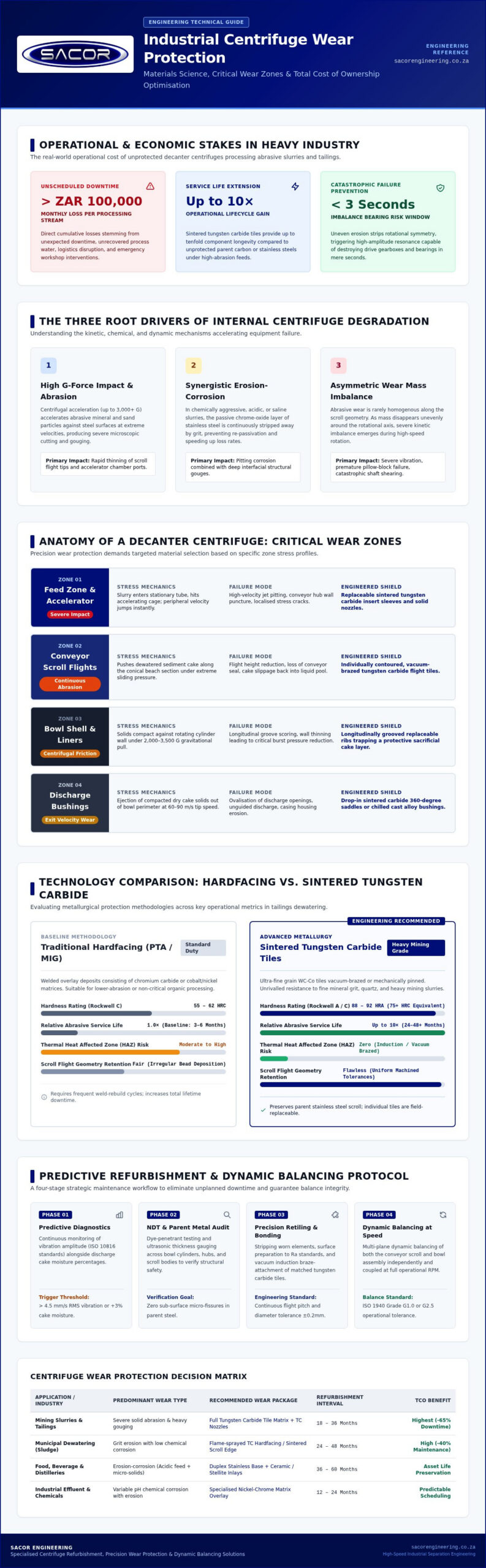
The economic impact of neglecting these services is significant. Beyond the immediate repair costs, the financial burden of unplanned downtime can exceed ZAR 100,000 per month for heavy industrial operations. Proactive protection preserves the structural integrity of industrial decanter centrifuges, ensuring that the rotating bowl and conveyor scroll maintain their original engineering tolerances. This prevents the thinning of parent metal, which would otherwise lead to costly structural failures or the need for a total machine replacement.
The Mechanics of Centrifugal Wear
The primary driver of internal damage is the immense G-force generated during operation. These forces accelerate abrasive particles against internal surfaces with incredible velocity, creating a constant sanding effect. In food and beverage processing, this is often compounded by “erosion-corrosion.” This phenomenon occurs when the chemical profile of the feed material weakens the metal’s passive layer, allowing solids to strip away the surface more rapidly. Perhaps most critically, wear is rarely uniform. When material erodes unevenly across a scroll or bowl, it creates a mass imbalance. This imbalance is the leading cause of catastrophic vibration failure, which can destroy bearings and drive systems in seconds.
Benefits of Professional Engineering Intervention
Partnering with experts to apply bespoke wear packages offers several operational advantages:
- Extended Service Cycles: Engineering interventions can extend operational intervals from a few months to several years, even in highly abrasive environments.
- Maintained Performance: Protecting the geometry of the scroll flights is essential for keeping the separation process efficiency at peak levels, ensuring high-yield outputs and drier cake solids.
- Asset Preservation: By shielding the expensive parent metal of the centrifuge, you significantly reduce the frequency of full-scale centrifugal equipment replacements.
Ultimately, professional wear protection transforms a centrifuge from a high-maintenance liability into a reliable, long-term asset. It’s a strategic choice that prioritises mechanical reliability over reactive repairs.
Identifying Critical Wear Zones in Industrial Centrifuges
Precision in centrifuge wear protection services requires a granular understanding of internal fluid dynamics. Not every surface within a machine experiences the same level of stress; instead, specific zones bear the brunt of high-velocity mechanical impact and sliding abrasion. Identifying these areas early prevents localised thinning from evolving into a structural failure. The feed zone, for instance, is the initial point of contact where slurry exits the accelerator at peripheral speeds. Without impact-resistant shielding, this area suffers from rapid pitting and erosion, which eventually compromises the conveyor hub.
Bowl liners play a secondary but equally vital role in shielding the main structural component from internal scoring. These liners often feature grooved surfaces designed to trap a sacrificial layer of solids. This layer acts as a natural buffer, protecting the stainless steel bowl from direct contact with abrasive grit. Regular inspection of these liners is essential, as once the protective solids layer is lost, the parent metal can degrade rapidly under the intense G-forces of operation.
Scroll and Conveyor Vulnerabilities
Scroll flight tips are the most vulnerable part of the conveyor mechanism. The leading edge of the flight performs the mechanical work of scraping settled cake toward the discharge end, making it susceptible to extreme sliding abrasion. As the flight edge wears down, the clearance gap between the flight and the bowl wall increases. Research indicates that even a small increase in this gap can drastically cut conveyance efficiency, leading to wetter cake discharge and higher power consumption. Professional centrifuge scroll refurbishment is necessary to restore this original geometry. Standard practice suggests visual inspections every 1,000 to 2,000 operating hours to ensure the scroll remains within functional tolerances.
Bowl and Discharge Protection
The solids discharge port represents another high-intensity wear zone. As dry cake is blasted outward at high speeds, it creates concentrated abrasion on the port edges. To combat this, replaceable tungsten carbide bushings or ceramic inserts are typically installed to prevent the housing from washing out. Operators should also pay close attention to the “beach” section of decanter centrifuges, where the shallow angle increases scouring. Following EPA centrifuge operation and maintenance guidance helps in identifying “wash-out” patterns before they penetrate the bowl wall. These patterns often appear as longitudinal scoring, indicating that the wear protection has been breached. If you notice these indicators, it’s wise to consult with a separation expert to assess the integrity of your equipment.
Comparing Wear Protection Technologies: Hardfacing vs. Ceramic Inserts
Selecting the correct material for centrifuge wear protection services is a precision engineering decision rooted in metallurgy and fluid dynamics. Whilst many operators focus solely on surface hardness, the choice between hardfacing, tungsten carbide, and ceramics requires a careful balance of impact resistance and chemical compatibility. Sacor Engineering adopts a bespoke approach to this selection, analysing the specific particle morphology and slurry chemistry of your feed material. This ensures the chosen protection matches the operational reality of the plant rather than relying on a one-size-fits-all solution.
Tungsten Carbide: The Gold Standard for Mining
In high-abrasion environments, such as coal or mineral processing, sintered tungsten carbide tiles are the industry benchmark. Unlike spray-on coatings that can peel or crack under stress, these solid tiles offer 8 to 10 times the wear life of conventional chromium carbide hardfacing. The mechanical bonding process is a critical factor in their success. Tiles must be brazed or mechanically fastened to ensure they remain attached under the immense G-forces that would otherwise cause them to detach and damage the bowl. This level of durability is essential for tailings dewatering equipment, where the constant flow of silica and grit would otherwise scour the parent metal in a matter of weeks.
Hardfacing and Protective Coatings
Hardfacing involves applying cobalt or nickel-based alloys via specialised welding techniques to create a metallurgical bond with the parent steel. This method is particularly effective for intricate geometries, such as the curved surfaces of a scroll hub or the internal accelerator, where rigid tiles cannot fit. However, there is always a trade-off between hardness and impact resistance. As highlighted in weld hardfacing wear resistance research, the microhardness of the overlay must be precisely matched to the abrasive media to prevent brittle fracturing or “undercutting” of the base metal.
In food-grade separation environments, hardfacing is often the preferred choice because it creates a smooth, non-porous surface that meets strict hygiene standards whilst providing sufficient protection against moderate erosion. Ceramic linings offer another alternative, excelling in applications where chemical resistance is as vital as abrasion protection. Alumina tiles are highly effective against corrosive slurries, though they’re more susceptible to impact damage from tramp metal than tungsten carbide. By integrating these various technologies, our centrifuge wear protection services create a multi-layered defence system that optimises the lifespan of every internal component.
Strategic Maintenance: When to Organise Wear Protection Refurbishment
Adopting a proactive stance toward equipment health requires moving beyond reactive repairs to a structured maintenance framework. Effective centrifuge wear protection services rely on a predictive schedule often calculated by processed tonnage or operating hours. Standard industrial benchmarks suggest visual scroll inspections every 1,000 to 2,000 hours, whilst major overhauls are typically scheduled between 8,000 and 16,000 hours depending on the abrasiveness of the slurry. Waiting for a visible failure is a high-risk strategy; by the time vibration is felt on the plant floor, the internal damage is often extensive.
Monitoring vibration levels and cake quality serves as your primary early warning system. A sudden drop in cake dryness often indicates that the scroll flight tips have worn beyond their functional clearance. More dangerously, “over-wearing” occurs when the protective tiles or hardfacing are completely breached, allowing the abrasive feed to scour the parent steel. If the base metal is significantly thinned, the structural integrity of the machine is compromised, making a successful refurbishment impossible and necessitating a complete component replacement.
Vibration Monitoring and Dynamic Balancing
Asymmetric wear patterns are a common cause of mass loss, which leads to imbalance and accelerated bearing failure. Modern facilities increasingly use real-time monitoring systems based on ISO 20816-3 standards to detect these shifts before they reach trip thresholds. Any time new wear materials are applied, professional centrifuge bowl balancing is non-negotiable. Following ISO 21940-11, this process ensures the rebuilt scroll and bowl operate with the mechanical symmetry required for high-speed rotation, preventing the destructive resonance that shortens machinery life.
The Refurbishment Lifecycle
The refurbishment process is a methodical engineering sequence. It begins with stripping old protection and conducting Non-Destructive Testing (NDT) to check for underlying stress cracks in the parent metal. Precision engineering is then required to re-apply wear materials whilst maintaining strict internal clearances, usually between 1.5 and 3.0 mm. Documenting these wear patterns is a vital part of the partnership; it allows for the optimisation of future material selection based on real-world performance data. To ensure your equipment remains within these critical tolerances, organise a professional centrifuge inspection with our technical team today.
Sacor Engineering: Advanced Separation Protection and Refurbishment
Sacor Engineering has established a national reputation for excellence in centrifugal separation across South Africa. We provide a comprehensive suite of solutions that encompasses everything from the supply of new hardware to intricate technical refurbishment. Our expertise is not limited to a single machine type; we maintain deep technical knowledge of both decanter centrifuges and disk stack separators. This dual focus allows us to support diverse sectors, including mining and food processing, by extending the operational life of critical industrial assets through precision engineering. By choosing our centrifuge wear protection services, you’re investing in a partnership that prioritises mechanical reliability and long-term performance.
Bespoke Engineering Solutions
We recognise that every industrial application presents a unique abrasive profile. Our team develops customised wear protection packages tailored to the specific morphology of your mineral or food slurries, ensuring that the materials used are perfectly matched to the stress of your process. This in-house technical support is vital for solving complex separation challenges where standard coatings often fail. Additionally, our refurbishment expertise integrates seamlessly with the maintenance of high speed disk stack separators. By combining advanced material application with precision dynamic balancing, we ensure that even the most sensitive equipment remains stable at high rotational speeds, preserving the integrity of internal components whilst maintaining peak throughput.
Partnering for Long-Term Efficiency
Choosing Sacor Engineering means moving beyond transactional repairs and adopting a long-term asset management strategy. We partner with our clients to monitor wear trends over multiple service cycles, providing a level of consultative support that goes far beyond simple part replacement. This collaborative approach allows us to refine material choices and optimise maintenance intervals based on real-world data, ultimately lowering the total cost of ownership for your separation machinery. Our national availability ensures that technical consultations and high-precision refurbishment projects are accessible regardless of your location. We remain committed to the sustainability of South African industry by ensuring your machinery performs at its peak for as long as possible. Contact Sacor Engineering today to discuss your centrifuge wear protection needs.
Securing Your Separation Infrastructure for the Long Term
Protecting the internal geometry of your centrifuge is the most effective method for maintaining separation efficiency and preventing the structural degradation that leads to catastrophic failure. By integrating advanced metallurgical choices with precision dynamic balancing, you ensure your machinery operates within its original design parameters even in the harshest tailings environments. Professional centrifuge wear protection services transform reactive maintenance into a strategic asset management programme that directly impacts your total cost of ownership.
At our Specialised Decanter Refurbishment Centre, we combine expertise in high-speed balancing and metallurgy to deliver national South African support for your most critical separation equipment. Our team is ready to help you navigate complex erosion challenges with bespoke engineering solutions that extend service cycles and significantly reduce operational risk. We look forward to partnering with you to achieve dependable excellence and long-term mechanical reliability in your separation processes.
Request a Technical Consultation for Your Centrifuge Refurbishment
Frequently Asked Questions
What are the primary signs that my centrifuge needs wear protection refurbishment?
Leading indicators include increased vibration levels and a noticeable decline in cake dryness. When the scroll flights wear down, the clearance gap increases, reducing conveyance efficiency. You might also observe higher power consumption as the motor works harder to process the same tonnage. Regular visual inspections every 1,000 to 2,000 hours help identify these patterns before they lead to catastrophic mechanical failure or structural thinning of the parent metal.
Can wear protection materials affect the balancing of my centrifuge bowl?
Yes, any modification to the internal mass of the machine will impact its dynamic balance. Uneven wear or the application of new tiles can create significant vibration. Following the application of centrifuge wear protection services, we perform high-speed dynamic balancing to ISO 21940-11 standards. This step is critical for protecting bearings and ensuring the machine operates smoothly at peripheral speeds reaching thousands of revolutions per minute without destructive resonance.
Which is better for mining tailings: tungsten carbide tiles or hardfacing?
Sintered tungsten carbide tiles are the superior choice for the extreme abrasion found in mining tailings. Research indicates these tiles deliver eight to ten times the wear life of conventional chromium carbide hardfacing. Whilst hardfacing is useful for complex geometries where tiles cannot fit, the sliding abrasion of silica and grit in tailings dewatering requires the extreme hardness and consistent geometry that only modular tiles can provide.
How much longer will my centrifuge last with professional wear protection services?
Professional protection can extend the operational life of your equipment by up to ten times compared to unprotected or standard surfaces. By shielding the parent metal from direct contact with abrasive grit, you preserve the structural integrity of the bowl and scroll. This strategic intervention often extends service intervals from a few months to several years, significantly lowering the total cost of ownership for your separation machinery.
Is wear protection necessary for food-grade centrifugal separators?
Yes, wear protection is essential in food and beverage processing to combat erosion-corrosion. This occurs when acidic or chemically active feed materials weaken the metal’s passive layer, allowing solids to strip the surface more easily. Applying specialised hardfacing creates a smooth, non-porous finish that meets strict hygiene requirements whilst preventing the pitting that can harbour bacteria or lead to mechanical imbalances during high-speed separation cycles.
How does Sacor Engineering ensure the quality of wear protection applications?
Sacor Engineering ensures quality through a rigorous technical sequence that begins with Non-Destructive Testing (NDT) to identify underlying stress cracks. Our engineering team uses precision application techniques to maintain internal clearances between 1.5 and 3.0 mm. Every refurbished component undergoes static and dynamic balancing to ensure it meets international reliability standards, providing a level of mechanical symmetry that guarantees long-term operational stability for our industrial partners.
Can you provide wear protection services for all brands of decanter centrifuges?
We provide comprehensive refurbishment and protection services for all major brands of industrial decanter centrifuges and disk stack separators. Our technical team is experienced in handling diverse mechanical designs and proprietary geometries used across the mining and food sectors. This broad expertise allows us to restore equipment to its original engineering specifications, regardless of the manufacturer, ensuring that South African industrial assets remain productive and efficient.
What is the typical turnaround time for a centrifuge scroll refurbishment?
The turnaround time for a scroll refurbishment varies based on the extent of the wear and the complexity of the protection package required. A standard refurbishment involves stripping old materials, structural testing, and the precise re-application of tiles or hardfacing. We prioritise minimising unplanned downtime for our partners by maintaining a methodical workflow. For a specific timeline based on your equipment’s current condition, we recommend organising a technical consultation.