
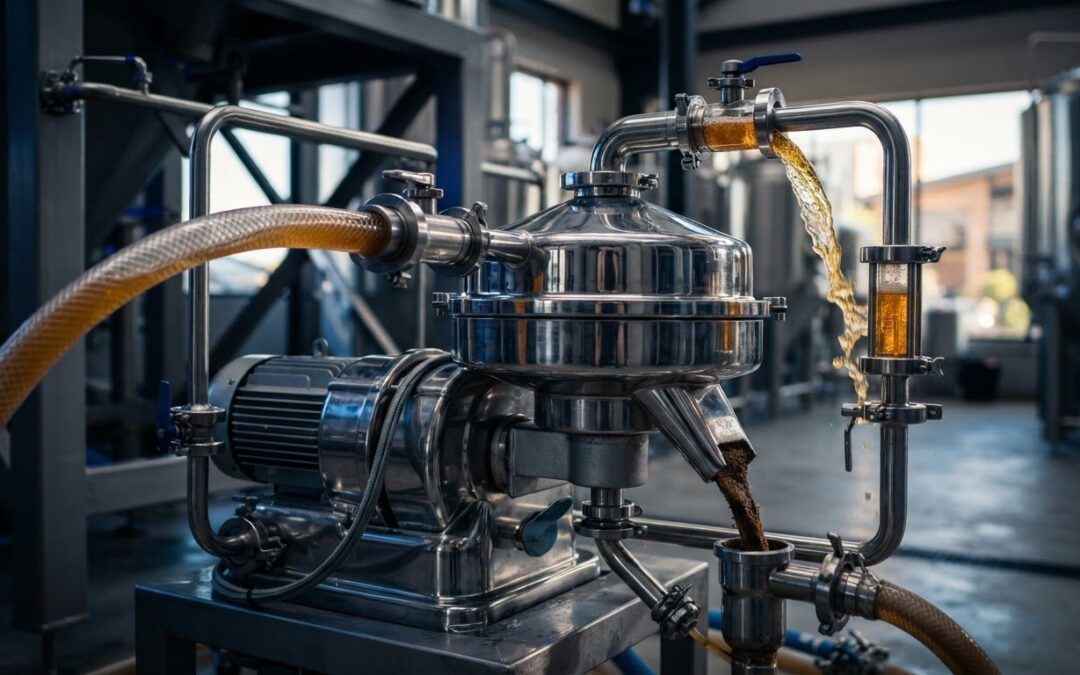
Pouring up to 10% of your finished volume down the cellar drain is an operational tax that commercial brewing can no longer afford to accept. If you have spent long cellar shifts clearing blinded filter media, waiting days for stubborn yeast and trub to settle, or worrying about dissolved oxygen pick-up dulling fresh hop character, you already understand the frustrating bottlenecks of conventional filtration. Integrating mechanical centrifugal separation for breweries resolves these operational compromises, replacing slow gravity sedimentation with rapid, high-precision clarification.
Rather than stripping out essential body or risking oxidative spoilage, high-speed disc stack separation safeguards delicate volatile hop oils whilst accelerating tank turnaround by two to five days per batch. By recovering between 5% and 10% in additional cellar yield and delivering automated, repeatable turbidity control, modern separation machinery unlocks latent fermentation vessel capacity without expanding physical cellar footprints. In this guide, we examine how mechanical separation transforms beer clarification, preserves peak product flavour stability, and establishes dependable operational efficiency across your entire packaging schedule.
Key Takeaways
- Understand how rotational acceleration exploits density differentials to accelerate yeast and trub sedimentation, dramatically reducing fermentation vessel residence times.
- Compare the operational, safety, and waste-reduction benefits of mechanical centrifugal separation for breweries against conventional kieselguhr and consumable sheet filtration systems.
- Identify primary process integration points across the brewhouse and cellar, from hot wort trub separation to clarifying heavily dry-hopped beers without disc fouling.
- Evaluate essential sanitary engineering benchmarks, including 316L stainless steel surface finishes and hygienic mechanical seals, to prevent dissolved oxygen ingress.
- Learn why proactive mechanical maintenance regimes, spindle overhauls, and high-precision dynamic bowl balancing are critical for preventing catastrophic vibration and operational downtime.
Understanding Centrifugal Separation for Breweries and Modern Cellar Operations
Modern cellar throughput depends entirely on how quickly you can separate insoluble particles from green beer without stripping flavour or introducing oxygen. Centrifugal separation utilises high gravitational fields to rapidly separate yeast, trub, and hop matter from suspension. Rather than waiting days for gravity to pull solids through thousands of litres of liquid, rotational acceleration accelerates sedimentation velocity based on particle size and liquid density differentials. Implementing continuous centrifugal separation for breweries replaces static gravitational sedimentation and eliminates recurring consumable media, allowing cellars to maintain brisk batch turnarounds without compromising bright beer clarity.
The Mechanics of Centrifugal Force in Brewing
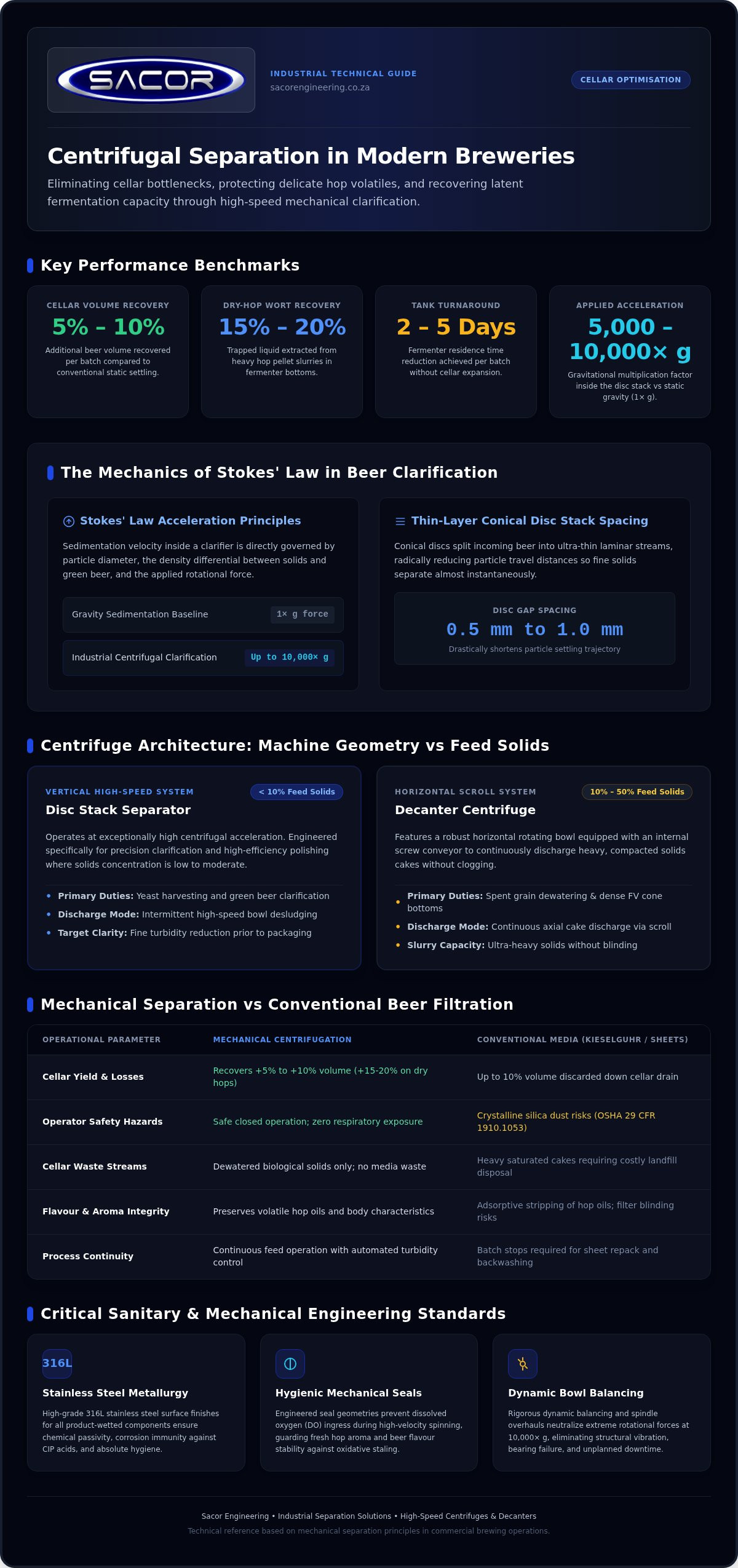
Sedimentation velocity inside a clarifier is governed by Stokes’ Law, where settling speed is directly proportional to particle diameter, the density differential between solids and liquid, and the applied acceleration. Gravity sedimentation applies a baseline force of 1× g. In contrast, industrial clarifiers achieve gravitational force multiplication between 5,000× g and 10,000× g inside the rotating bowl. Understanding the core principles of centrifugal separation reveals why this process is so efficient: conical disk stacks divide the liquid flow into thin layers spaced roughly 0.5 to 1.0 mm apart, drastically shortening the settling distance so fine solids separate almost instantaneously.
Disk Stack Separators vs Decanter Centrifuges in the Brewhouse
Selecting the right machine architecture depends on your suspended solids concentration and the stage of production. Both geometries serve vital roles across brewery workflows:
- Disk stack separators: Operating at exceptionally high centrifugal forces, high speed disk stack separators deliver high-precision clarification. They excel at yeast harvesting and green beer polishing where feed solids generally range below 10% by volume.
- Decanter centrifuges: Featuring a horizontal rotating bowl with an internal scroll conveyor, decanters continuously discharge heavy cake. They are engineered to handle high-solids slurries between 10% and 50% solids, such as spent grain processing and dense fermentation vessel cone bottoms.
Configuring customized separation solutions that align bowl geometry with feed solids ensures optimal clarification without premature clogging or product loss.
Centrifugal Clarification vs Conventional Beer Filtration: Technical Comparison
Traditional beer clarification relies heavily on disposable depth filter sheets, lenticular cartridges, or kieselguhr (diatomaceous earth) leaf filters. While these methods trap particulate matter effectively, they create significant process bottlenecks. Inhaling crystalline silica from dry diatomaceous earth presents documented occupational hazards under OSHA 29 CFR 1910.1053, and disposing of spent, heavy filter cakes incurs steep landfill costs. Operating mechanical centrifugal separation for breweries removes these hazards by using a closed, continuous mechanical system. Rather than stripping out valuable volatile oils or discarding saturated sheets, a clarifier isolates yeast and solids purely through acceleration, sharply reducing operating expenditures and cellar waste streams. To evaluate broader mechanical principles across other continuous processing setups, examine the professional guide to industrial separation solutions.
Yield Optimisation and Cellar Volume Recovery
Centrifuges consistently deliver between 5% and 10% additional beer volume per batch compared to conventional settling. For heavy dry-hopped styles, where spent pellets absorb vast quantities of wort, disc-stack systems can recover up to 15% to 20% of trapped liquid from fermenter bottoms. Slashing sedimentation wait times reduces tank residence by two to five days, enabling cellars to turn fermenters over in four to seven days instead of two full weeks.
Dissolved Oxygen Pick-Up and Flavour Stability
Flavour stability degrades rapidly if clarified beer absorbs ambient air. Conventional filters contain dozens of gasket interfaces and dry media cavities that risk air entrapment during initial pack wetting. Modern brewery separators mitigate this through hydro-hermetic mechanical liquid seals and de-aerated water flushes. These closed designs keep dissolved oxygen pick-up strictly below 3 to 10 parts per billion, safeguarding delicate hop aromas against premature staling.
Preserving Sensory Character and Selective Clarity
Depth filtration media acts as an indiscriminate physical sieve, often stripping foam-positive lipid proteins and delicate hop terpenes along with yeast. Centrifugation operates strictly by mass and density. As highlighted in the Brewers Association clarification systems white paper, calibrated mechanical separation provides agile operational control over turbidity. Automated discharges let brewers run clear lagers and stable hazy IPAs through the same machine without shear forces lysing yeast or releasing foam-destroying Protease A. If you are reviewing your process layout, consulting with specialists at sacorengineering.co.za can help tailor disk stack separators to your exact cellar requirements.
Primary Application Stages for Centrifugal Technology in Brewing
Modern cellars extract value from centrifugal machinery across several operational touchpoints rather than treating it merely as a packaging filter. Tailoring centrifugal separation for breweries to distinct production phases allows cellar teams to address bottlenecks in hot wort production, primary fermentation, and waste dewatering. Similar mechanical clarification strategies deliver comparable gains across other processing environments, as detailed in our guide to centrifuges for wine clarification. In brewing, three critical process stages benefit most from mechanical separation.
Hot Wort and Whirlpool Trub Separation
Clarifying hot wort directly downstream of the kettle eases mechanical burdens on the whirlpool, particularly during brews with high adjunct ratios or heavy late kettle additions. Deploying a centrifuge here reduces whirlpool resting times, limiting prolonged heat exposure that can accelerate dimethyl sulphide (DMS) formation. Capturing fine hot trub prior to the heat exchanger improves oxygen transfer in the aeration line and safeguards the collection of healthy, unpolluted yeast slurry during primary pitching.
Fermentation Cellar Clarification and Hop Creep Mitigation
Post-fermentation separation delivers the greatest operational flexibility for craft and production facilities. When dealing with heavily dry-hopped beers dosed above 20 grams per litre, centrifuges quickly strip out vegetal particulate matter. This rapid purge stops the extraction of harsh polyphenols and mitigates hop creep, a persistent issue where hop enzymes continue breaking down unfermentable dextrins in the presence of suspended yeast. Removing both particulate hop mass and yeast at terminal gravity stabilizes the beer before carbonation, avoiding the harsh astringency known as hop burn.
Tank Bottoms Beer Recovery and Effluent Reduction
Dense sediment left in cylindroconical fermenter cones holds considerable volumes of high-value beer. Discarding this slurry directly down the cellar drain inflates biological oxygen demand (BOD) loads, triggering steep municipal wastewater surcharges. Industrial decanter centrifuges dewater these heavy bottoms efficiently, separating concentrated solids cakes from clarified beer. The reclaimed liquid can be blended back upstream or sent to secondary processing, converting brewery waste into saleable stock whilst significantly lowering environmental discharge footprints.
Crucial Technical and Sanitary Criteria for Selecting Brewery Centrifuges
Specifying the proper machinery requires balancing hydraulic capacity, feed solids loading, and hygienic construction. A unit sized solely on nominal liquid throughput will fail when confronted with heavy hop trub or dense yeast slurries. Implementing effective centrifugal separation for breweries involves scrutinising the mechanical boundary seals, metallurgy, and automation package. You need equipment that integrates into compact cellar layouts without demanding costly brewhouse re-engineering or forcing proprietary supplier lock-in.
Flow Rate, Solids Capacity, and Sizing Calculations
Clarifier sizing must mirror continuous downstream processing speeds. Sizing the centrifuge to feed packaging lines directly avoids intermediate bright beer tank buffers, but internal sediment holding capacity dictates true throughput. High-gravity or heavily hopped worts contain significantly elevated solids that trigger frequent bowl discharges. If solids exceed disk stack limits, separation efficiency drops rapidly. For heavy solid-liquid slurries, consult our detailed decanter centrifuge selection criteria to determine when continuous scroll discharge outperforms disk geometry.
Sanitary Mechanical Seals and Oxygen Management
Sanitary standards demand product-contact surfaces fabricated from AISI 316L stainless steel with surface finishes polished to Ra ≤ 0.8 µm. These smooth finishes eliminate bacterial harborage sites and micro-crevices. Maintaining low dissolved oxygen pick-up depends on seal design:
- Hydro-hermetic liquid seals: Submerged liquid barriers isolate the rotating liquid surface from ambient cellar air, keeping oxygen ingress below 10 parts per billion.
- Mechanical seal flushes: Continuous flushes using sterile, de-aerated condensate or cold degassed water cool the seal faces whilst preventing micro-leaks.
- Carbon dioxide blanketing: Pressurised inert gas pockets purge discharge cyclones before and during bowl discharges.
Clean-in-Place (CIP) and Automation Integration
Modern clarification skids run fully automated Clean-in-Place cycles, tolerating hot caustic washes at 85°C and periodic nitric or phosphoric acid circulations without requiring manual bowl strip-downs. Optical turbidity sensors continuously measure feed and effluent streams, adjusting back-pressure valves or triggering partial bowl ejections only when the sediment space fills. Paired with variable frequency drives, these automated controls cut operational energy draw and minimize mechanical shock loads. To implement robust food and beverage processing equipment configured for your cellar footprint, contact the engineering team at Sacor Engineering for tailored solutions.
Maintaining and Refurbishing Brewery Centrifugal Machinery for Peak Efficiency
Rotating at several thousand revolutions per minute, industrial clarifiers operate under immense mechanical and centrifugal forces. Over consecutive production cycles, the combination of high rotational speeds, dynamic hydraulic loads, and abrasive process solids places substantial stress on bowls, vertical spindles, and gear trains. Without diligent mechanical oversight, slight imbalances induce harmonic vibration, accelerate bearing wear, and risk catastrophic mechanical failure. Sustaining long-term reliability in centrifugal separation for breweries demands a disciplined maintenance framework alongside expert mechanical overhaul services.
Dynamic Bowl Balancing and Mechanical Tolerances
Centrifuge bowls handle substantial mechanical stress during routine acceleration and solids ejection. Over time, recurring contact with abrasive hop particles and high-velocity yeast slurries causes uneven surface erosion, disrupting factory mass distribution. When an assembly loses balance, operational vibration spikes rapidly, transferring destructive lateral forces straight into the spindle bearings and gearbox. Maintaining peak mechanical health requires regular dynamic two-plane bowl balancing to return vibration levels to safe operational limits. Technicians must also inspect bowl walls for erosion grooves, check spindle runout tolerances, and verify that lock rings seat securely without mechanical play.
Comprehensive Refurbishment and Life-Extension Strategies
Breweries do not always need to invest in brand-new machinery when cellar throughput expands or legacy equipment tires. As detailed in our guide to industrial centrifuge life extension through strategic refurbishment, targeted reconditioning reliably restores aging machines to factory performance benchmarks. A comprehensive overhaul encompasses several crucial engineering stages:
- Non-destructive testing: Bowl shells and lock rings undergo ultrasonic and dye-penetrant flaw detection to identify micro-cracks before they cause structural failure.
- Spindle and drive renewal: Spindles are precision-machined, drive gears re-toothed or replaced, and high-speed bearings renewed to maintain exact alignment.
- Seal and elastomer replacement: All internal process gaskets, distributor O-rings, and discharge seals are swapped for sanitary, food-grade materials resistant to harsh cleaning chemicals.
Rather than accepting restrictive original equipment manufacturer lock-in, forward-thinking breweries partner with vendor-neutral mechanical specialists. Operating nationwide, the technical team at Sacor Engineering delivers turnkey centrifuge refurbishment services, high-precision bowl balancing, and customized separation solutions tailored to your production schedule.
Optimising Cellar Performance Through Precision Separation
Replacing sluggish gravity settling and consumable media with continuous mechanical clarification fundamentally transforms brewing operations. Integrating centrifugal separation for breweries safeguards delicate volatile hop aromatics and foam-positive proteins whilst recovering high-value volume that conventional filtration routinely discards. From hot wort trimming to rapid tank turnover on heavy dry-hopped batches, mechanical separation establishes dependable cellar cycles, negligible oxygen pick-up, and substantially reduced effluent loads.
Long-term operational success depends on robust mechanical integrity and disciplined equipment stewardship. Backed by extensive engineering expertise across high-speed separation machinery, Sacor Engineering provides nationwide technical support, high-precision bowl balancing, and complete mechanical overhauls. Whether your cellar requires turnkey refurbishment services or tailored process skids designed around existing pipework, our consultative approach ensures your facility operates without restrictive OEM lock-in. Consult Sacor Engineering for customised brewery separation solutions to elevate your cellar throughput and build lasting operational resilience.
Frequently Asked Questions
How does a brewery centrifuge remove solids without stripping delicate hop aromas?
Centrifuges separate particles based strictly on mass and density rather than forcing liquid through an absorbent physical filter matrix. Because volatile hop terpenes and essential aromatic oils remain emulsified within the beer rather than bound to dense solids, they pass freely through the disc stack. This density-dependent acceleration removes inert vegetal trub and yeast cells while leaving aromatic hop profiles intact.
What is the typical increase in beer yield after implementing centrifugal separation?
Most commercial operations experience an immediate volume recovery between 5% and 10% compared to conventional settling. For facilities producing heavily dry-hopped styles, liquid gains frequently reach 15% to 20% because the equipment extracts high-value wort and beer otherwise trapped in saturated hop cones at the tank base. This dramatically lowers cost per hectolitre.
Can a centrifugal separator produce both crystal-clear lagers and hazy IPAs?
Yes, modern clarifiers manage diverse turbidity targets through variable bowl speeds, back-pressure adjustments, and automated discharge intervals. Running the machine at high relative centrifugal force yields bright lagers with low residual yeast counts. Alternatively, increasing flow velocity or moderating rotational speed allows stable colloidal proteins and hop haze to carry forward into finished hazy ales.
How do modern brewing centrifuges prevent dissolved oxygen pick-up during clarification?
Oxygen ingress is prevented by hermetic or hydro-hermetic mechanical seals that create a liquid barrier between rotating components and ambient cellar air. skids also utilise continuous carbon dioxide purging across ejection cyclones and degassed water seal flushes. These engineering safeguards keep dissolved oxygen pick-up consistently below 10 parts per billion throughout the clarification process.
Is a disk stack separator or a decanter centrifuge better suited for brewery operations?
Disk stack separators are the standard choice for centrifugal separation for breweries, delivering fine clarification and yeast polishing for feed streams with under 10% solids. Decanter centrifuges feature a horizontal scroll design built to handle dense, continuous solids between 10% and 50%. Decanters excel primarily at spent grain dewatering, whirlpool bottom recovery, and primary fermenter cone dump processing.
What maintenance routines are vital to prevent catastrophic centrifuge bowl failure?
Operating safety requires strict adherence to intermediate seal replacements every 2,000 to 4,000 hours and complete mechanical overhauls every 8,000 to 12,000 operating hours. Technicians must conduct non-destructive crack testing, spindle tolerance checks, and dynamic two-plane bowl balancing. Dynamic balancing prevents destructive harmonic vibrations caused by abrasive particle erosion, protecting bearings and operators from catastrophic high-speed failure.
Can pre-owned or aging industrial centrifuges be refurbished for sanitary brewery use?
Yes, pre-owned separation hardware can undergo complete mechanical reconditioning to meet rigorous sanitary food and beverage processing equipment standards. Specialised mechanical refurbishment restores OEM engineering tolerances, renews drive gearing, repolishes internal bowls to hygienic surface finishes, and fits certified food-grade elastomers. This comprehensive overhaul provides reliable operational efficiency without the prohibitive capital expense of purchasing new machinery.