

Selecting the incorrect separation technology isn’t just a minor technical error; it’s a silent drain on your bottom line that can lead to millions of Rand in lost product and excessive energy consumption. You’ve likely felt the frustration of a discharge that’s still too wet or a liquid phase that remains stubbornly cloudy despite your best efforts. When weighing up the decanter centrifuge vs disk stack separator, the decision often hinges on the delicate balance between G-force capability and the specific settling velocity of your industrial slurry.
We understand that achieving high-dryness solids and pristine centrate clarity is non-negotiable for your process integrity. In this article, you’ll learn how to choose the right centrifugal technology by comparing mechanical principles, feed requirements, and long-term maintenance costs. We’ll provide a clear decision framework that moves beyond basic definitions, focusing instead on the practical realities of South African industrial environments to ensure your equipment choice delivers lasting value and precision.
Key Takeaways
- Identify why mechanical orientation is the primary driver of performance, distinguishing between horizontal continuous discharge and vertical high-speed clarification.
- Determine the most efficient machine for your specific slurry by comparing a decanter centrifuge vs disk stack separator across varying solids concentrations.
- Evaluate how Relative Centrifugal Force (RCF) capabilities impact the critical trade-off between high-volume throughput and maximum liquid purity.
- Learn how professional refurbishment and precision balancing act as a cost-effective alternative to new capital expenditure whilst maintaining peak dewatering performance.
- Master a structured selection framework that prioritises lab-verified data to align your mechanical choice with your primary operational goals.
Fundamental Differences Between Decanters and Disk Stack Separators
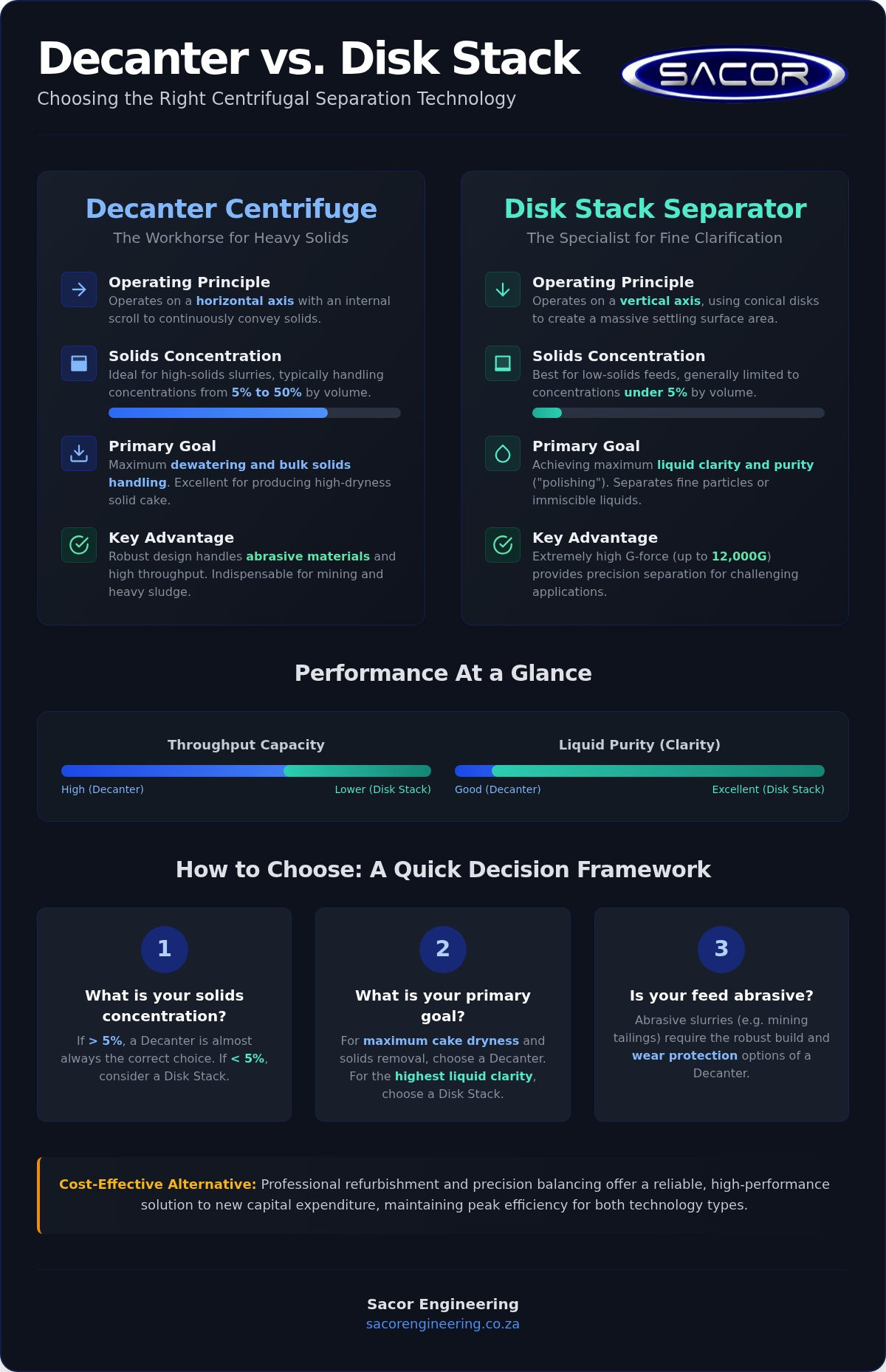
The mechanical divide between these two technologies isn’t just about geometry. It dictates how your plant handles abrasive wear, energy load, and product recovery. A Decanter centrifuge operates on a horizontal axis, making it the primary choice for high-solids separation. Conversely, disk stack separators utilise a vertical orientation to process fine particles at extreme speeds. Choosing between a decanter centrifuge vs disk stack separator requires a deep understanding of how these mechanical layouts interact with your specific feed slurry and overall process efficiency.
The Decanter Centrifuge: Built for Heavy Solids
The internal scroll, or conveyor, is the heart of this machine. It rotates at a slightly different speed to the bowl, continuously pushing separated solids towards the discharge ports. This design is essential for solid bowl decanter centrifuge applications where solids concentration exceeds 5% to 10% by volume. In South Africa’s mining sector, these machines are indispensable for tailings dewatering and heavy sludge processing. Their robust design allows for continuous operation even when faced with abrasive materials that would quickly clog less resilient systems.
The Disk Stack Separator: Precision for Fine Clarification
Disk stack technology relies on a series of conical disks to create a massive settling surface area within a compact footprint. This “stack” effect allows for the separation of extremely fine particles or immiscible liquids that a horizontal unit might miss. These vertical separators can reach forces up to 12,000G, providing the precision needed for beverage processing or intricate oil-water separation. Whilst they offer superior liquid clarity, they are generally limited to feeds with low solids content, typically under 5% by volume. The vertical design requires precision balancing to maintain stability at these high rotational speeds.
Your choice directly impacts operational costs and long-term reliability. A decanter might draw more power to move heavy solids, but it prevents the frequent discharge cycles and potential clogging issues that a disk stack would encounter in high-concentration environments. When comparing a decanter centrifuge vs disk stack separator, you are essentially choosing between bulk handling capacity and liquid polish. Selecting the right mechanical principle from the start ensures your process remains streamlined and cost-effective.
Evaluating Feed Characteristics for Technology Selection
The physical properties of your feed slurry often dictate the winner in the decanter centrifuge vs disk stack separator debate. It isn’t merely about the volume you process; it’s about how the material behaves under extreme gravitational force. Solids concentration serves as the primary filter for this decision. Decanters are the industrial workhorses for slurries with high solids content, typically thriving in environments where concentrations range from 5% to 50%. Attempting to process such heavy loads in a disk stack would lead to frequent discharge cycles and potential mechanical failure.
Particle size distribution and viscosity also play critical roles. When particles are too fine for a standard decanter scroll to capture efficiently, they may remain suspended in the liquid phase. Viscosity usually decreases as temperature rises, which can improve separation efficiency in both machine types. In many South African industrial processes, we use chemical flocculants to help organise these fine particles into larger clusters. This pre-treatment significantly enhances capture rates, ensuring that even challenging slurries meet discharge specifications. Consulting with an expert for customised separation solutions ensures your feed analysis translates into operational success.
When to Choose a Decanter for Mining Tailings
Mining operations across South Africa face unique challenges with abrasive slurries that can rapidly erode standard equipment. Decanters are preferred here because they can be fitted with specialised tungsten carbide wear protection on the scroll flights. This durability is vital when integrating the unit into broader tailings dewatering equipment systems. The goal is often to achieve maximum cake dryness, which reduces the volume of waste sent to tailings dams and ensures compliance with environmental regulations. The continuous discharge capability of the decanter allows for high-tonnage throughput without the downtime associated with cleaning or desilting.
When Disk Stacks Win in Food and Beverage
In the food and beverage sector, the priority shifts from bulk dewatering to extreme liquid clarity. Disk stack separators are the clear choice when the feed contains less than 1% solids. They provide gentle product handling, which is essential for sensitive proteins or yeasts that might be damaged by the mechanical shearing of a decanter scroll. These vertical separators also maintain the highest hygiene standards, often featuring fully automated “Clean-in-Place” (CIP) systems. Whether you’re clarifying fruit juices or separating cream, the disk stack’s ability to polish the liquid phase is unmatched in high-purity applications. For commercial kitchens and food producers who need to manage their waste streams effectively, Cash 4 Waste Oil offers a reliable collection service to ensure used cooking oils are recycled responsibly.
Decanter vs Disk Stack: Performance Comparison
Performance metrics for centrifugal hardware are defined by the physics of sedimentation. When comparing a decanter centrifuge vs disk stack separator, the most critical value is the Relative Centrifugal Force (RCF). Standard industrial decanters typically operate between 3,000G and 4,500G, which is sufficient for heavy solids sedimentation. Vertical disk stack separators, however, reach significantly higher intensities, often exceeding 12,000G. This extreme force is necessary to overcome the Brownian motion of sub-micron particles that would otherwise remain suspended in the liquid phase.
To assist process engineers in 2026, we’ve outlined the standard performance benchmarks for these technologies:
- Decanter Centrifuge: High solids handling (up to 50% volume), moderate G-force, horizontal footprint, and continuous solids discharge.
- Disk Stack Separator: Low solids handling (typically <1% volume), extreme G-force, vertical footprint, and intermittent or nozzle-based solids discharge.
- Energy Consumption: Decanters often require higher torque to drive the internal scroll against heavy solids, whilst disk stacks consume energy primarily to maintain high-velocity bowl rotation.
Plant layout also influences the selection. A decanter requires significant horizontal floor space and robust structural support to manage the vibrational harmonics of a long, rotating bowl. Disk stacks are more compact vertically but require precise overhead clearance for bowl removal during major service intervals. In South African plants where space is at a premium, the verticality of a separator can be a deciding factor, provided the feed characteristics allow for it. Ensuring your facility meets the necessary structural and utility requirements is equally critical, and following a comprehensive industrial centrifuge installation checklist can prevent costly structural oversights from the outset.
Clarification vs Dewatering Efficiency
The fundamental trade-off exists between centrate clarity and cake dryness. Disk stacks are the masters of clarification; they produce a liquid phase that is often “polished” to near-purity. Decanters, however, excel at dewatering. They compress solids into a dry “cake” that is far easier to transport and dispose of. For complex streams, three-phase models in both categories can handle oil, water, and solids simultaneously, though the decanter remains more resilient if the solids volume fluctuates unexpectedly.
Operational Flexibility and Control
Modern control systems allow for high levels of automation in both machine types. In a decanter, you can adjust the differential speed between the bowl and the scroll in real time to compensate for changes in feed consistency. Self-cleaning disk stack separators rely on timed or sensor-triggered “shots” to eject accumulated solids. Maintaining peak centrifugal separation efficiency requires sophisticated monitoring of these discharge cycles to prevent product loss in the liquid phase. Balancing these parameters ensures your plant achieves the lowest possible cost per cubic metre of processed material.
Maintenance, Wear, and the Role of Refurbishment
Mechanical wear is an inevitable byproduct of high-speed industrial separation, yet its impact on your bottom line is often underestimated. In the debate of decanter centrifuge vs disk stack separator, the primary mode of degradation differs significantly between the two. Decanters are susceptible to abrasive erosion because they handle high volumes of solids that grind against internal surfaces. Disk stacks, whilst processing fewer solids, operate at much higher rotational speeds, making them sensitive to even minor imbalances or fouling. Both technologies require a rigorous maintenance schedule to ensure that mechanical tolerances remain within original OEM specifications.
For many South African industrial plants, the decision to replace equipment is often premature. Implementing a strategy for industrial centrifuge life extension through professional refurbishment can restore performance to “as-new” levels at a fraction of the cost of a new unit. This approach is particularly effective in mining and food processing sectors where equipment is pushed to its operational limits. Restoring these machines isn’t just about fixing what’s broken; it’s about reclaiming the precision required for peak separation efficiency. A comprehensive approach to centrifuge performance optimisation addresses both the mechanical calibration and proactive maintenance protocols needed to maximise throughput whilst controlling your total cost of ownership.
Refurbishing Decanter Centrifuges
The scroll is the component most affected by abrasive slurries. Over time, the flights of the conveyor wear down, increasing the gap between the scroll and the bowl wall. This leads to poor solids transport and wetter cake discharge. Refurbishment involves scroll re-tipping and hard-facing with tungsten carbide, which is essential for South Africa’s harsh mining applications. Additionally, the gearbox must be overhauled to ensure precise differential speed control. Restoring the internal bowl geometry is also a priority, as any deviation can reduce the residence time needed for effective dewatering.
Maintaining High-Speed Disk Stack Separators
Precision is the defining requirement for disk stack maintenance. Because these machines can reach speeds exceeding 10,000 RPM, the vertical spindles and bowls must undergo precision balancing to prevent catastrophic vibration. The disk sets themselves must be regularly inspected for erosion or fouling, as even a thin layer of buildup can disrupt the flow patterns and compromise centrate clarity. Modern refurbishment also provides an opportunity to upgrade control systems. Integrating advanced efficiency tracking allows operators to monitor discharge cycles more accurately, reducing product loss and energy waste. To secure the longevity of your hardware, consider our specialised centrifuge refurbishment services to maintain your competitive edge.
How to Implement the Right Separation Solution
Implementing a high-performance system requires a methodical transition from theoretical selection to operational reality. The decision between a decanter centrifuge vs disk stack separator isn’t just a purchase; it’s a long-term engineering commitment. To ensure your investment delivers the expected return, follow this structured implementation framework:
- Step 1: Conduct a comprehensive lab analysis of your feed slurry to determine precise particle size, density, and chemical composition.
- Step 2: Define your primary goal, specifically whether your process prioritises maximum solids dryness or absolute liquid clarity.
- Step 3: Calculate the required G-force based on particle settling velocity to ensure the chosen machine can overcome fluid drag and Brownian motion.
- Step 4: Evaluate the total cost of ownership, accounting for power consumption (kW/m³), chemical flocculant requirements, and long-term maintenance cycles. This evaluation should also incorporate a thorough review of your site’s foundation integrity and utility specifications, as a properly executed industrial centrifuge installation can account for up to 40% of your total capital expenditure on a high-capacity unit.
- Step 5: Consult with high speed disk stack separators specialists for bespoke engineering advice tailored to your site.
Bespoke Engineering for Specific Industrial Needs
Standard machines rarely meet the exact demands of South Africa’s diverse industrial sectors. Customisation is often necessary, such as using specialised duplex alloys or coatings for corrosive chemical environments. We can modify discharge ports to better handle fluctuating solids volumes or adjust internal baffling to optimise fluid dynamics for sensitive products. Integrating these units into your existing plant workflow requires a deep understanding of upstream feed pumps and downstream cake handling systems to prevent process bottlenecks. This bespoke approach ensures that the hardware adapts to your process, rather than forcing your process to adapt to the machine.
Selecting a Technical Partner in South Africa
Operational uptime depends heavily on the availability of national technical support and a robust inventory of locally held spare parts. When evaluating a partner, look for engineering expertise that spans both decanter and disk stack technologies. A partner shouldn’t just sell hardware; they should offer a collaborative relationship aimed at continuous process optimisation. Contact Sacor Engineering for a professional process audit to determine how to enhance your current separation efficiency. Our team provides the localised support and technical precision required to keep your operations running at peak performance whilst minimizing capital expenditure through strategic refurbishment and customisation.
Securing Long-Term Operational Excellence in Separation
Mastering the technical choice between a decanter centrifuge vs disk stack separator is the foundation of a streamlined industrial process. You’ve seen how matching mechanical orientation to your specific slurry characteristics prevents product loss and reduces energy overheads. Whether your priority is achieving maximum cake dryness in mining tailings or absolute liquid clarity in beverage processing, the precision of your hardware dictates your facility’s overall efficiency and sustainability.
At Sacor Engineering, we don’t just supply equipment; we offer a partnership rooted in engineering reliability. As specialists in both decanter and disk stack technologies, we operate a comprehensive technical refurbishment centre that restores your existing assets to peak performance. Our national engineering support ensures that the South African industrial sector has access to the expertise required for complex process audits and bespoke customisation. We are committed to helping you revolutionise your workflow through dependable excellence and mechanical precision.
Frequently Asked Questions
What is the main difference between a decanter and a disk stack separator?
The primary distinction between a decanter centrifuge vs disk stack separator lies in mechanical orientation and solids handling capacity. Decanters utilise a horizontal bowl and internal scroll to process slurries with high solids concentrations, typically between 5% and 50%. Disk stack separators employ a vertical design with conical disks to clarify liquids with very low solids content. While decanters prioritise volume and dewatering, disk stacks focus on extreme liquid clarity and the separation of fine particles.
Can a decanter centrifuge achieve the same clarity as a disk stack?
Achieving the same level of centrate clarity is rarely possible with a decanter. Disk stack separators generate significantly higher Relative Centrifugal Force, often reaching 12,000G, which is essential for capturing sub-micron particles. A decanter is designed to produce a dry “cake” and can clarify liquids to a functional industrial standard, but it lacks the “polishing” capability of a vertical separator. For high-purity applications in food processing, the disk stack remains the superior choice for liquid phase purity.
Which machine is better for high-solids mining tailings?
A decanter centrifuge is the standard choice for mining tailings due to its ability to handle abrasive, high-density slurries. These machines manage continuous solids discharge, which is vital for large-scale dewatering operations across South Africa. Sacor Engineering provides specialised tailings dewatering equipment that incorporates tungsten carbide wear protection to withstand the harsh conditions of mineral processing. Vertical separators would quickly clog or suffer catastrophic wear if subjected to the high solids volumes typical of mining waste streams.
How does feed viscosity affect centrifugal separation efficiency?
Feed viscosity acts as a resistant force that slows down the settling velocity of particles within the centrifuge bowl. As viscosity increases, the efficiency of the separation process decreases because particles require more time or higher G-force to migrate through the liquid phase. Industrial operators often use heat to reduce the viscosity of the feed slurry before it enters the machine. This simple adjustment significantly enhances capture rates and ensures that the centrate meets the required clarity specifications.
Is refurbishment a viable alternative to buying a new centrifuge?
Professional refurbishment is a highly effective strategic alternative to significant capital expenditure on new machinery. By restoring mechanical tolerances to original OEM specifications, you can extend the operational lifespan of your hardware whilst maintaining peak performance. Sacor Engineering offers comprehensive refurbishment services that include scroll re-tipping and precision bowl balancing. This approach is particularly valuable for South African plants looking to optimise their existing assets and reduce the total cost of ownership without compromising on separation quality.
What are the signs that my disk stack separator needs balancing?
Excessive vibration is the most common indicator that your disk stack separator requires professional balancing. You might also notice unusual noise patterns, increased bearing temperatures, or premature wear on the vertical spindle. Because these machines operate at extreme rotational speeds, even minor imbalances can lead to mechanical failure or reduced separation efficiency. Regular inspections and precision balancing are essential to maintain the stability of the bowl assembly and ensure the long-term reliability of your high-speed separation system.
How do I calculate the G-force required for my specific slurry?
Calculating the required G-force involves analysing the settling velocity of your particles according to Stokes’ Law, relative to the bowl’s radius and rotational speed. This calculation must account for the density difference between the solid and liquid phases. We recommend conducting a comprehensive lab analysis of your feed slurry to determine these variables accurately. Professional process audits can then translate this data into a specific machine configuration, ensuring that the Relative Centrifugal Force is sufficient to overcome fluid drag.
Which technology is more energy-efficient for large volume processing?
Energy efficiency depends entirely on the ratio of solids to liquid in your process. Decanters are more efficient for processing large volumes of material with high solids content because they allow for continuous, automated discharge without frequent stop-start cycles. Disk stack separators are more efficient for clarifying massive volumes of liquid with minimal solids, as they maintain high-velocity rotation with lower torque requirements. Selecting the correct machine based on your feed profile ensures the lowest possible energy cost per cubic metre processed.